Solutions by typeIntrusion detection
What if what gets in never touches the ground?
It crosses the wall from above
It is 21:10, already dark. The outer road and the wall topped with razor wire, seen from a high camera. A quadcopter crosses the sky above the wall with something hanging underneath and carries straight on towards the yard. Below, on the road, a service vehicle is doing its round as it does every night. Nobody heard it: the motorway is fifty metres away and at that hour the motorway is all you hear.
2 cameras across 2 sectors
What IRIS is
IRIS watches the cameras for you.
IRIS Neural is an artificial intelligence that watches the cameras you already have and understands what happens in front of them. When something important happens —or something you told it you need to keep an eye on—, it alerts you; and whatever can be counted, it counts in numbers. All day long, without anyone having to watch a screen.
You tell it what you need to watch, and IRIS does it.
Works with the cameras you already have. Nothing to replace.
A person replies, not a form.
- Your footage never leaves your premises.
- It doesn't identify people.
- Certifications →
This is how you ask for it
«Tell me if something appears flying over the wall or the yard, and tell me which side it came from and where it is heading.»
What crossed the wall shows up days later in a search: a phone, a package. By then nobody knows when it came in, from which side, or who picked it up. And the hole stays open, because you cannot close what you cannot locate. The cost is not the package: it is searching a whole wing, the report, and the idea — inside and outside — that this way in works whenever someone wants it to.
You decide once
You decide this once. You say which zones have their sky watched, at what hours and in what colour: red outside service hours, amber during the day. You also say what size counts and who receives it, and whether you want the daily log even when nobody is alerted. IRIS applies it every night, without depending on the patrol vehicle happening to look up.
Perimeter security is built for the ground. Fence, razor wire, cameras looking out at a strip of earth, a patrol every so often and a gate control. All of it is designed for someone arriving on foot, by car or from underneath. A drone crosses all those metres in ten seconds, touches nothing and trips nothing. The wall is still a good wall; it has simply stopped being the edge of the place.
And it almost never comes just once. It comes at the same hour, on the same days of the week and from the same side, because whoever flies it has habits too. That is why the most valuable part of this rule is not the single alert: it is the list. Two weeks later you no longer have a hunch, you have a pattern — Tuesdays and Thursdays around nine, always from the north — and with a pattern you can do something: add light, add a person, or hand it to whoever has to take it on.
The hard part deserves saying too. Watching the sky with a camera is not like watching a door: a gull is also a moving dot, and at night the sky is mostly black. What separates a drone from a bird is how it flies: straight, holding still in the air, coming back the way it came. IRIS works with that and with the line of the wall, and you set the threshold. At three in the morning you may prefer to be told about a gull rather than miss a drone; at midday, probably not.
And there is something that surprises almost everyone once they start watching the sky: most of what crosses does not cross at night. A drone at five in the afternoon over a site full of people is just as interesting as the one at nine, and it is far easier to see. That is why many installations end up with two rules of the same kind: one in red for the hours in which nothing should be flying there, and one in amber for the daytime, which wakes nobody but leaves the list ready for Monday.
What changes
Before, you found out from what appeared inside: a package in the yard, a phone in a search, always days late and with no idea where it came in. Now you find out while it is crossing, with the time, the side and the video, and the patrol vehicle can go to the spot instead of to the report. And two weeks later you have something that did not exist before: a list of days and hours. That is no longer argued about in a meeting; it is looked at.
Where we have seen it
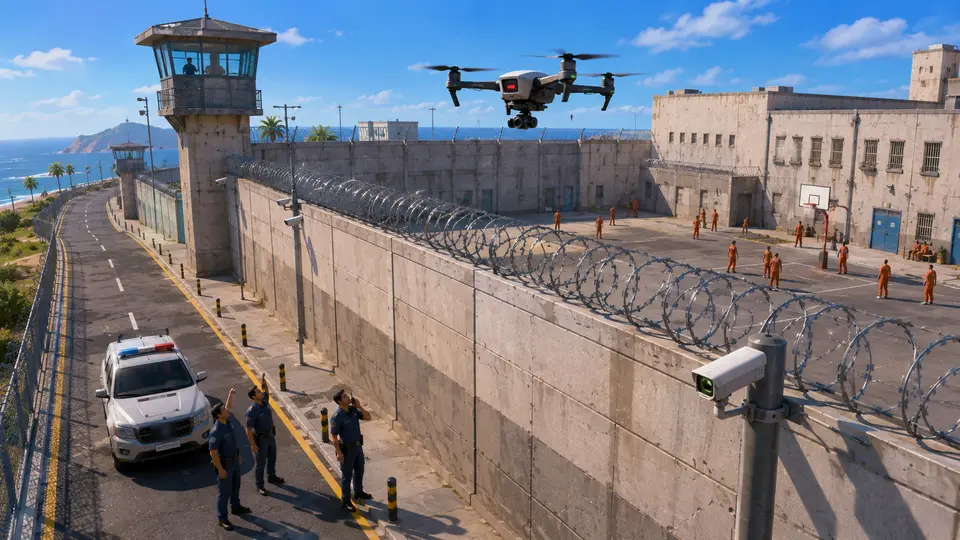
CAM-110A drone over the wall
«Tell me if something appears flying over the wall or the yard, and tell me where it came in and which way it is heading.»
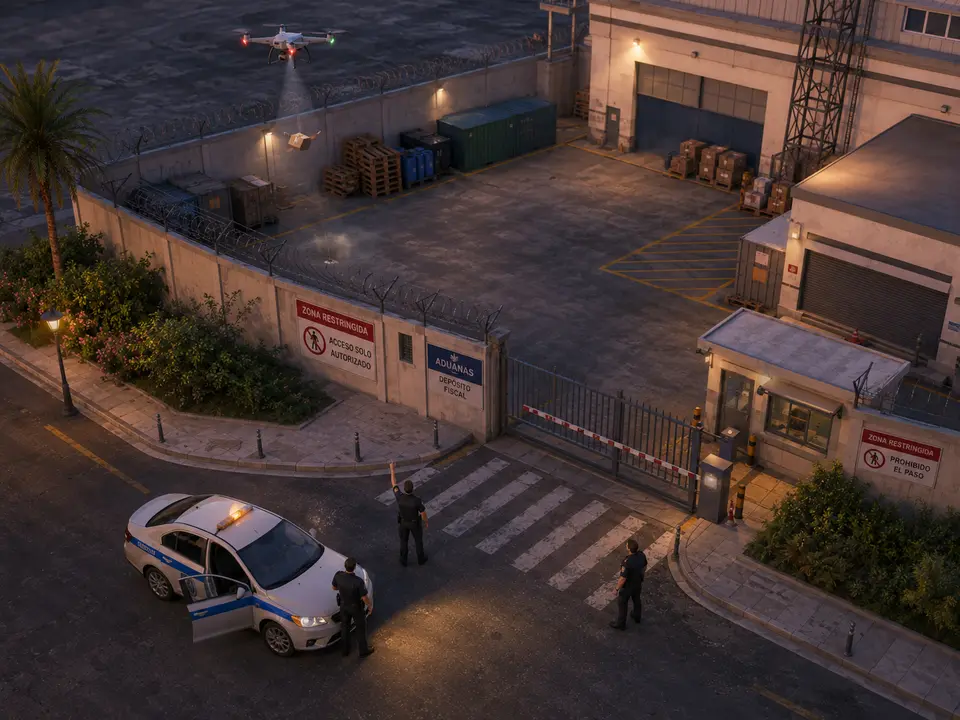
CAM-564Something crosses the wall from above and drops a package inside
«Give me a red alert if something flies over the wall outside service hours.»


What it does not do
IRIS does not bring drones down, does not jam signals, does not identify the pilot and is not a counter-drone system: we do not sell it as one. It sees what enters the frame of the cameras you already have, and says when and from where.
If the drone flies above the field of view, or the night is dark and the camera sees no sky, it does not see it. And there are gulls, rain and plastic bags. That is why you set the threshold, and why that camera is checked at night before the rule is signed off.
Questions
- Does IRIS bring the drone down or jam its signal?
- No, neither of those. IRIS is a camera that understands what it sees: it watches, it alerts and it keeps the video. Interfering with an aircraft or jamming a signal is not what a camera does, and it is regulated and not everyone’s call. What IRIS adds is the step before all that: knowing it happened, at what time, from which side and where it was heading, with the footage to show whoever has to decide what to do.
- Can it tell a drone from a bird?
- Most of the time yes, and it is worth saying why, and when not. A drone flies straight, holds still in the air and comes back the way it came; a bird glides, turns and does not stop. IRIS looks at the shape and above all at the movement, not just the dot. In fog, in heavy rain or at long range it gets it wrong more often, exactly as a person watching the same footage would. That is why you set the threshold, and can tighten it at night and loosen it by day.
- Does it work at night?
- It depends on the camera, not on IRIS, and that answer belongs before anything is signed. A camera meant to watch a fence sees very little sky once it is dark, and there is nothing to understand in pure black. If your problem is a night-time one, the camera looking at the wall has to be chosen for that. Before the rule is signed off, that camera is checked at eleven at night, with the light there is at eleven at night. Nothing is assumed.
- Does it tell me where it came from and where it went?
- Yes, within what your cameras see, and the limit is worth understanding. IRIS tells you which side of the wall it came in from, which way it crossed, at what time and for how long, with the video. It does not give you a route or a map position: that would mean tracking a device, and a camera tracks nothing outside its frame. Even so, two weeks of entries from the same side at the same hour already tell you a great deal more than you knew.
A different case every time
Watch what happens. Then watch what IRIS does with it.
Not a recorded video and not a drawing: it is a summary of the real tool, with a different case each time round. The whole tool does not fit in a box.
- You ask
- IRIS searches
- It shows you
Not seeing yours here?
These words are the ones we have built, not the ones IRIS understands. The list falls short on purpose: you ask for it in a sentence, and sentences do not run out. Tell us what is in front of your cameras and we will tell you whether it understands it, or not yet.
And the best part
Video is late by definition:you watch it once the thing has already happened.
IRIS tells you while it is happening, with the camera, the time and what it saw. Arriving in time changes the end of almost any story, and no new cameras are needed for that.
Tell us your problem and we will say whether IRIS understands it, or not yet.
We reply the same working day.