Solutions by typeCustomer experience
Why does nobody walk down that corridor?
An empty corridor twenty metres from a packed wing
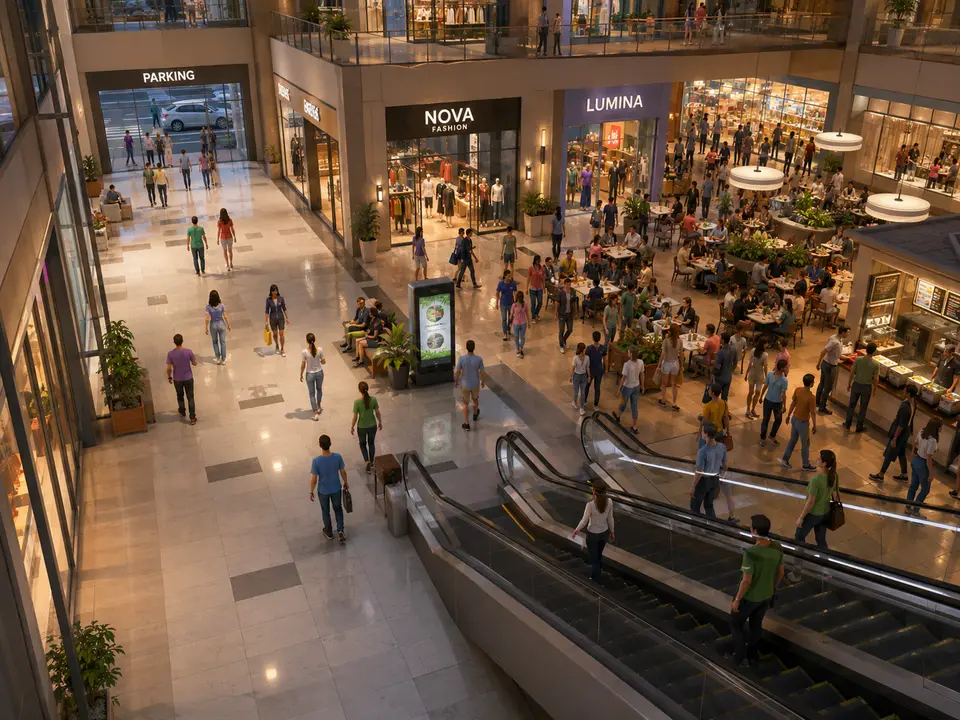
It is 17:30 on a Tuesday and from the upper floor you can see both at once. The escalator cuts the frame diagonally. On the left, a corridor with a polished floor and eight people counted along the whole stretch; the windows are lit and the doors are open. On the right, the other wing is packed: people cross in both directions and two units have queues. Twenty metres apart.
4 cameras across 2 sectors
What IRIS is
IRIS watches the cameras for you.
IRIS Neural is an artificial intelligence that watches the cameras you already have and understands what happens in front of them. When something important happens —or something you told it you need to keep an eye on—, it alerts you; and whatever can be counted, it counts in numbers. All day long, without anyone having to watch a screen.
You tell it what you need to watch, and IRIS does it.
Works with the cameras you already have. Nothing to replace.
A person replies, not a form.
- Your footage never leaves your premises.
- It doesn't identify people.
- Certifications →
This is how you ask for it
«“Tell me every week how many people walk down the left corridor compared with the right-hand wing.”»
That corridor costs the same as the other one. It is cleaned the same, heated the same and let for nearly the same, but it is not worth the same, and nobody can prove it. When a unit there asks for a rent cut or leaves, the conversation runs on impressions: “fewer people go that way”. And when you have to decide where the new kiosk goes or which way to pull the flow, it gets decided on the hunch of whoever has been in the centre longest.
You decide once
Here you are not setting a threshold: you are setting a measurement. Where the line goes — the mouth of the corridor, the shop door, the window — which area gets counted, and over what period you want the figure: by hour, by day, by season. You draw it once on the image. From then on the number comes out every day with the same criterion, which is why you can compare a Tuesday in March with one in October without arguing about how it was counted.
A dead corridor does not complain. There is no incident, no report and nobody calls anybody: fewer people simply walk through, year after year, and the centre gets used to it. The only alarm comes when the unit at the end closes, and by then the conversation is about why they left, not about what could have been done.
This is not asked for with a sentence. You cannot describe a line by talking: you have to draw it. You trace a line across the mouth of the corridor and another in the opposite wing, mark the area in front of the window, and from then on the number comes out every day: how many walked past, at what hour, how many stopped in front of the glass and how long they stayed. Asking is for finding. Counting is for measuring. They are not done the same way.
Two weeks of numbers change the whole conversation. A window that eighteen hundred people walk past and two hundred stop at does not have the same problem as one that six hundred walk past and two hundred stop at: the first has a window problem, the second a route problem. With that you negotiate a rent, move a kiosk, change an entrance or decide where not to put the new store. The same camera that today only records can start measuring your operation.
What changes
Before, this got measured two days a year: someone hired with a hand counter at the door on a Tuesday in March, and that number carried the whole financial year. Now the corridor is counted every day, hour by hour, and so is the wing opposite, with the same criterion. Whoever runs the centre stops negotiating with impressions and starts negotiating with the same figure the tenant can see.
Where we have seen it

CAM-590Two thousand four hundred pass, two hundred and sixty stop
«Tell me if footfall past the unit rises for two hours running and the number of people stopping does not rise with it.»
CAM-536An empty corridor twenty metres from a packed wing
«Tell me each week how many people go down the left corridor compared with the right wing.»

CAM-538Eighteen hundred walk past and two hundred stop
«Tell me every day how many people walked past the window and how many stopped to look at it.»

CAM-539The ground floor packed and the upper walkway deserted
«Tell me each month how many people use the upper walkway compared with the aisle below.»


What it does not do
IRIS counts crossings over a line and people inside an area; it does not know who anyone is. It also does not know why that corridor is empty: that is explained by the people who know the centre. It does not say whether anyone bought: for that you cross footfall with till data. One detail: someone who crosses the line twice is counted twice, so lines are placed for the question you want answered.
Questions
- Is this an alert too?
- No. There is nothing to alert about here: there is something to measure. And that is why it is not set up by talking but by drawing. You cannot describe a line with a sentence, you have to trace it on the image, and the same goes for an area. In exchange, the number always comes out the same way: same place, same criterion, every day. Not everything important is an alarm. Sometimes what matters is a number, and this is one of the numbers that changes a rent.
- Is the number good enough to compare different months?
- Yes, as long as the line and the camera do not move. What makes a count comparable is not the technology: it is that the criterion stays the same every day. Same line, same framing, same way of counting. That is why the number is repeatable and can be audited: you can go back to the video of that Tuesday and see the same crossings. If someone moves the camera, the series breaks, and that has to be said rather than papered over.
- Does IRIS know whether those people bought anything?
- No. IRIS measures what can be seen: how many walked past, how many stopped and for how long. The sale lives in your till system, not in the camera. The interesting part appears when you put the two numbers side by side: eighteen hundred passes, two hundred stops and thirty receipts tells a very different story from eighteen hundred passes, twenty stops and thirty receipts. IRIS supplies the half nobody had until now.
- Do I need sensors in the floor or at the door?
- Not necessarily. If there is already a camera that sees that whole corridor, that camera can count, and there is no need to open the floor or hang anything at the door. What you do need is a framing that covers the full crossing and people who do not block each other the whole time; in a narrow, packed aisle the camera goes higher. It is checked beforehand with that camera at peak hour, not assumed.
A different case every time
Watch what happens. Then watch what IRIS does with it.
Not a recorded video and not a drawing: it is a summary of the real tool, with a different case each time round. The whole tool does not fit in a box.
- You ask
- IRIS searches
- It shows you
Not seeing yours here?
These words are the ones we have built, not the ones IRIS understands. The list falls short on purpose: you ask for it in a sentence, and sentences do not run out. Tell us what is in front of your cameras and we will tell you whether it understands it, or not yet.
And the best part
The cameras you bought years agostill hold up. What they were missing was not image quality.
It was someone to look. IRIS connects to the installation you already have — same equipment, same cabling — and those images go from being stored to being understood.
Tell us your problem and we will say whether IRIS understands it, or not yet.
We reply the same working day.