Solutions by typeProduction efficiency
How do I know the cleaning is actually finished?
The cleaning is signed off and residue is still there
Half past five in the morning, end of the night shift. The packing line is stopped and empty. On the wet floor there are patches of unrinsed foam, and on the blue belt yellow product residue sits between the guides. A broom with blue bristles is lying on the floor with foam around it. The supervisor is standing there looking at the room, hand on his chin, about to call the shift finished. The line starts at six.
3 cameras across 3 sectors
What IRIS is
IRIS watches the cameras for you.
IRIS Neural is an artificial intelligence that watches the cameras you already have and understands what happens in front of them. When something important happens —or something you told it you need to keep an eye on—, it alerts you; and whatever can be counted, it counts in numbers. All day long, without anyone having to watch a screen.
You tell it what you need to watch, and IRIS does it.
Works with the cameras you already have. Nothing to replace.
A person replies, not a form.
- Your footage never leaves your premises.
- It doesn't identify people.
- Certifications →
This is how you ask for it
«Before we start up in the morning, tell me if anything is still visible on the line: foam, residue or a tool on the floor.»
If something was left half done, it gets discovered with the line running and product inside. And part of it is never known at all: the validation sample is taken at one point, and if the residue was two metres away, the lab result comes back fine and the problem is still in the room. The signature says the cleaning finished; the signature does not say where the residue was left.
You decide once
The organisation decides what is looked at and when: at what moment cleaning counts as closed, which areas must be clear, what counts as visible residue and who gets told. When cleaning is closed on the packing room, if there is foam, product or a tool left on the floor, alert the supervisor with a photo of the exact spot before start-up. IRIS applies it every night, in every room carrying the rule, at whatever hour that falls.
Cleaning is closed with a signature and a checklist. That works almost every time, and it fails in one very specific way: the person signing is on their third batch in a row, it is twenty past six in the morning and the room is empty. The list says which steps had to be done. It does not say where the residue was left. On a packing line it is unrinsed foam and a broom on the floor. On a shopping centre concourse it is something else entirely — a spreading spill, napkins around it, a service trolley parked for twenty-two minutes — and none of them is an emergency.
What they are, together, is the reason there is a deviation open tomorrow or a one-star review. Nobody is doing their job badly: at the end of a night shift everyone looks at what they already know to look at, and what gets forgotten is forgotten precisely because it was in nobody’s head.
IRIS looks at the room at the moment cleaning is called finished and says what is still visible, with a photo of the exact spot and the time. The obvious gets cleared before the sample is taken, and the sample stops being spent on finding what was already visible to the naked eye. The morning argument stops being about who cleaned and becomes a time-stamped image.
What changes
Before, the supervisor called the shift finished and left, and anything left half done turned up with the line running. Now, when cleaning is closed he gets the list of what is still visible, with a photo of each point and the time. He goes back over two spots and starts up with a clear head. And the before-and-after video is on file, which is exactly what he cannot show today when somebody asks.
Where we have seen it
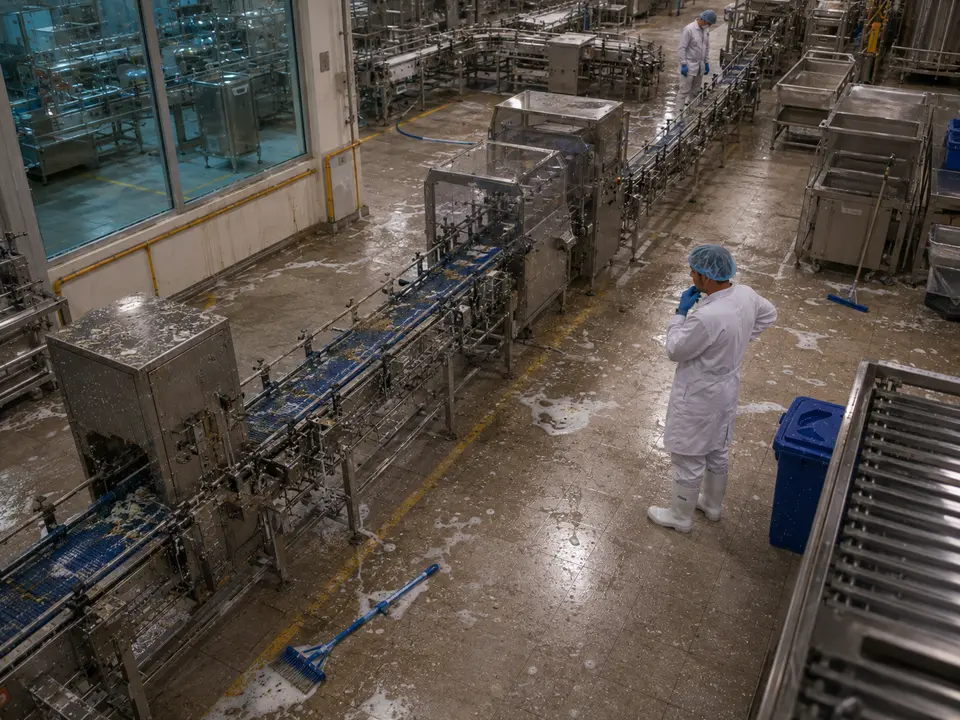
CAM-211The clean-down is not finished
«Before we start up in the morning, tell me if anything is still visible on the line: foam, residue or a tool left on the floor.»

CAM-544Four cleaning jobs in a single frame
«Tell me if there is a spill in a walkway, a service trolley standing for more than fifteen minutes, or a shopping trolley outside its area.»
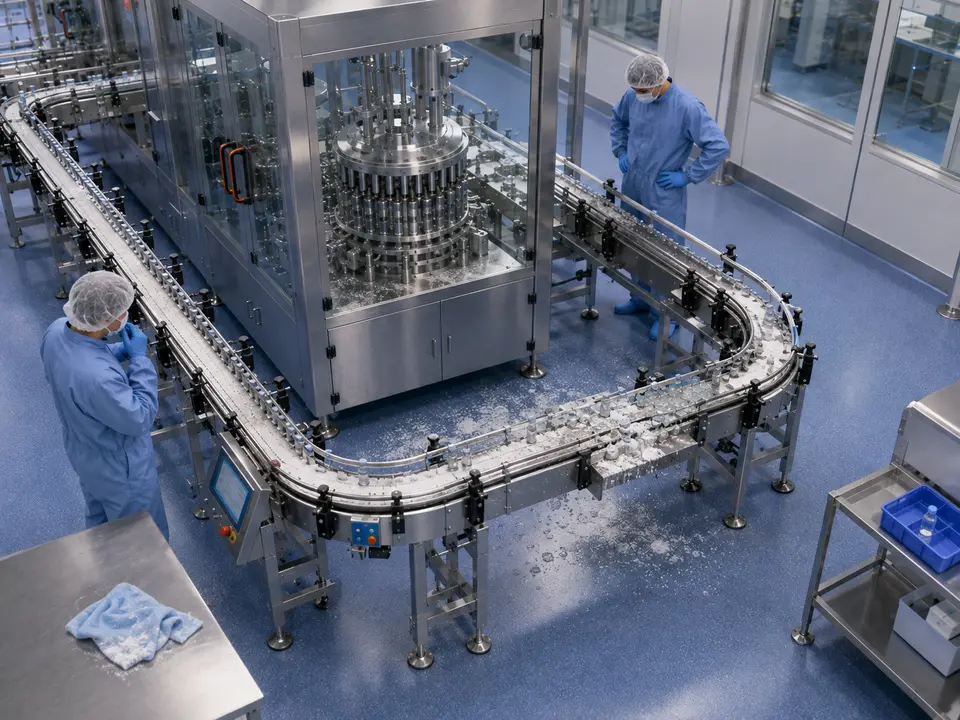
CAM-295The cleaning is signed off and the floor still has residue
«Tell me if, once cleaning is closed, anything is still visible on the floor or on the line, or a cloth has been left behind.»


What it does not do
A camera sees objects, liquids, foam and visible dirt. It does not see a microorganism, an allergen or a detergent residue. Cleaning validation is done with sampling and laboratory analysis, and that is how it should be asked for.
IRIS goes before that: it clears the obvious so validation is not spent finding what was already visible to the naked eye.
Questions
- Does IRIS certify that a line is clean?
- No. IRIS sees what is still visible: product residue, unrinsed foam, a tool on the floor, an area that has not been touched. That is one part of cleaning, not all of it. Whether a surface is sanitised is settled by laboratory analysis, with its sample and its result. IRIS goes before that sample and clears the obvious. Claiming otherwise would be promising something a camera cannot do.
- Does the camera detect bacteria or chemical residue?
- No, and it is worth saying plainly. A camera sees objects, people, liquids, foam and visible dirt. It does not see a microorganism, an allergen or a detergent residue. That needs laboratory analysis, and that is how it should be asked for. IRIS provides the image and the exact minute of what it can see, and works alongside the plant’s quality systems, not in their place. Honesty here is part of the product.
- Does it work as a record for an audit?
- Yes, as a time-stamped image record. The before-and-after video is kept, with the exact time and the point marked in frame. It is attached to the plant’s cleaning record and puts a picture to what today is only a signature. It does not replace that record, nor the quality system: it works alongside and adds the image and the minute. And when the cleaning was done properly, which is nearly always, that record proves it too.
- Is this for keeping tabs on the cleaning staff?
- No, and it is worth saying plainly. IRIS measures the state of the floor and the line and how long an alert takes to be cleared, not what each person does. It identifies nobody, recognises no faces and follows nobody through the building. What comes out of it is a map of where things get dirty and at what hour, and it is used to put more people where they are genuinely needed and to adjust the cleaning shift. Not to single anyone out.
Demo · IRIS at work
We won't just tell you. We'll show you.
It is a summary of the real screen: it plays by itself, step by step, and shows only the path of one case. The actual tool has far more than fits in here.
- The alert fires
- It lands in the tray
- You open it
- You confirm or dismiss
Not seeing yours here?
These words are the ones we have built, not the ones IRIS understands. The list falls short on purpose: you ask for it in a sentence, and sentences do not run out. Tell us what is in front of your cameras and we will tell you whether it understands it, or not yet.
And the best part
By the eighth hour of a shiftnobody watches the way they did in the first. That is not a flaw.
It is being human. A camera has no eighth hour: at four in the morning it understands what it understood at noon, and it speaks up just the same.
Tell us your problem and we will say whether IRIS understands it, or not yet.
We reply the same working day.