Critical infrastructureInfrastructure integrity
CAM-153
Worker on the ground by the pumps
The yard outside the pump house. A worker is lying face down on the concrete, still wearing his hi-vis vest, with his white helmet fallen on the ground beside him. Another worker, in helmet and vest, is running towards him from the clarifier side. In the foreground, the vertical pump sets; at the back, the green door of the room and the control cabinets.

Turn on IRIS Vision
AI-generated image
What IRIS is
IRIS watches over critical infrastructure.
IRIS looks at the cameras you already have at the dam, the water plant or the power plant, and understands what it sees: someone entering where they shouldn't, a strange vehicle, an overflow, the perimeter. When something like that happens, it alerts right away; and whatever can be counted, it counts in numbers. All day long, with no one needing to watch the screen.
You tell it what you need to watch, and IRIS does it.
Here IRIS sees a person lying on the ground by the pumps who hasn't moved for a while, and it alerts right away with the image and the exact time. That way the alarm goes out in three minutes instead of twenty, which is everything you can gain at a plant with just one worker on the night shift. With that alert you decide to send someone to check; IRIS doesn't know what happened to him, only that he's been still for a while.
Works with the cameras you already have. Nothing to replace.
A person replies, not a form.
- Your footage never leaves your premises.
- It doesn't identify people.
- Certifications →
What IRIS understands
What it recognises in this scene
- person on the ground
- fallen helmet
- worker coming over
- pump set
- control cabinets
What this camera measures
An alert says something is happening. The reading says how much.
- 3 min 10 sNot moving for
- 10:31Last movement seen
- 52 minHad been alone in the area
- 1People on their way
- 1Helmets on the ground
- 10:34Time of the alert
The figures on this screen are an example from the illustration, not any client's measurement.
The rule
You decide once. IRIS applies it always.
If
a person has been on the ground, without moving, for longer than the plant has set
Then
- alert the operator on duty and the plant's emergency number, with the camera and the location
- open the live video from that camera, so whoever responds sees what is there before arriving
- log the time they were last seen moving
The instruction that set it up«Tell me if someone has been on the ground and not moving for a while in a technical area, even at night when there is nobody else on site.»
What changes
What changes for whoever answers for the site
This is the one that matters of the eight. A treatment plant has confined spaces, gases and open tanks, and at night there is one operator for the whole site. Someone on the ground by the pump house can lie there for twenty minutes with nobody walking past, and in a place like that time is the only thing you can win. IRIS does not know what happened to him: it does not diagnose and will not try. It knows there is a person who has not moved for a while in a technical area, and it raises it so somebody goes to look. We do not promise it prevents anything. The only thing that changes, and it is not small, is that the call goes out at three minutes instead of at twenty.
What people usually ask
Does IRIS know what has happened to that person?
No, and it will not claim to. IRIS diagnoses nothing. What it sees is a person on the ground who has not moved for a while in a technical area, and that is why it raises the alert: so that somebody goes and looks. They may have slipped, they may have felt unwell, or they may be working flat on their back under a pump. Whoever arrives says which; the camera does not. That is also why the rule carries a clock: the plant decides how many seconds without movement are too many in that spot.
What if he is just crouched down working and the alert fires for nothing?
It will happen sometimes, and that is fine. This alert is deliberately tuned to the safe side: on a site with nobody around, a false alarm costs ten seconds of video, and not looking costs vastly more. The plant sets how long without movement triggers it and which areas it covers, and whoever receives it opens the live feed before sending anybody. We would rather go and find it was nothing.
Does IRIS recognise the person on the ground?
No. IRIS does not identify anyone: it does not recognise faces, it does not read number plates, it does not compare them against any database and it does not store who anyone is. It knows there is a person, where they are and how long they have not moved. To send help you need nothing more, and whoever arrives will know who it is.
A different case every time
You set the rule once. IRIS applies it every time.
You will see a summary of the interface, played step by step and hands-free. Each round starts with another case. The complete tool does not fit in a demo.
- You draw the line
- It counts by itself
- A number comes out
See it somewhere else
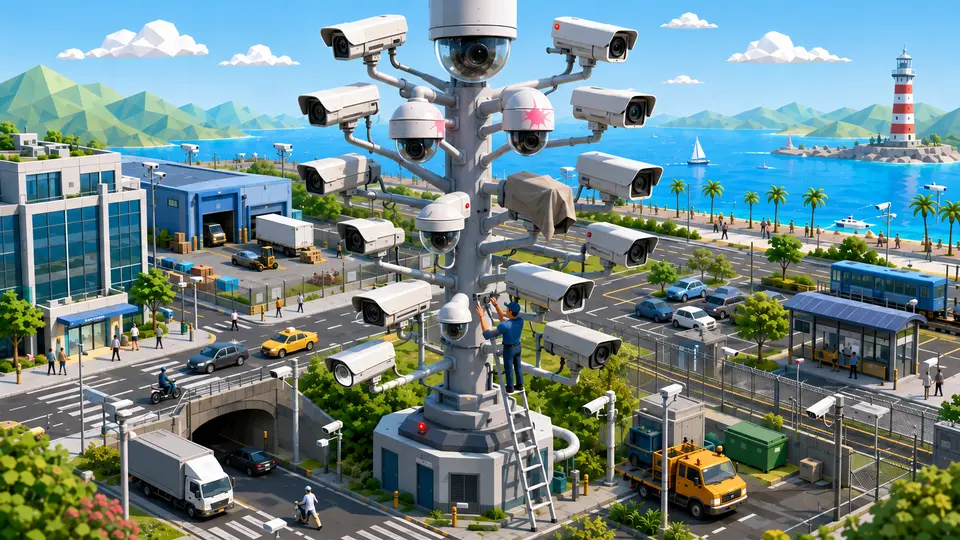
And who watches the cameras?
34 cases, and in every one of them IRIS raises an alert when something happens. You see each image as it is, and then with what it understands on top.

Who watches the cameras of a whole city?
23 cases: 18 raise an alert when something happens and 5 only measure. You see each image as it is, and then with what IRIS understands on top.


And the best part
By the eighth hour of a shiftnobody watches the way they did in the first. That is not a flaw.
It is being human. A camera has no eighth hour: at four in the morning it understands what it understood at noon, and it speaks up just the same.
Tell us your problem and we will say whether IRIS understands it, or not yet.
We reply the same working day.