CAM-922
Blown out
The same crossroads, and at first glance the camera looks fine: there is a picture, there is colour in the bottom left, you can see people waiting by the planter and the leaves of the corner tree. But from halfway up, nothing is left. The façade, the pharmacy’s green awning, the terrace and the far pavement are a single white patch with no drawing inside it. The zebra crossing is barely a ghost. Where there was light, there is now white. IRIS sees that a large part of the frame is above what the sensor can record, and that there is nothing left to recover there. It does not know whether it is the sun at this hour, a setting that has drifted, or a new floodlight aimed badly.

Turn on IRIS Vision
AI-generated image
What IRIS is
IRIS watches the cameras for you.
IRIS Neural is an artificial intelligence that watches the cameras you already have and understands what happens in front of them. When something important happens —or something you told it you need to keep an eye on—, it alerts you; and whatever can be counted, it counts in numbers. All day long, without anyone having to watch a screen.
You tell it what you need to watch, and IRIS does it.
Here, for example, IRIS sees that a large part of the image has turned pure white, with nothing drawn inside it, right where the façade and the pavement used to show. That's how you know which part of the frame has been lost and from what time, even though the rest of the picture still looks normal and has movement. With that alert you decide whether a floodlight needs moving or a shade needs adding, then check afterward whether that part is visible again.
Works with the cameras you already have. Nothing to replace.
A person replies, not a form.
- Your footage never leaves your premises.
- It doesn't identify people.
- Certifications →
What IRIS understands
What it recognises in this scene
- frame blown to white
The rule
You decide once. IRIS applies it always.
If
a large part of the frame saturates to white and stays without detail for longer than a passing reflection
Then
- alert maintenance with the camera, the time and the video of how it got that way
- point out which area of the frame has lost its detail, not just that the picture is bright
- run the same check at the same hour on following days, to tell each afternoon’s sun apart from a fault
The instruction that set it up«Tell me if part of a camera’s frame stays blown out to white for longer than a passing reflection, and tell me which part.»
What changes
What changes for whoever answers for the cameras working
A blown-out picture is more deceiving than a black one. Anyone walking past the monitor spots a black image; a white one looks like it is working: there is movement, there is colour at the bottom, there are people. And the part that has been lost is almost always the part that mattered: the doorway, the far pavement, the entrance to the shop. The day that video is asked for, the top half does not exist, and in a report «nothing can be made out» carries very little weight. With IRIS somebody finds out today, with the time and with the part of the frame that has lost its detail. Often it is fixed by moving a light or fitting a shade, without buying anything.
What people usually ask
The sun hits it head-on for an hour every afternoon and always has. Will it alert every single day?
Not if you tell it that hour is normal for that camera. The rule is written per camera and per time band: the sun hour is marked as expected and stops raising anything. What does fire is what departs from that pattern: the day the burn-out starts two hours earlier, lasts twice as long, or does not go away at sunset. Even so, it is worth knowing that this spot is blind for an hour a day, because an hour without seeing a doorway is an hour without seeing, whether the cause is the sun or a fault.
Doesn’t the camera correct this by itself? It has backlight compensation.
Often it does, and when it succeeds there is nothing to report. The problem is the day it does not: the sun moves with the season, a new glass front across the street starts bouncing light back, or somebody installs a floodlight where there was none. The correction then falls short, and the result is this picture. IRIS does not touch the camera’s settings and does not claim to: it looks at the result and says whether that frame is usable or not. Adjusting the camera is still a person’s job.
Is blown-out video any use at all?
Some use, yes: it tells you something happened and at what time, because movement is still visible. For anything else, no. There are no clothes, no face, no number, no reliable colour. And once it is blown out, turning the brightness up afterwards recovers nothing: what the sensor did not record is not in the archive. That is why this page treats it as a fault and not as a nuisance. The picture still looks pleasant on the monitor, and it fails at the only thing it will be asked for on the day it matters.
Every simulation
On foot among machines
Tell me if someone walks into where a machine is moving and stays there for more than five seconds.
- The sentence
- Where it applies
- What it finds
- The same rule
See it somewhere else
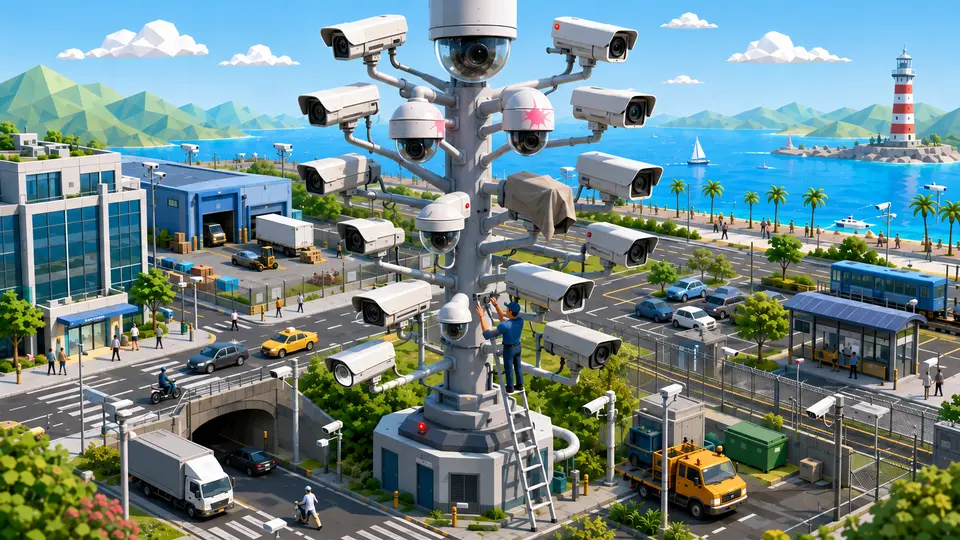
And who watches the cameras?
34 cases, and in every one of them IRIS raises an alert when something happens. You see each image as it is, and then with what it understands on top.

Who watches the cameras of a whole city?
23 cases: 18 raise an alert when something happens and 5 only measure. You see each image as it is, and then with what IRIS understands on top.


And the best part
The rule does not decide anything.It just never forgets, and it tells the person who decides.
You write once what needs watching, and it holds at three in the morning just as at noon. What to do with the alert is still a person’s decision.
Tell us your problem and we will say whether IRIS understands it, or not yet.
We reply the same working day.