Solutions by typeMobility analysis
What if the top is blocked and the escalator keeps feeding people into it?
Still feeding people into a blocked landing
It’s 6:20 p.m. on a Saturday, the upper floor of a mall, right between the escalator and the panoramic elevator. Someone is on the floor and two people have crouched down to help. A ring of fourteen onlookers has closed around them and blocked the landing. The escalator knows nothing about this: it keeps delivering people at the same rate, and those arriving at the top have nowhere left to put a foot.
2 cameras across 2 sectors
What IRIS is
IRIS watches the cameras for you.
IRIS Neural is an artificial intelligence that watches the cameras you already have and understands what happens in front of them. When something important happens —or something you told it you need to keep an eye on—, it alerts you; and whatever can be counted, it counts in numbers. All day long, without anyone having to watch a screen.
You tell it what you need to watch, and IRIS does it.
Works with the cameras you already have. Nothing to replace.
A person replies, not a form.
- Your footage never leaves your premises.
- It doesn't identify people.
- Certifications →
This is how you ask for it
«Alert me if the top of an escalator gets blocked, or if an escalator is stopped and people pile up in front of it for more than three minutes.»
What starts as a fainting spell turns into a shoving problem: people coming up can’t see what is at the top until they’re already there, and those behind keep arriving. In an airport the same failure has a different bill: an escalator out of service for three hours is a line of eighty people with suitcases, an elevator beside it traveling empty, and a handful of missed connections paid for one by one.
You decide once
You decide it once and it stays written down. You mark the landing area and the foot of the escalator on the image, say how many people standing for how many seconds is no longer normal there, and who gets told: the floor manager and maintenance, with the camera open. For a stopped escalator, the same with a different clock: if after three minutes there is still a line in front, somebody has to open a route or send people to the elevator. IRIS applies it to every escalator in the building, every day.
An escalator is the only machine in a building that pushes people without looking. It carries ten, twenty, a hundred people a minute at the same rate, whether the landing is clear or taken up by a ring of onlookers around somebody who’s fallen. That’s why, in accident studies, the bad spot on an escalator is almost never the steps. It’s the patch of floor at the top.
Then there’s the escalator that isn’t running. It looks like a minor maintenance matter until you look at what happens around it: in an airport, an escalator fenced off with yellow barriers leaves eighty people with suitcases waiting in front of it while the elevator beside it goes up and down empty, because nobody sees it or because a large case won’t fit.
IRIS watches both from the camera already covering the area. It treats the landing as a zone and checks that people keep moving through it; when they stop moving and the number standing there climbs, it says so at once, with the camera open, so somebody can stop the escalator or open a route. And at the foot, when the escalator isn’t moving and the line grows, it alerts maintenance and the floor manager with how long it’s been stopped. Neither of those needs an operator watching that particular screen at that particular moment, which is exactly what never happens at six thirty on a Saturday.
What changes
Before, this came in over the radio: someone from a store saw the crowd and called, or an annoyed customer reported it at the information desk half an hour later. Now the floor manager gets the camera open with the landing blocked and knows whether to go personally or send somebody. And a stopped escalator stops being a line written up at the end of the shift: it’s an alert with the exact time it stopped moving.
Where we have seen it
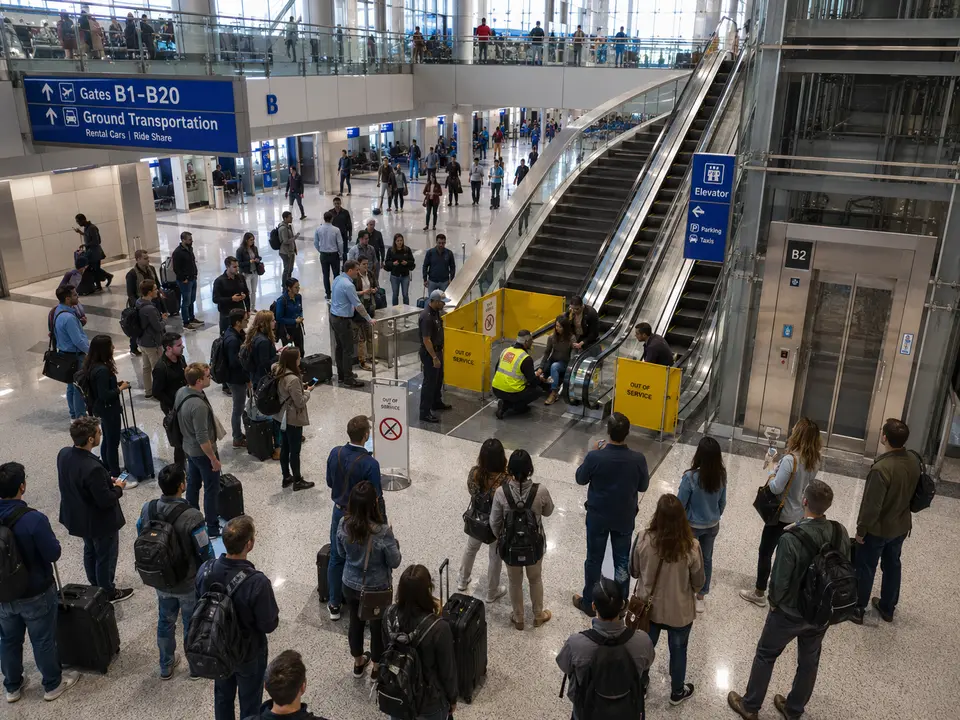
CAM-587The escalator is stopped and the elevator is empty
«Tell me if an escalator is stopped and people pile up in front of it for more than three minutes.»

CAM-543The escalator keeps feeding people into a blocked landing
«Tell me if somebody has been on the ground for over thirty seconds, or if an escalator landing runs out of clear width.»


What it doesn’t do
IRIS does not stop the escalator. It alerts whoever can stop it, and that stop is made by a person or by the building’s own system, depending on what you have in place.
And it does not know why it stopped or what is wrong with the person on the floor: it sees that someone is down and that the way through is blocked. If the camera does not see the landing, it can say nothing about the landing.
Questions
- Can IRIS stop the escalator?
- Not by itself. IRIS sees that the landing has become impassable and says so at once, with the camera open and the number of people standing there. Stopping it is a physical action on the installation, done by a person, or by the escalator’s own system if your team has it wired up. We prefer to put it plainly: IRIS shortens the time until somebody knows, and in these cases those seconds are what separates a fright from a chain of falls.
- How does it know too many people have piled up?
- Because you told it beforehand what normal looks like there. You mark the landing zone on the image and set a number and a time: more than eight people standing still for more than twenty seconds in that box isn’t normal flow, it’s a blockage. On a Saturday afternoon plenty of people cross that spot, but they cross it; nobody stays. What triggers the alert isn’t the quantity, it’s that they stop moving. The figures get tuned in the first few days by watching what that place actually does.
- Does it detect someone who’s fallen?
- Yes. IRIS sees that a person has been lying on the floor longer than the number of seconds you set, and says so with the camera and the time. What it doesn’t do is medicine: it doesn’t know whether that person has fainted, tripped or is tying a shoelace, so the alert doesn’t say what is wrong, it says there is someone on the floor and since when. Whoever arrives decides. At an escalator landing that alert is worth double, because besides the person down there are twenty still riding up toward them.
- Does it also cover an escalator that is out of service?
- Yes, and it’s usually the first thing you notice. IRIS sees that nobody’s moving up the escalator and that people are gathering in front of it, and alerts with how long it’s been like that. That’s what turns a breakdown into a decision: open a route, sign the elevator, send someone to split the line. In an airport the alert also records what time it stopped and what time it ran again, which is the figure you need later to press the maintenance contractor or to plan the shift.
Demo · IRIS at work
A new case each time. Always the same screen.
It plays by itself and shows one case from start to finish. It’s a summary: the real screen has far more functions than fit in this box.
- Cameras on the map
- You draw an area
- What passed shows up
Not seeing yours here?
These words are the ones we have built, not the ones IRIS understands. The list falls short on purpose: you ask for it in a sentence, and sentences don’t run out. Tell us what is in front of your cameras and we’ll tell you whether it understands it, or not yet.
And the best part
One camera,and you already have a watchman. Four thousand cameras, and you have four thousand watchmen.
None of them tires, none of them looks away and none of them works shifts. And there’s nothing to install: the cameras you already have can start understanding what they see.
Tell us your problem and we’ll say whether IRIS understands it, or not yet.
A person answers, the same working day.