Solutions by typeInfrastructure integrity
Who sees what happens thirty metres up?
Someone on the tower platform, with no harness
Mid-morning at a coastal wind farm. The camera looks down at the tower, and out on the external platform, next to the ladder, a person is standing with no harness and nothing holding them. Below, inside the fence, there is a van and no work scheduled for that machine today. The nearest site with people on it is forty minutes away down a dirt track.
1 cameras across 1 sectors
What IRIS is
IRIS watches the cameras for you.
IRIS Neural is an artificial intelligence that watches the cameras you already have and understands what happens in front of them. When something important happens —or something you told it you need to keep an eye on—, it alerts you; and whatever can be counted, it counts in numbers. All day long, without anyone having to watch a screen.
You tell it what you need to watch, and IRIS does it.
Works with the cameras you already have. Nothing to replace.
A person replies, not a form.
- Your footage never leaves your premises.
- It doesn't identify people.
- Certifications →
This is how you ask for it
«“Tell me if anyone is on a tower ladder or platform without a harness, or if anyone enters the fence of a tower with no work scheduled today.”»
There is no colleague beside them saying “clip on”. No site manager, no supervisor, nobody walking past by chance: one person, one tower and the wind. If they fall, the first thing anyone will need to know is what time it was and on which machine, and today that gets reconstructed from the work sheet and whatever the first responder remembers. And if the person who climbed had no business being there, it is discovered once they have already come down.
You decide once
The wind farm decides what is normal on each tower and on each day: which machines have work today, in which slot, which crew, and what happens when someone shows up at one that has none — call the contractor, notify the control room, send someone out. It also decides the height at which a harness becomes mandatory. That is written once, with the work plan in front of you, and from then on IRIS applies it across all fifty towers at once, every day.
A wind farm is a place with nobody in it. The machines work alone, the visit comes when it is due, and between visits there are kilometres of track and not a soul. Everything done well here is done well because the person doing it is a professional: nobody is watching, and whoever climbs onto the platform knows perfectly well there is no safety net up there.
The two problems of that place are the same problem with two faces. One is the worker who climbs without clipping on, almost always in a hurry and almost always because “it will only take a second”. The other is the person who turns up inside the fence of a tower with no work today, who might be a technician who took a detour or might be somebody who came for the copper. Both look the same from the same camera: there is someone where there should be nobody today.
IRIS looks at the tower and says what it sees: there is a person on the platform, a harness is visible or it is not, and it is twenty past ten. It does not know who they are, does not recognise faces and keeps no record of anyone, and for what is needed here it does not need to. The alert reaches the control room with the camera and the video, and what happens next is decided by a person: a call to the contractor, a radio message, or nothing, because sometimes the explanation is that the harness is clipped behind and cannot be seen. That thirty-second call is worth more than the video watched after the fall.
What changes
Before, what happened on a tower was known from the sheet the contractor handed in at the end of the day, and what happened in an empty wind farm was not known at all. The video existed, but it was opened after there had been an accident or a theft, to reconstruct. Now the alert arrives while the person is still up there, which is the only moment when a phone call changes the ending. And the van round of all fifty towers still happens — it is just no longer the only time anyone looks at them.
Where we have seen it
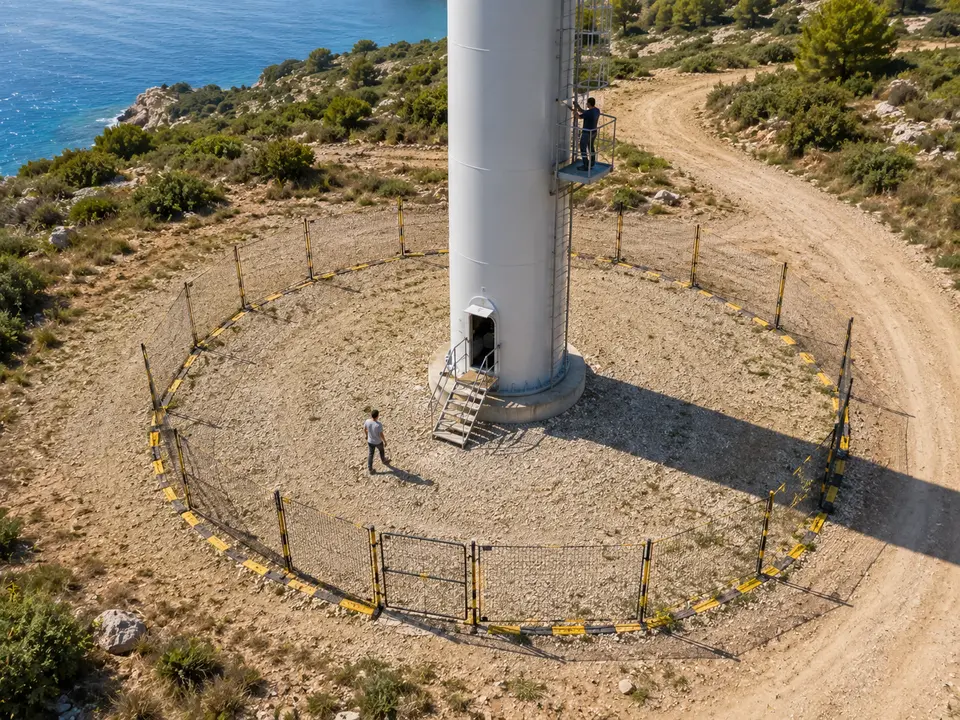
CAM-355Someone is on the turbine platform with no harness
«Tell me if anyone is on a tower ladder or platform without a harness, or if someone enters the fence of a tower with no work scheduled today.»

What it does not do
IRIS identifies nobody. It does not know whether the person up there is from the contractor, does not recognise faces and keeps no list of authorised people: it knows there is someone and that this tower had no work scheduled today. Nor does it guarantee always seeing the harness: against the light or from behind, the image does not support the claim, and then it says so as a doubt and not as a fact. And it prevents no falls: it shortens the time until somebody calls.
Questions
- Can a harness really be seen from a camera?
- Sometimes yes and sometimes no, and it has to be said that way. A harness with lanyards and a karabiner shows up well when the person is facing the camera, in good light and at a reasonable distance. From behind, against the light, or with a rain jacket over the top, the image supports no claim at all. When it is not clear, IRIS states it as a doubt: there is someone on the platform and no harness can be made out. That distinction matters, because what reaches the control room is a call to confirm, not an accusation.
- Do you need a camera on every tower?
- To see the platform, yes: each tower is a location and one camera sees one tower. What you do not need is to cover everything from day one. The usual approach is to start with the machines people climb most — the ones that generate the most maintenance calls — and with the ones furthest from everything, because those are the hardest to reach if something happens. And some things are covered without putting a camera up the tower at all: the gate and the access track are visible from ground level, and half the alerts come from there.
- Does it also work for copper theft?
- Yes, and at many wind farms it is what pays for the installation. The rule is the same sentence with a different meaning: tell me if anyone enters the fence of a tower with no work scheduled today. It makes no difference whether they came to work or to take material away: what is being said is that there is a person where nobody was due today, with the time and the machine. Who they are and why they came is worked out by a person, with a phone call or a patrol. IRIS accuses nobody of anything and calls nobody suspicious.
- What if there is no signal at the wind farm?
- IRIS can run inside the wind farm itself, without depending on the internet. The alert is generated and the video is stored on site, and if the link to the control room is down, all of it arrives as soon as the link returns, stamped with the time it actually happened. What cannot be promised is that an alert reaches a phone when there is no network for it to travel on: that depends on the site’s comms and not on us. It is worth looking at up front, with the coverage map on the table.
Demo · IRIS at work
A new case each time. Always the same screen.
It plays by itself and shows one case from start to finish. It is a summary: the real screen has far more functions than fit in this box.
- Cameras on the map
- You draw an area
- What passed shows up
Not seeing yours here?
These words are the ones we have built, not the ones IRIS understands. The list falls short on purpose: you ask for it in a sentence, and sentences do not run out. Tell us what is in front of your cameras and we will tell you whether it understands it, or not yet.
And the best part
You do not need to buy cameras:you need yours to understand what they see.
Nothing gets built, mounted or rewired. It plugs into what is already up and running, and the only thing that changes is what those cameras understand.
Tell us your problem and we will say whether IRIS understands it, or not yet.
We reply the same working day.