Solutions by typePersonal safety
What are you wearing when you open the valve?
Two minutes without the apron
It is 13:40 and today’s transfer takes two minutes: fill a twenty-litre carboy and close it. The PVC apron hangs on its hook, three metres away. It is heavy, it is hot and it ties at the back. Nobody puts on an apron for two minutes, least of all in August. The carboy fills from the top and the opening sits at waist height. Whatever splashes, splashes right there.
1 cameras across 1 sectors
What IRIS is
IRIS watches the cameras for you.
IRIS Neural is an artificial intelligence that watches the cameras you already have and understands what happens in front of them. When something important happens —or something you told it you need to keep an eye on—, it alerts you; and whatever can be counted, it counts in numbers. All day long, without anyone having to watch a screen.
You tell it what you need to watch, and IRIS does it.
Works with the cameras you already have. Nothing to replace.
A person replies, not a form.
- Your footage never leaves your premises.
- It doesn't identify people.
- Certifications →
This is how you ask for it
«Tell me if someone transfers product in this area without the apron on.»
A caustic that lands on overalls does not hurt at first. It works through the fabric slowly, and by the time it burns there is no time left to get the clothes off. The burn shows up in the changing room at the end of the shift. What follows is a long absence, an investigation and a job somebody has to cover for months. All for a piece of kit three metres away.
You decide once
It is decided once, and in this area it is almost trivial to define: the point is the square metre in front of the pump, and the mandatory kit is whatever the product sheet says. The sentence reads: if someone takes up position in front of the pump, and they are not wearing the apron, then tell the shift supervisor and keep the video. A second decision matters more: who reviews the count.
Of all the kit at a transfer point, the apron is the piece that stays on its hook. It is the most awkward, the hottest and the one that seems least necessary: goggles go on in two seconds, so do gloves, but an apron has to be tied. And since the risk it prevents is invisible, it gets postponed. It is only two minutes, after all.
And the harm it prevents gives no warning either. A caustic landing on clothing does not burn straight away: it works through the fabric slowly while the person carries on working. By the time it hurts, there is no way to get the overalls off in time. The burn is discovered in the changing room at the end of the shift, and it is the kind that keeps someone off work for three months and leaves a mark for good. Nobody remembers feeling anything.
IRIS watches that square metre in front of the pump and speaks up when someone stands there without the apron. An alert, at that moment, costs twenty seconds of walking to the hook. It is one of the least spectacular things IRIS does in a chemical plant, and one of the things that will be used most often each day. Twenty seconds at the hook against three months off work: that is the whole calculation.
What changes
Before, there was nothing at this point. Goggles and gloves are visible from a distance and the supervisor asks for them in passing; the apron is not, because nobody looks at anyone’s waist. Now there is an alert at the moment and, above all, a count at month end: fifteen times, nearly all on the afternoon shift. With that you buy lighter aprons.
Where we have seen it
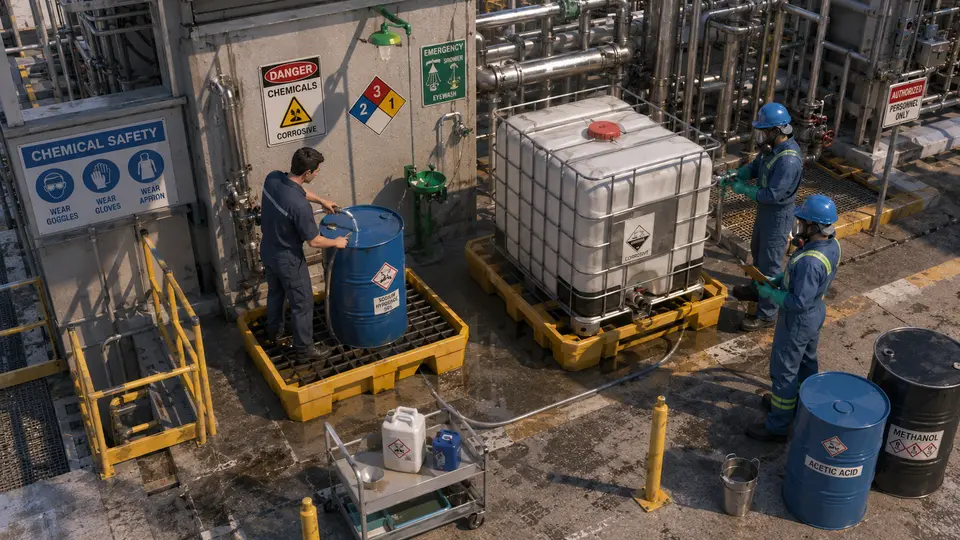
CAM-313Decanting a caustic with no goggles, no gloves and no apron
«Tell me if anyone transfers product in this bay without the goggles, the gloves and the apron.»

What it does not do
IRIS does not know what the apron is made of or whether it will stand up to the product being transferred. It sees whether someone is wearing it in front of the pump or not.
Choosing the right kit for each product still belongs to whoever knows the safety data sheet. This rule checks that it is worn, not that it is right for what is inside the drum.
Questions
- Is a rule just for the apron worth it?
- Yes, precisely because the apron gets skipped without anyone noticing. Goggles and gloves are visible from a distance and anyone walking past asks for them; nobody looks at the apron, because you have to notice somebody’s waist to see it is missing. It is the item with no natural supervision, and the burn it prevents gives no warning until the end of the shift. A rule covering only what is already visible would be solving the easy problem.
- Does it count if the overalls are already resistant fabric?
- No, IRIS cannot take that into account, and it is worth saying plainly. It does not know what fabric a set of overalls is made of, or whether that fabric resists the product in that drum: that is in the safety data sheet, not in the image. If in your plant certified overalls replace the apron in some areas, that exception is decided when the rule is written and applied only where it belongs. What you cannot do is expect IRIS to work it out by looking.
- Can it count how often the apron gets skipped?
- Yes, and that is what makes this rule genuinely useful. A single alert is an anecdote; fifteen alerts in a month, nearly all on the afternoon shift and nearly all in summer, are a diagnosis. With that you can see whether the problem is the people or the kit, and it is nearly always the kit: an apron that is too hot, or a hook thirty metres away that should be beside the pump.
- Does IRIS know if that apron resists that product?
- No, and it is a limit to be clear about from the start. IRIS sees that an apron is being worn; it does not read labels, does not know the material and does not know what product is in today’s drum. Compatibility between kit and product lives in the safety data sheet and is decided by whoever knows it. This rule solves one very specific problem — that the apron stays on its hook — and does not claim to solve any other.
Every simulation
Something has spilled
Tell me if there is liquid or foam outside its place and it is still there two minutes later.
- The sentence
- Where it applies
- What it finds
- The same rule
Not seeing yours here?
These words are the ones we have built, not the ones IRIS understands. The list falls short on purpose: you ask for it in a sentence, and sentences do not run out. Tell us what is in front of your cameras and we will tell you whether it understands it, or not yet.
And the best part
What happens in the small hoursdoes not have to wait for the morning report.
IRIS understands it there and then and tells whoever is on call, with the camera and the time. The next day there is nothing to reconstruct: it is already written down.
Tell us your problem and we will say whether IRIS understands it, or not yet.
We reply the same working day.