Solutions by typeLogistics efficiency
Why is the hall packed and the belt empty?
The belt stopped and the hall full
It is 23:50. Around belt 4 there is a ring of people two and three deep: two hundred and ten of them standing, with trolleys and sleeping children in their arms. Four suitcases go round on the band. A long stretch comes past empty and has done for six minutes. Nothing has been announced, because upstairs nobody yet knows that down in the basement the belt has jammed at a bend and bags are piling on top of each other.
2 cameras across 1 sectors
What IRIS is
IRIS watches the cameras for you.
IRIS Neural is an artificial intelligence that watches the cameras you already have and understands what happens in front of them. When something important happens —or something you told it you need to keep an eye on—, it alerts you; and whatever can be counted, it counts in numbers. All day long, without anyone having to watch a screen.
You tell it what you need to watch, and IRIS does it.
Works with the cameras you already have. Nothing to replace.
A person replies, not a form.
- Your footage never leaves your premises.
- It doesn't identify people.
- Certifications →
This is how you ask for it
«Alert me if the belt goes more than five minutes without delivering a bag while people are still waiting.»
It is the last thing a passenger sees before going home, and the single biggest source of complaints in the whole terminal. On top of that, there is a figure written into the contract: how long the first bag takes and how long the last. Today it is declared by whoever unloads the aircraft, an interested party, so every review meeting ends as one side’s word against the other’s.
You decide once
You decide the minutes: five with an empty band, or three, or seven late at night when the hall is fullest. That is written once and tuned with what the first two weeks show in your terminal, not with what happens in general. After that IRIS applies it on every belt and every small hour, with nobody having to watch.
A reclaim hall is a strange place: it is the one part of an airport where people can do nothing but wait. No shop, no screen to check, no queue that moves. Just a band going round. That is why six minutes of empty band feel like twenty, and why this is where a passenger decides what they will remember about the whole terminal.
The problem is almost never in the hall: it is in the basement. Bags ride up over each other at a bend and the stretch stops moving. The person at the console downstairs has it right in front of them; the person upstairs does not. Two worlds separated by a concrete floor and by the absence of one sentence linking them.
IRIS watches both places and links them. Downstairs it sees that the band is not moving bags and that they are stacking at the bend. Upstairs it measures how many people are waiting, how long the first bag took and how many minutes the belt has gone without delivering one. When the two line up, the alert goes out at the same time to the hall and to whoever is coordinating the unload, with the belt, the minutes and the video. Somebody goes down to clear it and somebody picks up the microphone. Both happen sooner, which is all that was ever being asked.
What changes
Before, upstairs found out from the queue at the complaints desk and downstairs found out from a phone that rang late. Now the alert reaches both places at once with the same video in front of them, and the number is generated by the hall itself: the same line and the same zone, measured the same way every night. Less arguing, and someone goes down sooner.
Where we have seen it
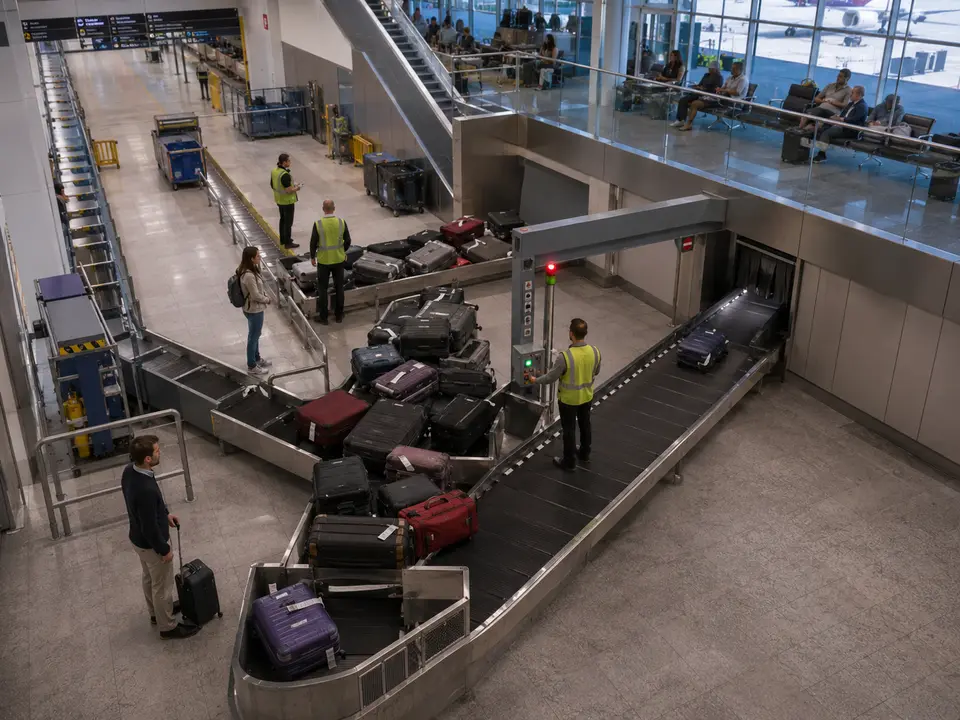
CAM-592Downstairs the belt is jammed and upstairs nobody knows
«Tell me if the conveyor stops moving bags and luggage stacks up at the bend.»
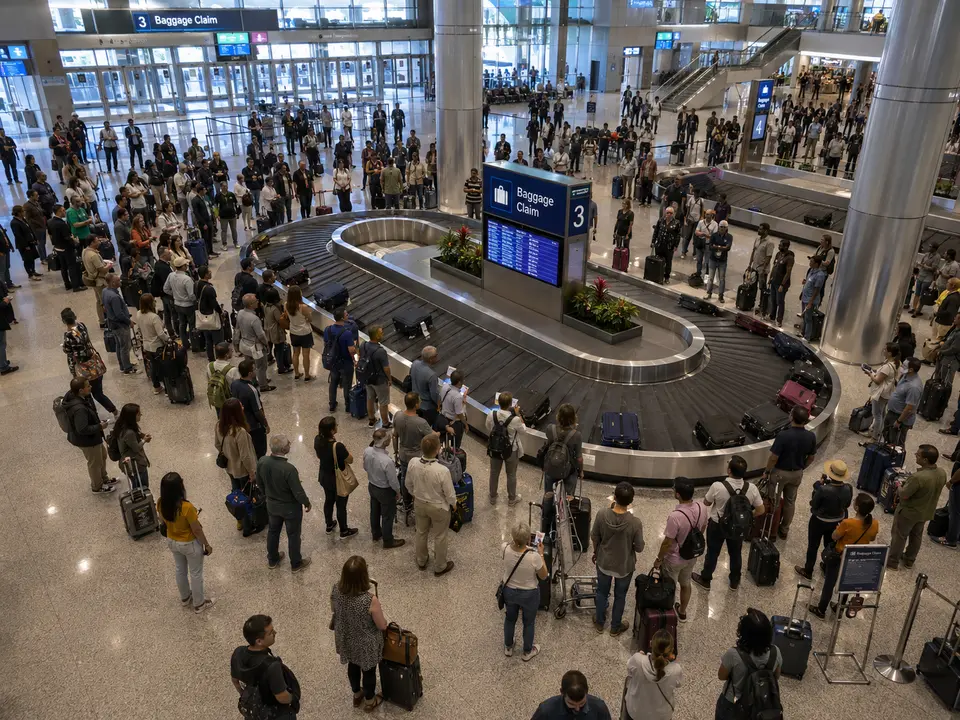
CAM-591Two hundred people watching an empty belt
«Tell me if the belt has gone more than five minutes without producing a bag and people are still waiting.»


What it does not do
IRIS does not identify passengers: it counts people, it recognises nobody. And it does not say why the belt stopped — a fault, a bag jammed sideways, a shift change: it says from which minute nothing has come out and how many people are waiting. The cause comes from whoever watches the video.
Questions
- Does IRIS know which flight each bag belongs to?
- No. IRIS sees bags going past on a band and counts how many come out and how many minutes pass with none. Which bag belongs to which flight is known by the airport’s baggage system, and that is where it belongs. The two figures support each other: the system says which flight was assigned to that belt and at what time; the camera says whether during those minutes the band was moving bags or going round empty in front of two hundred people.
- Does this camera alert or measure?
- Both, and they are not set up the same way. The alert is asked for in words: a sentence with the minutes you choose. The count is asked for by drawing: a line at the mouth of the hall to know who comes in to wait, and a zone hugging the belt to know how many are standing in front of it. A line cannot be described in a sentence, it has to be drawn, and that is why the number comes out the same tomorrow as today. Asking is for finding. Counting is for measuring.
- Is it good enough for the figure the contract demands?
- Yes, because it is repeatable and has video behind it. The same line, the same zone and the same criteria every night, so two parties can look at the figure without arguing about where it came from. A number declared by the party being held to it is not a measurement: it is a declaration, and both sides know it. One precision on our side: what we hold certified with the Spanish Metrology Centre is people counting, not bag counting.
- Does it also see the jam down in the basement?
- Yes, if there is a camera looking at that stretch. At the bend you can clearly see when bags stop advancing and start riding over each other: that is a change in the image, not a sensor reading. IRIS counts how many are piling up and from which minute the band stopped moving. And because the alert can go out to the basement and the hall at the same time, you stop losing the stretch of time where downstairs already knows and upstairs still does not.
Demo · IRIS at work
We won't just tell you. We'll show you.
It is a summary of the real screen: it plays by itself, step by step, and shows only the path of one case. The actual tool has far more than fits in here.
- The alert fires
- It lands in the tray
- You open it
- You confirm or dismiss
Not seeing yours here?
These words are the ones we have built, not the ones IRIS understands. The list falls short on purpose: you ask for it in a sentence, and sentences do not run out. Tell us what is in front of your cameras and we will tell you whether it understands it, or not yet.
And the best part
There is a moment when you can still act.It is while it is happening, and it is short.
After that, all you can do is tell the story. IRIS speaks up at that moment — camera, time and images — and whoever is on call decides what to do with it.
Tell us your problem and we will say whether IRIS understands it, or not yet.
We reply the same working day.