Critical infrastructureIntrusion detection
CAM-144
Someone climbs the gate onto the dam crest
The crest of a dam late in the afternoon. Somebody is going over the mesh gate that closes the way through: both hands on the top rail and one leg already on the other side. Beside it, the control hut with its green steel door, the red no-entry sign wired to the gate leaf and the barrier on the track. Nobody else is in shot. IRIS sees that someone has crossed a closed barrier; it does not know who they are and does not try to find out.

Turn on IRIS Vision
AI-generated image
What IRIS is
IRIS watches over critical infrastructure.
IRIS looks at the cameras you already have at the dam, the water plant or the power plant, and understands what it sees: someone entering where they shouldn't, a strange vehicle, an overflow, the perimeter. When something like that happens, it alerts right away; and whatever can be counted, it counts in numbers. All day long, with no one needing to watch the screen.
You tell it what you need to watch, and IRIS does it.
Here, for example, IRIS sees someone climbing over the closed gate at the top of the dam, right as it happens, with the camera and the exact spot. It doesn't know who they are and doesn't try to find out: it just alerts whoever's on call. With that alert you decide whether to call, send someone, or do nothing, and later check if it happens again.
Works with the cameras you already have. Nothing to replace.
A person replies, not a form.
- Your footage never leaves your premises.
- It doesn't identify people.
- Certifications →
What IRIS understands
What it recognises in this scene
- person crossing the barrier
- crest gate
- no-entry sign
- control hut
- barrier on the track
What this camera measures
An alert says something is happening. The reading says how much.
- 9 sSince they crossed
- 1People inside the fence
- 0Site staff in shot
- 0Vehicles on the crest
- 0Gates left open
- 18:24Time
The figures on this screen are an example from the illustration, not any client's measurement.
The rule
You decide once. IRIS applies it always.
If
a person crosses the fence that closes off the crest, at any time of day or night
Then
- alert whoever is on call, with the camera, the point on the fence and the video of the seconds before
- switch on the lighting for that stretch and keep the scene recording without a break
- log the exact time, so that next morning's report does not start with the damage
The instruction that set it up«Tell me the moment anyone climbs over the fence onto the crest, at any hour, and tell me which camera and where they got in.»
What changes
What changes for whoever answers for the site
A dam is the site with the fewest people and the most at stake. At night nobody is looking at the crest: no shift, no gatehouse, no screen switched on. Today an entry like this is discovered the next morning, from a forced door or a smashed cabinet, and by then the only question you can answer is what it costs to repair. With IRIS the alert goes out while the person is still on the fence, with the camera and the point they came in at, and whoever is on call decides what to do: phone someone, send someone, or nothing. IRIS does not lock the gate, does not call anyone on its own account and does not know who climbed over: it points at what is happening and where.
What people usually ask
Does IRIS know who climbed over?
No. IRIS does not identify anyone. It does not recognise faces, it does not read number plates, it compares nothing against any database and it does not store who anyone is. What it detects is a situation: a person has crossed a closed barrier, at this time, at this point. Who that person is, is a question for whoever has the authority to answer it, with the video in front of them, not for the camera.
And if the one climbing over is a technician who has lost the key?
The alert fires just the same, and it should. The camera does not judge intentions and it is not its place to: it sees that someone has crossed a barrier where you do not cross. What stops the alert becoming noise is the rule, and the rule is written by the site operator: it can be silenced during working hours, limited to the stretches with no pedestrian access, or made conditional on there being no service vehicle in shot. If the alert fires at everything, within a week nobody looks at it.
Does it need light to see this at night?
It needs a picture. The lighting already on the crest is usually enough; where it does not reach, the right camera is one with night vision or a thermal one, and that is decided by looking at the spot before anything is installed, not afterwards. What does not change is the rule: the sentence that describes the situation is the same by day and by night. And if the picture is not there, IRIS says so instead of inventing a reading.
The real interface, step by step
Watch what happens. Then watch what IRIS does with it.
Not a recorded video and not a drawing: it is a summary of the real tool, with a different case each time round. The whole tool does not fit in a box.
- Cameras on the map
- You draw an area
- What passed shows up
See it somewhere else

What does a shopping centre see beyond the visitor count?
12 cases: 4 raise an alert when something happens and 8 only measure. You see each image as it is, and then with what IRIS understands on top.
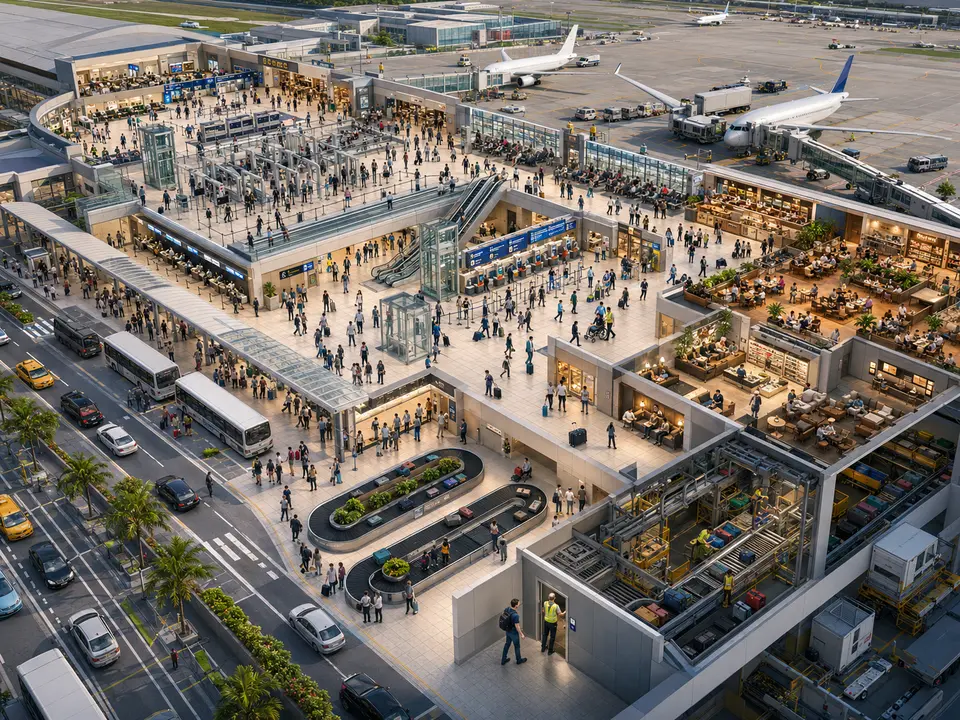
What does an airport see before the queue forms?
14 cases: 7 raise an alert when something happens and 7 only measure. You see each image as it is, and then with what IRIS understands on top.


And the best part
You can ask which van came in yesterday.Who was inside is not a question you ask here.
IRIS searches for things and situations, not people: it identifies nobody and recognises no faces. You write what you are looking for and it returns the matching minutes.
Tell us your problem and we will say whether IRIS understands it, or not yet.
We reply the same working day.