CAM-928
Mono at midday
A shopping avenue at midday, palm trees down both sides, shop windows under the arcades and shadows drawn sharp on the pavement. Three or four cars are moving, people are crossing at the zebra and more are walking along both footways. The picture is in focus, correctly exposed and perfectly readable. And it is entirely in black and white, with the sun high overhead. The camera is stuck in the mode it uses at night. IRIS still sees everything it always saw — people, vehicles, who crosses and where — but it can no longer say what colour anything was. Why it stayed there, light sensor or a setting, it does not know.

Turn on IRIS Vision
AI-generated image
What IRIS is
IRIS watches the cameras for you.
IRIS Neural is an artificial intelligence that watches the cameras you already have and understands what happens in front of them. When something important happens —or something you told it you need to keep an eye on—, it alerts you; and whatever can be counted, it counts in numbers. All day long, without anyone having to watch a screen.
You tell it what you need to watch, and IRIS does it.
Here, for example, IRIS sees that this camera is still in black and white right at midday, when it should be giving you ordinary colour. So you find out the same day it happens, not the day you go looking for “the red backpack” and it never turns up. With that alert you decide whether to check the sensor or the setting, and meanwhile that camera stays flagged so nobody trusts a colour search that could never work.
Works with the cameras you already have. Nothing to replace.
A person replies, not a form.
- Your footage never leaves your premises.
- It doesn't identify people.
- Certifications →
What IRIS understands
What it recognises in this scene
- no colour at midday
The rule
You decide once. IRIS applies it always.
If
the picture stays monochrome with plenty of daylight, or switches between colour and black and white again and again within the same hour
Then
- alert maintenance with the camera, the time and the video of that moment
- mark that camera as unavailable for colour searches for as long as it lasts
- log how long it has been like this and how many times it has switched today
The instruction that set it up«Tell me if a camera is still in black and white with the sun high, or if it spends the day flipping from colour to grey and back.»
What changes
What changes for whoever answers for the cameras working
On the day it matters, the description that comes in is always a colour: a red rucksack, a white van, a yellow bike. With that you search hours of recording and get there in minutes. On this camera that search returns nothing. Not because the person never walked past, but because for this camera everything is grey. And nobody knew, because a black-and-white picture looks sharp and correct, and nothing on the screen says it is failing. With IRIS somebody finds out on the first midday, not on the day of the search. And while it lasts, that camera is flagged so nobody trusts a colour search that never could have worked.
What people usually ask
How does IRIS know the camera should be in colour and is not?
By the light in the scene, not by the clock. IRIS measures how much light reaches the frame and checks whether the picture carries colour. With hard shadows and midday light, a healthy camera gives colour; if it stays grey under that light, something is holding it in night mode. And if a camera is monochrome on purpose, you declare it once and it stops raising anything: the rule is set by whoever runs the site, not by us.
And if the camera keeps flipping between colour and grey all day?
That is a different fault and it is reported too. It usually happens when the light in the scene sits right on the point where the camera hesitates: an awning that shades it mid-afternoon, a lamp that comes on and off. Every switch cuts the recording into stretches that look different, so a search that starts in colour ends in grey and stops halfway. IRIS counts the switches over the day, and that count is what somebody needs to decide to adjust the camera.
If the picture looks sharp, why does it matter that it is grey?
For live viewing it does not matter: an operator sees the same thing. It matters for searching afterwards. Half an hour of video can be reviewed by hand; three days cannot. Colour is the filter that turns three days into three minutes, and on this camera that filter does not exist. That is why it is a warning and not a critical: the camera is still watching, what it has lost is half of what made it searchable.
Demo · IRIS at work
This isn’t a video. It’s a slice of the real screen.
A summary of the real interface, played hands-free. You see one case from start to finish; what you do not see are the other screens, and there are many.
- Checks the whole system
- Flags what is failing
- Puts it on one screen
See it somewhere else
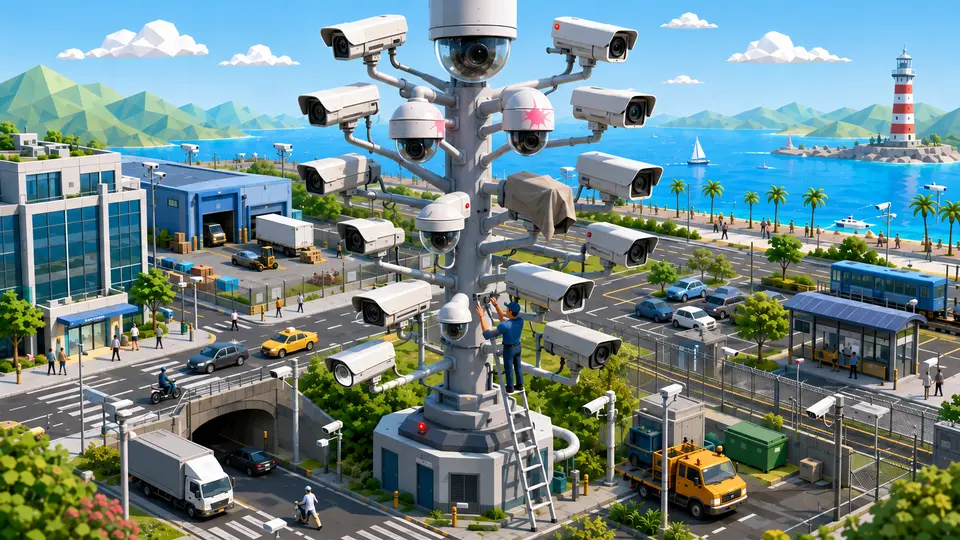
And who watches the cameras?
34 cases, and in every one of them IRIS raises an alert when something happens. You see each image as it is, and then with what it understands on top.

Who watches the cameras of a whole city?
23 cases: 18 raise an alert when something happens and 5 only measure. You see each image as it is, and then with what IRIS understands on top.


And the best part
The door was left open at two.Finding out at nine is no use to anyone.
The video tells you at nine. IRIS says it at two, with the camera, the time and the images from that moment. The difference between the two is whether someone can go.
Tell us your problem and we will say whether IRIS understands it, or not yet.
We reply the same working day.