Solutions by typeIntrusion detection
What if someone leaves who should not be going out alone?
Out the door, and nobody knows
It is 16:40. The lobby of a hospital ward. On the right, someone is walking towards the doors to the outside, his hand already near the push bar. On the left, the desk: two people on the phone and a family asking about visiting hours. Nobody is watching the door, because watching the door is nobody’s job. In four seconds they are on the pavement.
2 cameras across 2 sectors
What IRIS is
IRIS watches the cameras for you.
IRIS Neural is an artificial intelligence that watches the cameras you already have and understands what happens in front of them. When something important happens —or something you told it you need to keep an eye on—, it alerts you; and whatever can be counted, it counts in numbers. All day long, without anyone having to watch a screen.
You tell it what you need to watch, and IRIS does it.
Works with the cameras you already have. Nothing to replace.
A person replies, not a form.
- Your footage never leaves your premises.
- It doesn't identify people.
- Certifications →
This is how you ask for it
«Tell me if someone leaves the unit towards the street during the hours when nobody leaves, and tell me while it is happening.»
Nobody misses him until the six o’clock round. From there it all starts: call the family, call the police, search the whole hospital, write the report. And the heaviest part appears on no form: the head start. At minute two, the person is on the corner and you catch up on foot. At minute eighty they could be anywhere, and the search is no longer a search: it is a difficult phone call.
You decide once
You decide this once. You say which doors lead to the street and which are internal, in which windows leaving has to be accompanied, how many seconds of margin to leave so the delivery driver sets nothing off, and who receives it: the nurses’ station screen, the school office tablet, the on-call phone. IRIS checks it on every person who crosses, every day, without depending on anyone watching.
A hospital ward and a school gate have nothing in common, and they share the same fear. It is not fear of the person leaving: almost nobody is doing anything wrong. Someone just out of surgery who wakes up disoriented and heads home; a five-year-old who sees an open gate and crosses. What both places share is what happens next, and it has a name: the head start — the time that runs between someone leaving and someone noticing.
Today that time is set by an absence. The empty bed on the round. The parent who arrives at five and the child is not there. Finding out through an absence is the slowest way there is, because it depends on someone going to look for a person who is no longer there. Two hours can pass between the door and the empty bed, and in two hours the whole city is a place to search.
IRIS watches the door, not the person. It sees someone cross towards the street during a window in which nobody should cross alone, and it says so in that second, with the camera open. Whoever answers does not start from zero: they know the exact time, the door and which way they went. Nothing is locked, nobody is held and nobody is named. The head start drops from an hour to a minute, and that is the whole difference between catching up with someone on the pavement and making a difficult phone call.
And there is a third place where this weighs even more and is hardly ever talked about: a care home. There the front door is open all day, because it has to be, and through it come families, suppliers and physiotherapists. The window in which leaving alone is a problem is not the whole night: it is three in the afternoon, when the desk is changing shift. Writing that window properly is half the rule, and it is not written by a technician: it is written by whoever knows the house.
What changes
Before, the discovery started with the empty bed or the parent asking, and the search set off with no time and no direction: everywhere at once. Now it starts at the door. Whoever goes out to look knows the exact time, which door and which way, and most of the time they catch up across the street. The conversation that follows is different too: it is about one minute, not two hours.
Where we have seen it
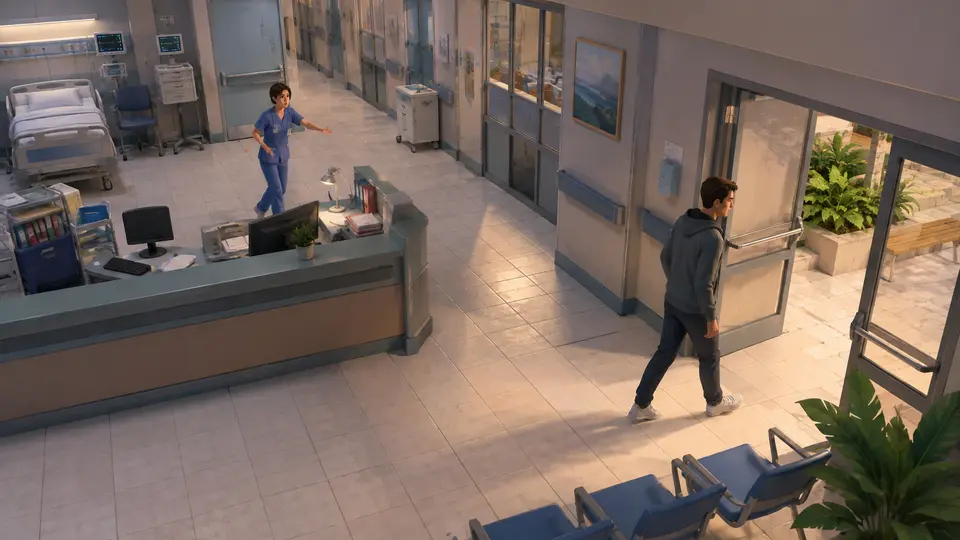
CAM-121Someone leaves the ward for the street
«Tell me if somebody leaves the unit towards the street at the hours when nobody should, so the ward knows while it is happening.»
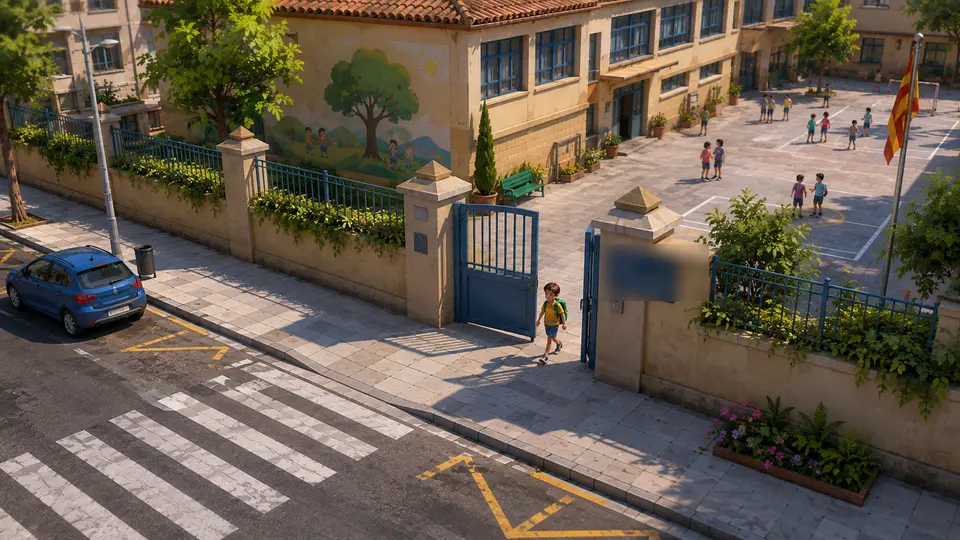
CAM-139A child leaves school on their own
«Tell me if a small child comes through the gate towards the street with no adult beside them, during the slot when leaving has to be accompanied.»


What it does not do
IRIS does not recognise faces, so it cannot tell a patient from a visitor by the face, and it does not know whether that person is allowed to leave. It works with what is visible — a gown, pyjamas, the height of a child — and above all with the door and the hours you set.
And it does not lock doors or hold anyone back. It alerts, and a person decides. If you need to know that the person who left is one specific patient, that is what a wristband is for, not a camera.
Questions
- Can IRIS tell a patient from a visitor?
- Not by the face, because IRIS does not recognise faces. It tells them apart by what is visible and by the rule you write: someone leaving in a gown or pyjamas, someone the height of a five-year-old, anyone crossing that door during the window when nobody leaves. On most wards that is enough, because street clothes and hospital clothes do not look alike. When you need certainty about one specific person, that certainty comes from a wristband, and IRIS adds the camera and the time.
- Does it lock the door when it detects this?
- No. IRIS alerts; a person decides. It does not lock doors, does not touch locks and does not hold anyone back — and in a hospital or a school that is not a gap, it is the right answer. A door that locks itself is an evacuation problem and a decision somebody has to sign. If your installation allows an alert to switch on a light or call a phone, you configure that and your safety officer approves it. IRIS does not do it on its own.
- What about home time, with three hundred children at once?
- At that moment the rule is off, because you decided it should be. A supervised mass exit is not the problem: the problem is the child who crosses the gate at 15:20, when nobody is waiting on the pavement. That is why the rule lives in one specific time window and not around the clock. Outside that window it produces nothing, and that is why the office screen stays useful instead of turning into noise.
- Does it replace anti-wandering wristbands?
- No, and the two work well together. The wristband knows who it is and alerts even through a door with no camera. The camera sees things a wristband never will: a child not wearing one, someone who took theirs off and left it on the bed, or who was walking beside them on the way out. One answers «who»; the other answers «what happened» and shows it. Many wards use both, and they are two different costs for two different reasons.
Demo · IRIS at work
We won't just tell you. We'll show you.
It is a summary of the real screen: it plays by itself, step by step, and shows only the path of one case. The actual tool has far more than fits in here.
- The alert fires
- It lands in the tray
- You open it
- You confirm or dismiss
Not seeing yours here?
These words are the ones we have built, not the ones IRIS understands. The list falls short on purpose: you ask for it in a sentence, and sentences do not run out. Tell us what is in front of your cameras and we will tell you whether it understands it, or not yet.
And the best part
A wall of monitors is impressive.Nobody can read forty tiles at once.
The more tiles there are, the less each one gets looked at. IRIS watches all four thousand cameras at once and points at a single one: the one that needs someone right now.
Tell us your problem and we will say whether IRIS understands it, or not yet.
We reply the same working day.