Solutions by typeProduction efficiency
Is everything back in its place before we close up?
They have left and the tools are still on the floor
Half past eleven at night in an aisle of cabinets. The job has finished and the aisle has not: on the floor there is an open tool case, a packing box, a coil of cable, a bunch of cable ties and a few loose screws on the tiles. The cabinet that was worked on is still open. The person is already walking away down the aisle, back turned. Opposite is the grille the cold air comes up through.
3 cameras across 3 sectors
What IRIS is
IRIS watches the cameras for you.
IRIS Neural is an artificial intelligence that watches the cameras you already have and understands what happens in front of them. When something important happens —or something you told it you need to keep an eye on—, it alerts you; and whatever can be counted, it counts in numbers. All day long, without anyone having to watch a screen.
You tell it what you need to watch, and IRIS does it.
Works with the cameras you already have. Nothing to replace.
A person replies, not a form.
- Your footage never leaves your premises.
- It doesn't identify people.
- Certifications →
This is how you ask for it
«Tell me if any tool is missing from the board when the workshop closes, and tell me which slot it is and since what time it has been empty.»
An open tool case in a narrow aisle is what someone running in at three in the morning trips over. In a workshop, the tool that is not in its place turns up halfway through a changeover, when there is no time left, and the count is done by hand, one by one, with the workshop full and the shift ending. In every case it is discovered on the next round, if there is a round.
You decide once
The organisation decides which holder is watched, at what moment it is checked and who is told: the workshop board at the end of the shift, the aisle once nobody is working in it, the trolley tray before a changeover. IRIS applies that check in every frame, every day, without depending on somebody remembering to look at the whole board.
In a tool shop the order already exists. On the blue board hang spanners, hammers and pliers, each above its marked place, and one missing is enough to leave a gap with a painted outline and nothing inside. That gap is the best signal there is, and it has one problem: it is only visible if somebody looks at the whole board.
The places where this matters are nothing like each other. In a plant, a missing tool is a stoppage announced in advance, halfway through a changeover. In a data centre aisle, what is left on the floor is something to trip over for whoever comes running at night, and a screw in front of an air grille. And in the workshop of a prison, a tool that is not there at closing is a serious problem, and today it is resolved by counting them one by one, by hand, every day, with the workshop still full and the shift ending.
IRIS compares the board with its reference image and says which slot is empty and since what time. No tag or chip has to be fitted to anything: the holder is watched exactly as it already is, because the order the workshop already keeps is precisely what makes a gap visible. And when everything is hanging, which is nearly always, IRIS says nothing: a full board is the good state.
What changes
Before, the board was checked by hand twice a day and the gap appeared when it appeared. Now the check is made by the camera in every frame, and a person only steps in when there is a gap: they get the photo of the board and the video of the moment the tool left its place. In the data centre aisle, the alert arrives as soon as the aisle is left alone with the things still in it, and clearing up takes two minutes when somebody knows where to look.
Where we have seen it
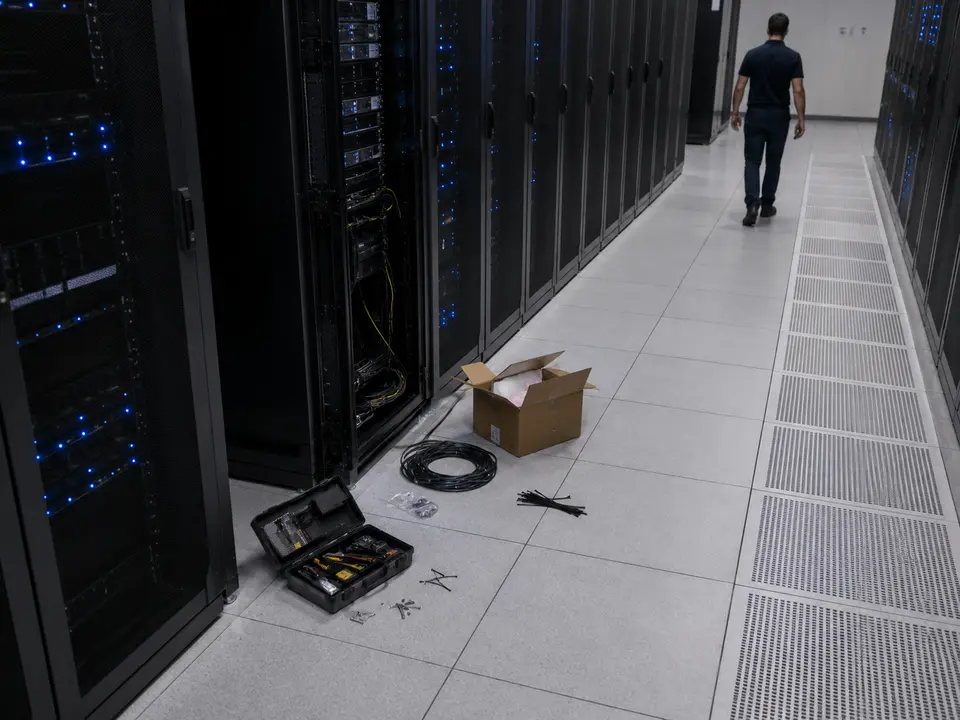
CAM-555A tool case, a coil of cable and some screws in the middle of the aisle
«Tell me if material is left on the floor of an aisle once nobody is working there any more.»
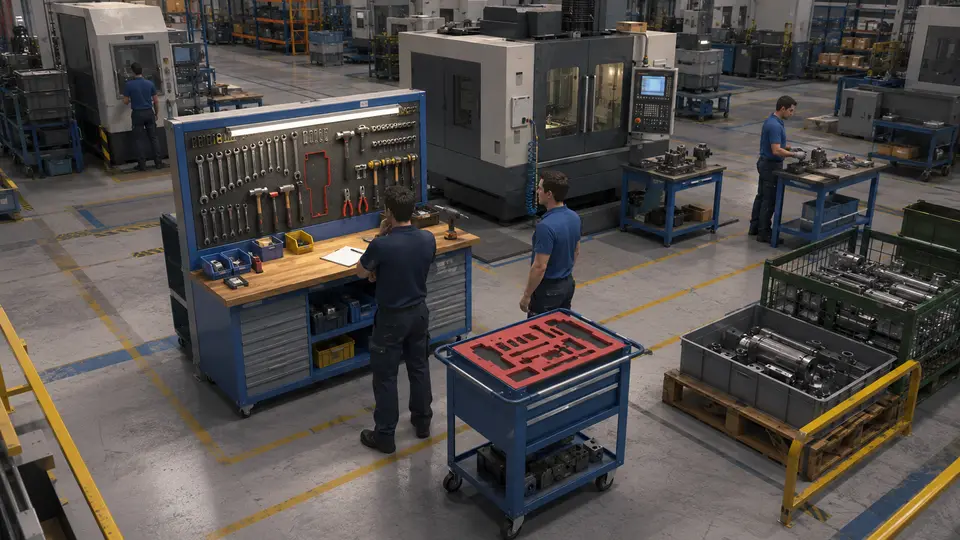
CAM-250One outline on the board is empty: a tool is missing
«Tell me when a board outline is left without its tool at the end of the shift.»
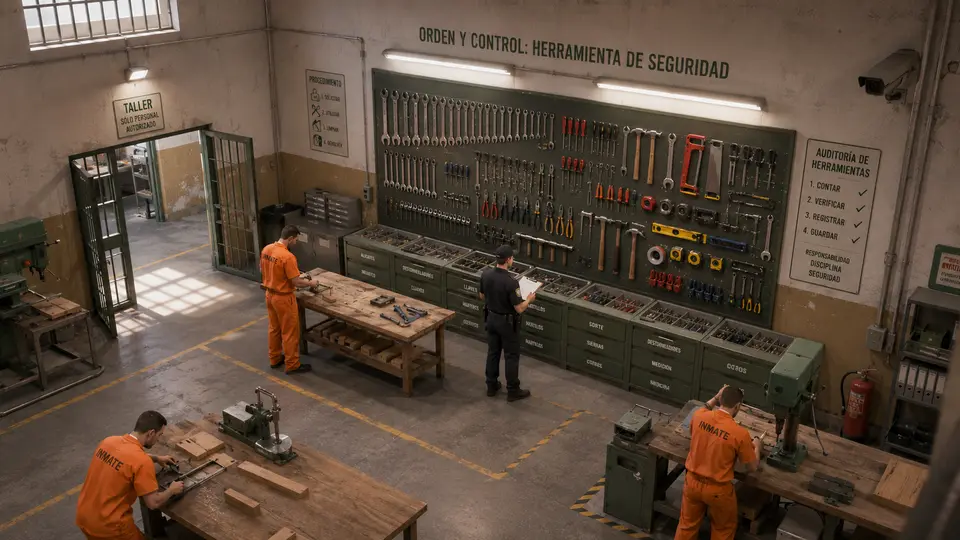
CAM-115The tool board in the workshop
«Tell me if any tool is missing from the board when the workshop closes, and tell me which slot and since what time it has been empty.»


What it does not do
IRIS does not know who took the tool. It identifies nobody, recognises no faces and stores nobody’s identity. Nor does it profile or predict anyone: it does not say who might take it.
And it answers only for what it sees. What is inside a closed drawer is not seen and not counted.
Questions
- Does IRIS know which tool is missing?
- Yes, if the outline is painted. IRIS compares the board with a reference image and points at the empty slot, with the exact time it became empty. The tool’s name is supplied by the plant when the rule is set up: the camera sees the shape, it does not read a catalogue. And if the board changes because a tool is added or a row is rearranged, you set the reference again and that is it.
- Does every tool need a tag or a chip?
- No. The board is watched exactly as it already is: each tool has its slot and its outline, and that is precisely what makes a missing one visible from a distance. The workshop already keeps that order; the only thing added is a camera that looks at it all the time instead of a person who looks twice a day. It works the same with trolleys, foam trays or gauge boxes, as long as each item has a fixed, visible position.
- What about tools inside a closed drawer?
- The camera can only answer for what it sees. The board is in plain sight and that is why it can be checked at a glance; what is inside a closed drawer is not seen, is not counted, and saying otherwise would be promising something we do not do. If those need to be included too, the way to do it is for them to be in frame at the moment of the count: an open tray on the bench is counted just as well as the board.
- What if the kit is on the floor because the job is still going?
- That is why the rule waits. While there is still somebody working in that aisle there is no alert: IRIS sees that people are there and stays quiet. The alert fires when the aisle is left empty with the things still in it, and how long to wait is set by whoever writes the rule. In one room it is ten minutes; in another, two. And whatever has always been part of the aisle raises no alert: what IRIS watches is the change, not the furniture.
Demo · IRIS at work
We won't just tell you. We'll show you.
It is a summary of the real screen: it plays by itself, step by step, and shows only the path of one case. The actual tool has far more than fits in here.
- The alert fires
- It lands in the tray
- You open it
- You confirm or dismiss
Not seeing yours here?
These words are the ones we have built, not the ones IRIS understands. The list falls short on purpose: you ask for it in a sentence, and sentences do not run out. Tell us what is in front of your cameras and we will tell you whether it understands it, or not yet.
And the best part
What happens in the small hoursdoes not have to wait for the morning report.
IRIS understands it there and then and tells whoever is on call, with the camera and the time. The next day there is nothing to reconstruct: it is already written down.
Tell us your problem and we will say whether IRIS understands it, or not yet.
We reply the same working day.