Solutions by typePersonal safety
What if he is only climbing up for a second?
He climbed on top of the press
It is 11:20. The press has been down for twenty minutes and a pallet of parts is waiting. A fitter climbs onto the frame to see the jam from above. He is two and a half metres up, standing on oiled steel plate, with nothing holding him. The harness is in the site hut, sixty metres away. Nobody says anything, because he will be down in a minute. Being down in a minute was exactly the plan. Nobody looks up.
2 cameras across 2 sectors
What IRIS is
IRIS watches the cameras for you.
IRIS Neural is an artificial intelligence that watches the cameras you already have and understands what happens in front of them. When something important happens —or something you told it you need to keep an eye on—, it alerts you; and whatever can be counted, it counts in numbers. All day long, without anyone having to watch a screen.
You tell it what you need to watch, and IRIS does it.
Works with the cameras you already have. Nothing to replace.
A person replies, not a form.
- Your footage never leaves your premises.
- It doesn't identify people.
- Certifications →
This is how you ask for it
«Tell me if someone climbs on top of a machine or works at height without a harness.»
If nobody sees it, nothing happens. Almost always nothing happens, which is why it happens again tomorrow. The day it does go wrong, the bill is long: an ambulance inside the building, the line down for the rest of the shift, an accident report and an inspector asking about the risk assessment for that job. And at Monday’s meeting nobody will be able to say how many times someone had climbed that frame before.
You decide once
You decide this once and never repeat it. Health and safety says where height begins on that machine, marks it on the camera image and sets who receives the alert. From then on the sentence never changes: if someone is above that height, and they are not wearing a harness, then an alert opens with the camera, the video is kept and the area supervisor is told. IRIS applies it on every shift, without anyone having to remember.
Nobody puts on a harness for two minutes. That is the whole problem, and there is nothing else to it. Harnesses almost never fail: what fails is that the harness hangs in the site hut while someone climbs. It happens in a workshop, on top of a press, and it happens on a wind turbine platform forty metres up. The scene is different; the sentence that explains it is the same: it was only going to take a second.
Two and a half metres is enough. A head against a concrete floor does not distinguish between a two-metre fall and a ten-metre one. In a tower it is bad in another way: nobody dies from the fall itself, but rescue at height takes time, and until it arrives there is nothing to do but wait. And on the day it happens, the supervisor was in another building, because one supervisor cannot be in ten places at once.
IRIS watches the area you have marked and speaks up when someone is above ground level where they should not be, or when they climb a ladder or a platform without a harness on. It speaks up while one foot is still down, which is the only moment an alert is worth anything. A harness left on its hook saves nobody. An alert that arrives before the second rung does.
What changes
Before, you found out in one of two ways: the supervisor happened to walk past, or someone fell. The video existed, but it was watched the next day and only if something had happened. Now the supervisor gets the camera open at the exact minute while the person still has one foot on the floor, with video kept from before the climb began. What used to be a telling-off after the fact is a word in time.
Where we have seen it
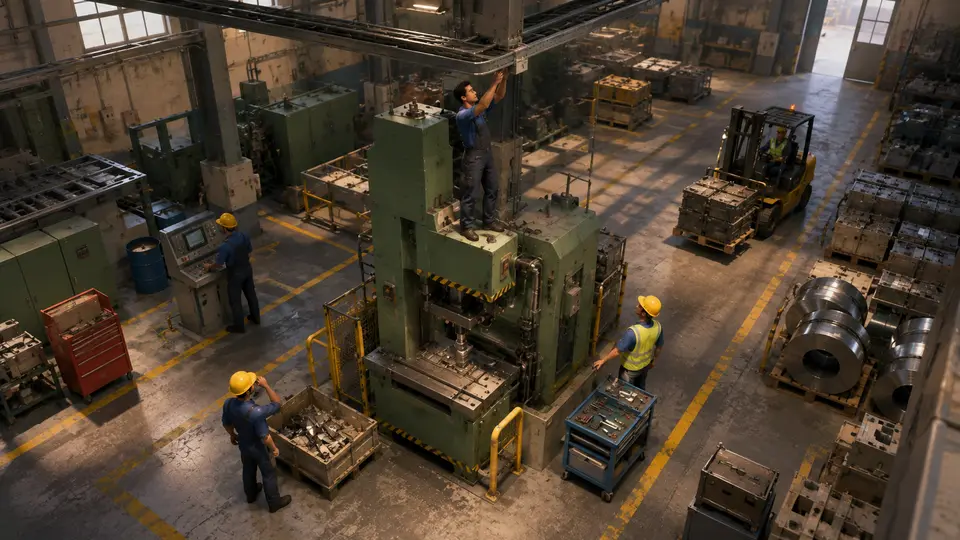
CAM-257Somebody is standing on top of the press
«Tell me if somebody climbs on top of a machine or works at height without a harness.»
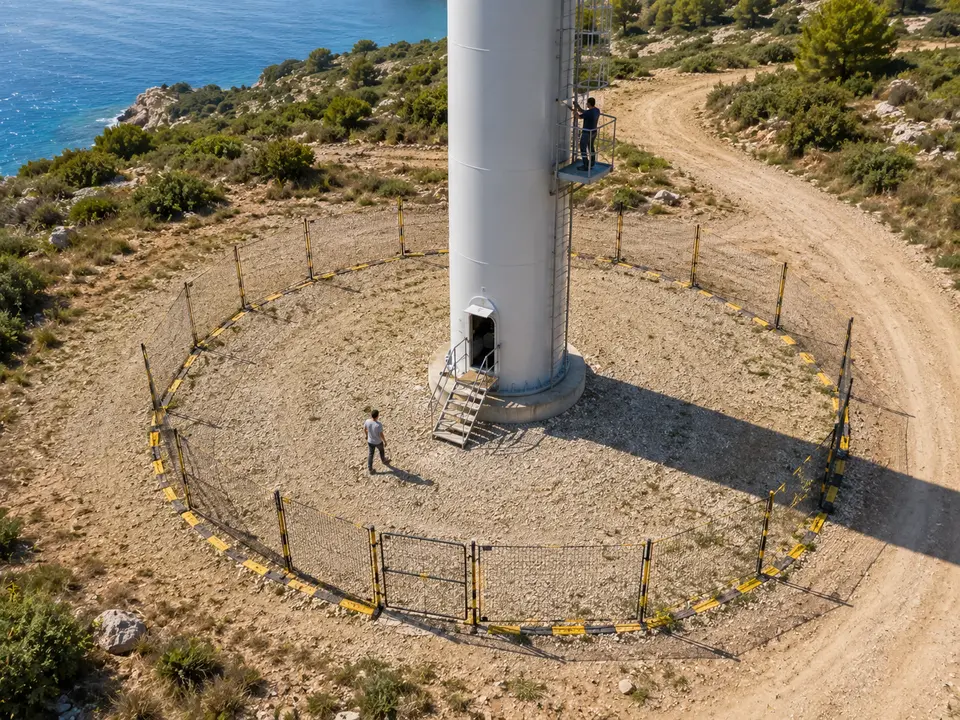
CAM-355Someone is on the turbine platform with no harness
«Tell me if anyone is on a tower ladder or platform without a harness, or if someone enters the fence of a tower with no work scheduled today.»


What it does not do
IRIS does not know whether the harness is clipped to anything or whether the lifeline would hold a fall. It sees whether someone is wearing one and whether they are above ground level where they should not be.
And if the harness is under overalls or a vest, it may miss it. That is why the camera goes at the foot of the ladder, where the person is seen in full before starting to climb.
Questions
- Do you need to fit sensors on the machine?
- No. You mark it once, on the camera image: where the floor is and where the not-floor begins — the machine frame, the ladder, the platform. From then on IRIS alerts when it sees a person above that height in that area, and also checks whether a harness is being worn. The machine is not touched, nothing is wired and production does not stop for the installation.
- Does it work on a wind turbine tower?
- Yes, and there it is usually asked for twice over. First, an alert for anyone on the ladder or the platform without a harness. Second, an alert for anyone entering the fence of a tower with no work scheduled that day, which is the simplest way to spot a visitor where there should be none. Two different sentences on the same camera, and they do not get in each other’s way.
- Can it miss a harness worn under overalls?
- Yes, it can happen, and we say so up front. That is why the camera goes at the access point, where the person is seen head-on and full-length before starting to climb: at the foot of the ladder, at the gate. If it has to be wrong, better one alert too many at the foot of the ladder than silence at forty metres. And whoever gets the alert watches the clip and closes it in ten seconds if the harness was on.
- Is it meant for disciplining whoever climbs without one?
- No, and using it that way ruins it. IRIS identifies nobody, recognises no faces, and the alert never says who: it says camera, time and what is missing. The aim is for that person to come down and fetch the harness, not to open a disciplinary file. Once people understand the alert exists so that nothing happens to them, they stop hiding from the camera, and that is exactly when the rule starts working.
The real interface, step by step
You set the rule once. IRIS applies it every time.
You will see a summary of the interface, played step by step and hands-free. Each round starts with another case. The complete tool does not fit in a demo.
- The rule gets built
- It goes to every camera
- Published, it watches alone
- And then it fires
Not seeing yours here?
These words are the ones we have built, not the ones IRIS understands. The list falls short on purpose: you ask for it in a sentence, and sentences do not run out. Tell us what is in front of your cameras and we will tell you whether it understands it, or not yet.
And the best part
Video tells you what happened.An alert reaches you while it is happening.
Reviewing the recording helps you explain. Hearing about it at the time helps you get there. Two different things, and until now you only had the first.
Tell us your problem and we will say whether IRIS understands it, or not yet.
We reply the same working day.