Solutions by typeProduction efficiency
Why is output short if the line never stopped?
The line never stopped, yet output is short
It is 16:20 in the bottling hall. The machine tower is green and nobody has raised anything. But on the conveyor the bottles are not running steady: a tight group goes past, a twelve-second gap opens, another group comes. Nobody logs those gaps, because they last less time than it takes to walk over there. At the end of the shift two thousand bottles are missing and the report says the line never stopped.
1 cameras across 1 sectors
What IRIS is
IRIS watches the cameras for you.
IRIS Neural is an artificial intelligence that watches the cameras you already have and understands what happens in front of them. When something important happens —or something you told it you need to keep an eye on—, it alerts you; and whatever can be counted, it counts in numbers. All day long, without anyone having to watch a screen.
You tell it what you need to watch, and IRIS does it.
Works with the cameras you already have. Nothing to replace.
A person replies, not a form.
- Your footage never leaves your premises.
- It doesn't identify people.
- Certifications →
This is how you ask for it
«Count the bottles going past here every minute and tell me when a gap of more than ten seconds opens up.»
The shift ends and the numbers do not add up. The machine says it was running, the warehouse says fewer pallets came in, and nobody can say where the difference went. With no stoppage on record, Monday’s meeting ends up being about people instead of the machine. And maintenance plans blind: you fix what makes noise, not what stands still for fifteen seconds twenty times a day.
You decide once
You decide this once. You say which stretch of conveyor is watched, how many seconds of gap stop being normal, which shifts it applies to and who gets the alert: if flow at the filler outlet breaks for more than ten seconds, tell the line manager and log it with the time. IRIS applies that on every shift, every day, with nobody standing there holding a stopwatch. Change the format and you change the number in the rule, not the habit.
A micro-stop is a stop that never looks like one. The conveyor sits still for eight seconds because a bottle has turned sideways on the bend, somebody straightens it by hand and everything carries on. No beacon lights up, no alert opens, nobody writes it down, because writing it down costs more than fixing it. On a line running four hundred bottles a minute, eight seconds is fifty bottles. And it happens thirty times a shift.
The problem is not each gap: it is that nobody adds them up. A month later there is a production figure that does not match the machine hours and, with no record, the explanation gets pinned wherever it can be: on the night shift, on the new operator, on the cap supplier. Meanwhile the guide rail that catches bottles on the bend is still there, costing fifty bottles every time.
IRIS watches that stretch of conveyor and counts what goes past, minute by minute. When flow breaks for longer than the seconds you set, it logs it with the time and keeps the video of those seconds. By the end of the week there is no opinion about the line: there is a list of gaps with times and video, and three or four of them almost always repeat at the same spot. That spot is the one to fix.
What changes
Before, the line manager saw a gap only if he happened to be standing there, and saw the total at month end as a figure he could not explain. Now he has the shift’s list of gaps, with the time and video of each one, and can see that fourteen of the thirty happen on the same bend. The morning meeting stops being an argument about who works harder and becomes a list of things to fix.
Where we have seen it
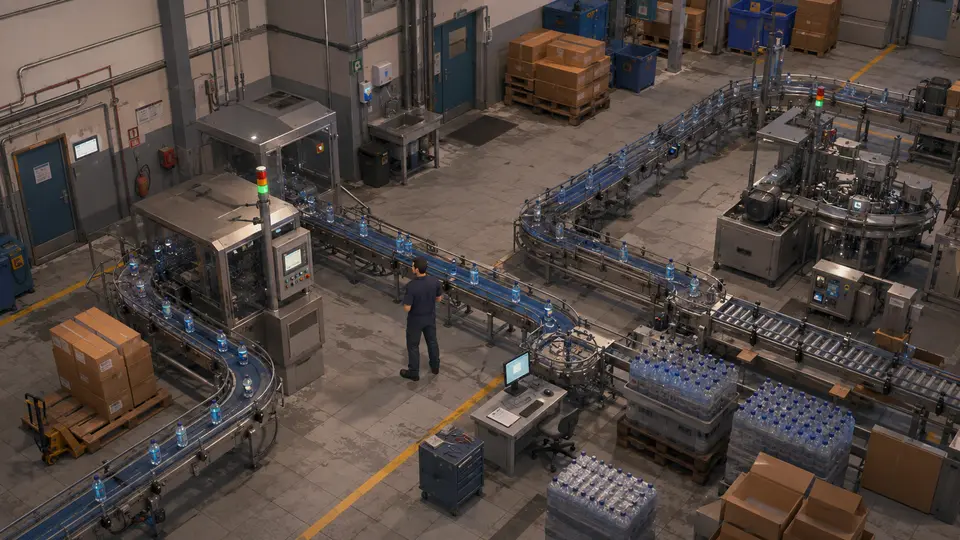
CAM-241The line is running, but a gap opens every few seconds
«Count the bottles going past here every minute and tell me if a gap of more than ten seconds opens up.»

What it does not do
IRIS does not know why the gap opened. It sees that flow broke, counts the seconds and logs it. Whether it was a bottle turned sideways, a label misfeed or a reel change is for whoever watches the video to say.
And it does not replace machine data. If your filler already counts cycles, that figure still rules. What IRIS adds is what happens between machines, on the conveyor, where there is no counter at all.
Questions
- Does the machine’s controller not count this already?
- Sometimes yes, and then you compare the two figures. What is almost never counted is the stretch between two machines: the conveyor, the bend, the accumulation table. There is no sensor there, and that is exactly where most gaps open. IRIS counts what goes past the camera, without touching the controller or asking the machine for anything. And if the two figures diverge, that difference is already a clue about where to look.
- Do we need to fit sensors on the conveyor?
- No. You draw the line the product crosses on the camera image, and IRIS counts what crosses it. No cutting into the conveyor, no stopping the line, no cable run back to the panel. And if tomorrow you want to measure somewhere else, you draw another line and that is it. A sensor measures where it is bolted; a camera measures where you say, and the same view can serve two different measurements.
- Is this good enough to justify spending on the line?
- Yes, and it is one of the most common uses. A single gap convinces nobody; a month of gaps with time, location and video does. It shows how many times a day flow breaks at the same bend and how much product is lost along the way. The conversation stops being an impression and becomes a number, one you can measure again after the fix, with the same camera and the same line.
- Do you ask for this in a sentence, or draw something?
- Both, and they are not the same thing. The gap alert is asked for out loud: «tell me when a gap of more than ten seconds opens up». The count is set up by drawing: you trace on the image the line the bottles cross, because a line cannot be described in a sentence. Asking is for finding. Counting is for measuring. And they are not done the same way: that is why the number is repeatable and can be audited.
Demo · IRIS at work
A new case each time. Always the same screen.
It plays by itself and shows one case from start to finish. It is a summary: the real screen has far more functions than fit in this box.
- Cameras on the map
- You draw an area
- What passed shows up
Not seeing yours here?
These words are the ones we have built, not the ones IRIS understands. The list falls short on purpose: you ask for it in a sentence, and sentences do not run out. Tell us what is in front of your cameras and we will tell you whether it understands it, or not yet.
And the best part
Nobody covers the night shift:the camera that is already on covers it.
It does not tire, it does not blink and it does not go for coffee. What happens at night is understood just as it would be at midday, and whoever is on duty hears about it while it is happening.
Tell us your problem and we will say whether IRIS understands it, or not yet.
We reply the same working day.