Solutions by typeEnvironment and cleanliness
Where does the liquid coming off the waste end up?
The black puddle that ends up in the drain
One in the afternoon on the tipping floor. Pit two is brimming: the mass of waste has gone over the top of the wall and started to fall onto the internal road. Under the spilled heap a dark puddle is forming and creeping towards the drain grating. Nobody has seen the overflow yet: the grab operator is watching his screen and the guard is at the weighbridge.
1 cameras across 1 sectors
What IRIS is
IRIS watches the cameras for you.
IRIS Neural is an artificial intelligence that watches the cameras you already have and understands what happens in front of them. When something important happens —or something you told it you need to keep an eye on—, it alerts you; and whatever can be counted, it counts in numbers. All day long, without anyone having to watch a screen.
You tell it what you need to watch, and IRIS does it.
Works with the cameras you already have. Nothing to replace.
A person replies, not a form.
- Your footage never leaves your premises.
- It doesn't identify people.
- Certifications →
This is how you ask for it
«Alert me when waste goes over the pit wall or falls onto the road.»
The puddle reaches the grating, and from there the liquid stops being the plant’s problem and becomes the river’s. A discharge recorded downstream is paid for with a case file, with lab tests you have to fund and with an inspector who comes back every month for a year. And one question is left hanging: how long was it running? With nobody watching, the honest answer is that nobody knows.
You decide once
The plant decides once what fill height is not to be crossed, which stretches of road have to stay dry and who handles the alert on each shift. IRIS checks it throughout the tipping, lorry after lorry, without depending on someone remembering to look into the pit. And it stores the exact time of the first overflow, which is precisely the fact the inspector will ask for and that nobody has today.
Leachate is the least photogenic problem in a waste plant. It makes no noise, never appears in the photo and nobody watches it, because the people on the tipping floor are watching the grab and the lorry, which is where you get hurt. The floor gets looked at at the end of the shift, once it has dried and only the tidemark is left.
IRIS watches the wall and watches the floor. It sees when the mass of waste reaches the top, when it starts falling onto the road, and the dark sheet growing under the spilled heap. It does not say what that liquid is: it says there is something dark where the floor should be dry, says which minute it started and keeps the whole sequence.
That changes two conversations. The one inside, because the pit gets emptied before it overflows instead of after. And the one outside: the day a complaint about a discharge arrives, the plant can show when it started, how long it lasted and what was done, instead of defending itself with the memory of a shift that ended three weeks ago. On a rainy day, when leachate multiplies, that difference is the whole difference.
What changes
Overflows used to be discovered by walking down the road, or the next day, with the trail already dry. The time written in the log was the time somebody saw it, not the time it started.
Now the shift gets the alert while the mass is going over the wall and there is still time to call the grab and bring the level down. And the log carries the real time, the first minute, because it came from the camera and not from memory.
Where we have seen it
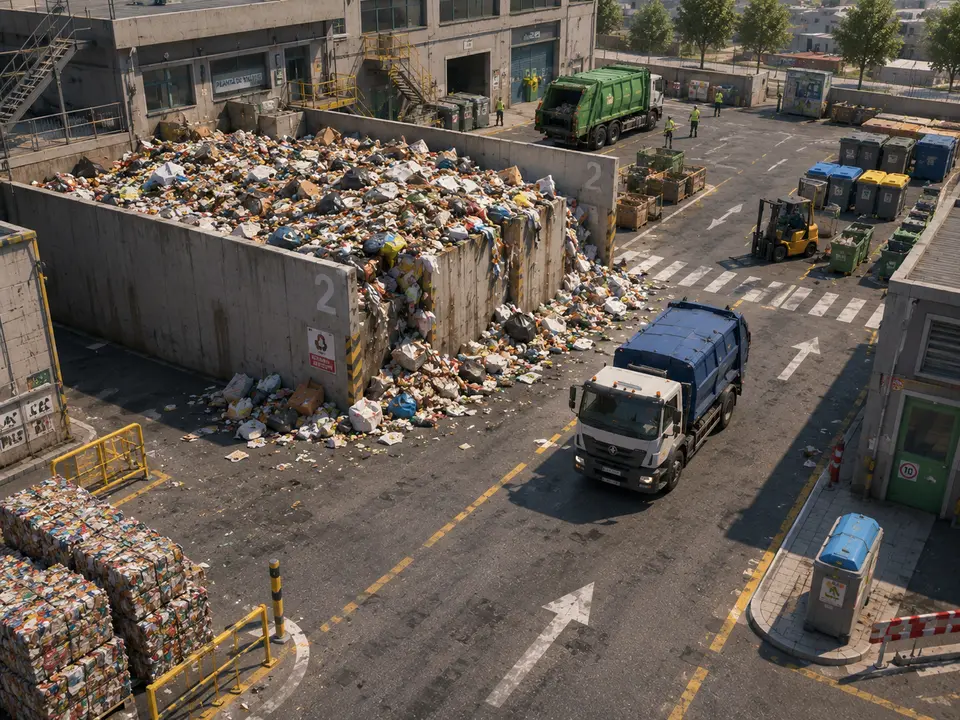
CAM-434The bunker is overflowing and waste is falling onto the road
«Tell me when waste rises above the bunker wall or falls onto the road.»

What it does not do
IRIS does not analyse the liquid. It does not know whether what is on the floor is leachate, rainwater or the flush from a hose, and it will not pretend to.
It sees a dark sheet growing where the ground should be dry, says where and since when, and keeps the video. Who takes the sample, what gets declared and who gets told remains the plant’s business.
Questions
- Can it tell a leachate puddle from a rain puddle?
- No. It sees a dark sheet on ground that should be dry, and that is what it reports. The difference between leachate, dirty water and rainwater is settled by a sample, not by a camera. In practice this matters less than it sounds: the alert fires where the plant has said the floor must stay dry, and in that area a puddle is a puddle somebody has to go and look at, whatever it came from.
- Can it warn before it overflows?
- Yes, and that is the version most plants use. The rule does not have to wait for the overflow: it can be written on the height of the mass inside the pit, using a mark on the wall as reference. When the waste reaches that mark the alert goes out and there is still room to call the grab. The overflow stays as a second rule, the one you can no longer prevent, kept to record the exact time.
- And on a rainy day, with the whole floor wet?
- On that day the floor rule does not work, and it should be said. With the yard soaked end to end, one more dark sheet does not stand out from the rest. That is why the rule that earns its keep in the rain is the wall one: pit level and material falling onto the road look the same wet or dry. The two rules coexist, and in practice the level alert is the one working through most of the winter.
- Does this count as proof for an inspection?
- It is not a certificate, and we are not going to claim it is. What you have is the video with its timestamp, the log of when it started and when it was closed, and what was done in between. Whether that stands up in a case file is for whoever handles the file to say. What certainly changes is the plant’s position: turning up with the full sequence is not the same as turning up with the memory of a shift from a month ago.
Every simulation
Something has spilled
Tell me if there is liquid or foam outside its place and it is still there two minutes later.
- The sentence
- Where it applies
- What it finds
- The same rule
Not seeing yours here?
These words are the ones we have built, not the ones IRIS understands. The list falls short on purpose: you ask for it in a sentence, and sentences do not run out. Tell us what is in front of your cameras and we will tell you whether it understands it, or not yet.
And the best part
There is a moment when you can still act.It is while it is happening, and it is short.
After that, all you can do is tell the story. IRIS speaks up at that moment — camera, time and images — and whoever is on call decides what to do with it.
Tell us your problem and we will say whether IRIS understands it, or not yet.
We reply the same working day.