Solutions by typeCustomer experience
How long has that shelf been empty?
The gap has been there two hours and nobody saw it
Twenty past six on a Friday. In the aisle there is a shelf with the bare backboard showing and, right beside it, another one still full. A customer stops in front of the gap with a basket in hand, looks for a moment and moves on. They do not ask anyone. The person who restocks will come down that aisle at nine, when their round says so, and until then the gap will stay exactly as it is.
1 cameras across 1 sectors
What IRIS is
IRIS watches the cameras for you.
IRIS Neural is an artificial intelligence that watches the cameras you already have and understands what happens in front of them. When something important happens —or something you told it you need to keep an eye on—, it alerts you; and whatever can be counted, it counts in numbers. All day long, without anyone having to watch a screen.
You tell it what you need to watch, and IRIS does it.
Works with the cameras you already have. Nothing to replace.
A person replies, not a form.
- Your footage never leaves your premises.
- It doesn't identify people.
- Certifications →
This is how you ask for it
«Tell me when a shelf empties out and stays empty for a while, so I do not find out only when the restocking round comes past.»
That customer does not take the product, and often does not take a substitute either: they go elsewhere or leave it for Saturday. The lost sale appears in no report, because the till never records what nobody picked up. And if the gap is on the shelf of a brand that pays to be there, Monday brings an awkward conversation: you charged for a space that sat empty for two hours, and nobody can say how often that happens in a week.
You decide once
You decide it once, aisle by aisle: which shelves genuinely matter, how many empty minutes are too many on each one — bread at eight in the morning is not tinned goods — and who is told depending on the time of day. IRIS applies it across as many stores as you like, with one rule or with a different one per format. You decide once, and it stops depending on whether the manager on that particular afternoon happens to be the one who notices shelves.
A gap on a shelf does not look like much. It is, because it is the one moment when a customer who had already decided to buy walks away with nothing. They came into the store, walked the aisle, reached the product: all the work is done, and the sale falls over at the very last step.
And it is invisible. A supermarket has tens of thousands of possible gaps and four people restocking. The out-of-stock is discovered when the round reaches that aisle, which may be two hours away, or when a customer bothers to mention it, which almost never happens. Stock figures do not help either: they may say six units remain and all six may be in the back, on a pallet nobody has brought down.
IRIS watches the shelf. You mark on the image which part of the shelving matters to you, and IRIS alerts when that area has been empty for the minutes you set. It does not watch the customers, and it does not need to: what it detects is the bare backboard showing. And after a month you have what no stock system gives you: what time each aisle breaks, on which days and which shelves. That is no longer fixed by restocking faster. It is fixed by changing the hour you restock.
And there is one case that pays for itself in the first month: the promotion. A well-built end cap empties in an hour, and that hour is usually exactly the one nobody is watching because the team is on the tills. With the alert, the pallet comes down while the promotion still has people in front of it. Without it, the promotion works for one morning and then sits half empty for three days, and at the results meeting somebody says that promotion did not work — when what happened is that there was no product on the display.
What changes
Before, the gap was found when the restocking round arrived, and it counted as an ordinary afternoon. Now the alert comes up with the camera and the shelf, someone looks at it from a phone and decides whether to bring the pallet down now or wait twenty minutes. And at month end there is a list of the shelves that empty most often and at what hours, which is what actually changes a replenishment schedule.
Where we have seen it
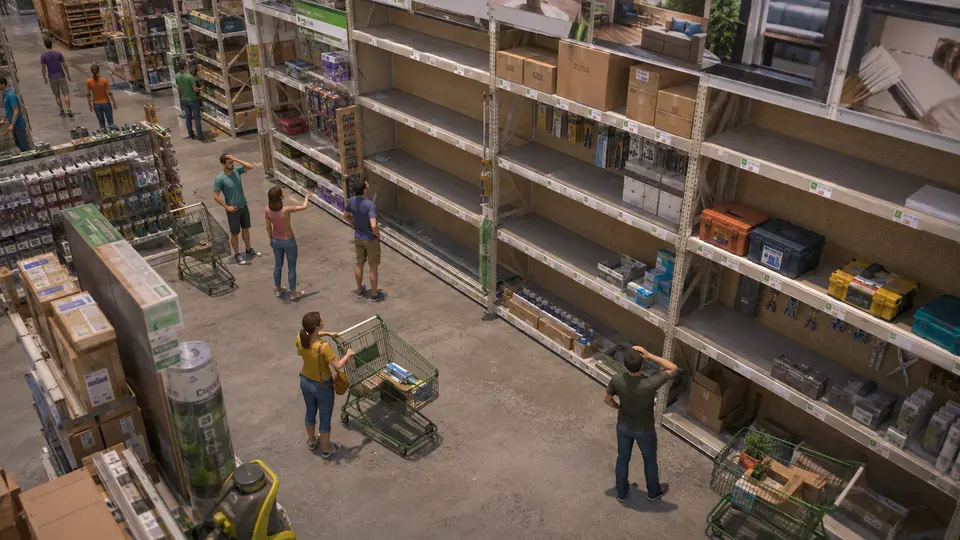
CAM-72Empty shelves in the aisle
«Tell me when a shelf runs empty and stays empty for a while, so I don't find out only when the stacker walks by.»

What it does not do
IRIS does not know which product is missing or how many units are left. It does not read labels and does not count stock: your inventory says that. What it sees is that there is a gap where there used to be product.
And it cannot see what cannot be seen. A very high shelf, one at a steep angle, or one hidden behind an end cap may not work for this. That is checked before the rule is written, and it is checked with the store busy, not after closing.
And it does not tell a gap from a shelf left empty on purpose. If you drop a product from the range and leave the shelf clear until the next reset, IRIS will keep alerting until you tell it that area no longer counts. This is a rule that has to be kept alive, not a box you plug in and forget.
Questions
- How does it tell an empty shelf from an almost empty one?
- By how much backboard is showing. You mark the shelf area on the image and decide how much gap is too much and how many minutes it has to last. With two products left in the corner of a wide shelf, most of the area is bare board and that counts as an out-of-stock; with the shelf half full, it does not. The tuning is done in your store with your shelving, because a run of tinned goods and a bread display have nothing in common.
- Would it not be easier to check the stock system?
- No, and this is the part that surprises people. Stock figures tell you how many units you have in the store, not where they are. There can be six in the system with all six in the back room, on a pallet nobody has brought down. For the customer standing in front of the gap, those six units do not exist. The camera watches the shelf, which is exactly where the sale is made or lost, and that is why the two work well together: stock says how much you have, the camera says whether it is out.
- Do I need a new camera in every aisle?
- Not always. Many supermarkets already have cameras that see whole aisles and, if the shelving is clearly visible, those work. What decides is not the brand or the age but whether the camera sees the shelf head-on or almost edge-on. In aisles where the angle does not work, one camera is added or an existing one is moved, and only in those. And you start with the aisles that sell most rather than all of them at once, so the spend justifies itself from the first month.
- Does this record the customers?
- The camera sees the aisle, and an aisle has customers in it: that is true in any shop with cameras. What IRIS does with this rule is something else: it looks at the shelf, not at people. It does not recognise faces, does not identify anyone and does not follow a customer around the store. The alert says which shelf is empty and since when, never who was standing in front of it. And if the camera can be framed to show more shelving and less aisle, better: what does not need to be seen is not framed.
A different case every time
Watch what happens. Then watch what IRIS does with it.
Not a recorded video and not a drawing: it is a summary of the real tool, with a different case each time round. The whole tool does not fit in a box.
- You ask
- IRIS searches
- It shows you
Not seeing yours here?
These words are the ones we have built, not the ones IRIS understands. The list falls short on purpose: you ask for it in a sentence, and sentences do not run out. Tell us what is in front of your cameras and we will tell you whether it understands it, or not yet.
And the best part
Finding something in yesterday’s videoshould take as long as asking for it.
No more scrubbing back through six hours with your finger on the mouse. You type what you are after, in plain words, and the matching moments come up. Same cameras as always.
Tell us your problem and we will say whether IRIS understands it, or not yet.
We reply the same working day.