Solutions by typeInfrastructure integrity
What condition is the pipe rack really in, and who is looking?
The pipe has been rusting under the cladding for months
Nine in the morning at the pipe rack. The cladding on the main line hangs in strips, leaving the pipe exposed and rusted end to end. Below, on the concrete, sheets have been lying long enough to have drawn their own rust ring around themselves. People walk past here every day on their way to the workshop. The last inspection of that section was seven months ago, and the report says “satisfactory”.
2 cameras across 1 sectors
What IRIS is
IRIS watches the cameras for you.
IRIS Neural is an artificial intelligence that watches the cameras you already have and understands what happens in front of them. When something important happens —or something you told it you need to keep an eye on—, it alerts you; and whatever can be counted, it counts in numbers. All day long, without anyone having to watch a screen.
You tell it what you need to watch, and IRIS does it.
Works with the cameras you already have. Nothing to replace.
A person replies, not a form.
- Your footage never leaves your premises.
- It doesn't identify people.
- Certifications →
This is how you ask for it
«“Tell me if cladding comes loose or sheeting falls under the rack, and keep the picture so I can compare it with last semester’s.”»
A pipe rusting under its cladding is invisible until it drips, and once it drips it is no longer a paintbrush job: it is an isolated section, a unit shutdown and a repair with scaffolding. And if what drips is product, then there is an incident report, an authority asking questions and a meeting to explain why last semester’s report said everything was satisfactory.
You decide once
The plant decides which lines matter, how often it wants the comparison, what counts as degradation worth looking at, and who receives the record: maintenance, integrity, or the unit manager. It also decides the other thing, which is more serious: on which lines a flange is not opened unless the isolation has been seen to be fitted first. That is written once, with the procedure in front of you. After that IRIS applies it on every section with a camera, every day, without depending on anyone’s calendar.
At a pipe rack the word insulation means two things, and both are visible from the same camera. One is the cladding that protects the pipe: when it splits, water gets in between the sheet and the steel and the pipe is eaten away from underneath with nothing showing on the outside. The other is the isolation that protects the person: the line drained, locked off and purged before anyone touches a flange.
The first is a calendar problem. The integrity inspection comes round every six or twelve months, and between them the rack is alone with the rain. What is needed is not an alarm: it is a photograph of the same spot, taken from the same framing, to place beside last semester’s and see what has changed. The video already does this; nobody was using it for this.
The second is a sequence problem, and it is the one that sends someone to hospital. A fitter unbolts a flange and, if the line was not isolated, whatever was still inside comes out through the gasket: steam, product, pressure. IRIS does not know whether a permit has been signed, but it does know what it has seen through that camera: if a flange is opened on a line where the isolation was not seen being fitted first, it says so straight away and shows the video from just before. Then a person decides — that is what the shift supervisor is for.
What changes
Before, the real condition of the rack was whatever the last report said, and between reports you trusted. Now the comparison happens by itself and arrives as two images of the same framing, the earlier one and today’s, so the engineer can decide which section gets the scaffolding first. And the sequence question, which used to be seen on video after something had already happened, is now seen while it is happening — which is when it is still of any use.
Where we have seen it
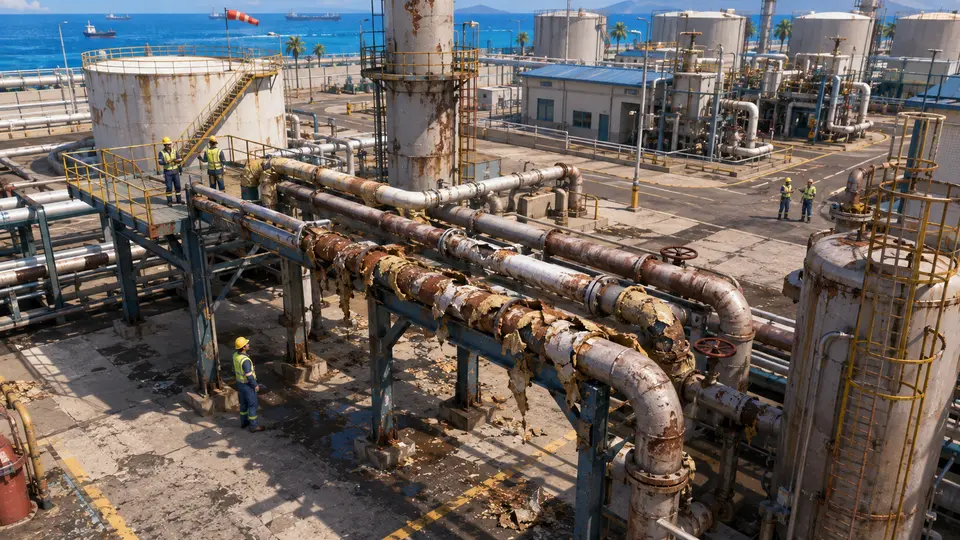
CAM-337The cladding hangs in strips and underneath it is all rust
«Tell me if cladding comes loose or sheets fall under the rack, and keep me the photo so I can compare it with the one from six months ago.»
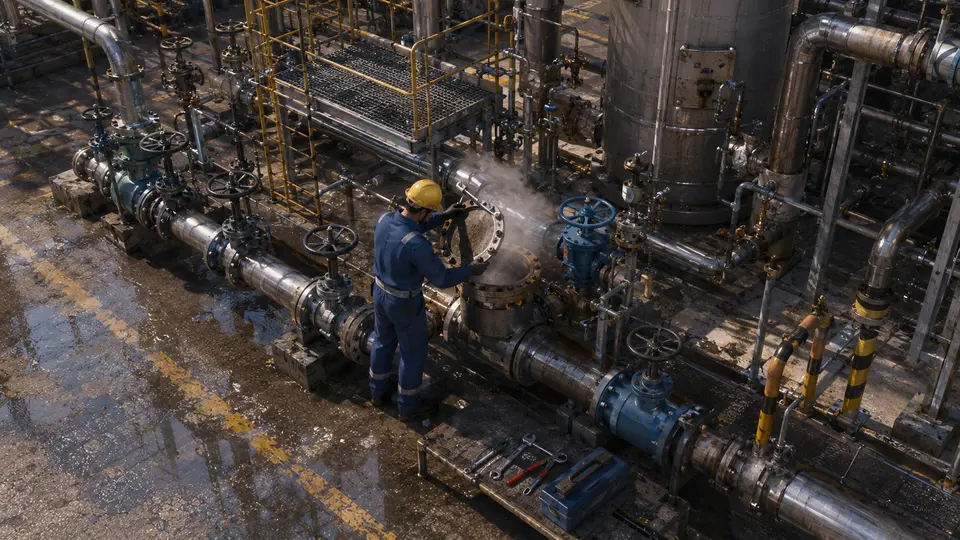
CAM-327The flange was opened before the line was isolated
«Tell me if anyone opens a flange on this line without the isolation having been seen fitted first.»


What it does not do
IRIS does not measure wall thickness and does not say how much pipe wall is left. That takes ultrasound and a technician, and no camera replaces it. Nor does it know whether a work permit has been signed or whether the line is genuinely depressurised: what it knows is what it saw through that camera, and in what order. And it does not see under cladding that is still in place: if the sheet is intact, the rust underneath does not appear in the image.
Questions
- Can it tell me how far a pipe has corroded?
- No. IRIS does not measure thickness or wall loss: a technician with ultrasound does that, and no camera replaces it. What it does do is show you where to look. It sees split cladding, fallen sheeting, a rust patch spreading and a drip leaving a trail on the ground, and it records when each of those appeared. With that, the inspection campaign stops being a full walk round the rack and starts with the sections where something has changed since last time.
- How does it compare two images taken months apart?
- By keeping the same framing. The camera is fixed, so today’s image and the one from six months ago look at the same section from the same place, and putting them side by side already shows what has changed. The light changes, the season changes and whether it is wet changes, and that has to be taken into account when looking. So what gets handed over is the pair of images with their dates, not a verdict: whether that is degradation or a shadow is decided by the integrity engineer.
- Does IRIS know whether the line is isolated?
- No, and this needs to be clear. IRIS does not read the permit system, does not know whether a lock is fitted or whether the line is depressurised. All it knows is what it saw through that camera: whether the isolation was seen being fitted on that section before anyone started unbolting the flange. It is a check on sequence, not on state. And that is why the alert goes to a person with the video, so that it is the person who stops the job if it needs stopping.
- Does this cover thermal cladding as well as fireproofing?
- Yes, as long as it is visible from the camera. IRIS does not care what that sheeting protects: it sees the covering is split, hanging or on the ground, and it reports it. What changes is the urgency, and the plant sets that: split thermal cladding on a cold line can wait for the next shutdown, and damaged fire protection on a column cannot wait for anything. The rule is written differently for each line, and it is written once.
See it for yourself
No extra alarms here. Just what needs looking at.
Not a recorded video, not an explanatory drawing: a summary of the real screen, with a different case every time it starts. There is a lot more behind it.
- You draw the line
- It counts by itself
- A number comes out
Not seeing yours here?
These words are the ones we have built, not the ones IRIS understands. The list falls short on purpose: you ask for it in a sentence, and sentences do not run out. Tell us what is in front of your cameras and we will tell you whether it understands it, or not yet.
And the best part
You have paid for years to store video.Nobody has ever watched it.
Recording is not understanding. The footage is still kept in case you need it, but you no longer have to sit through it to know what happened.
Tell us your problem and we will say whether IRIS understands it, or not yet.
We reply the same working day.