Solutions by typeEnvironment and cleanliness
What if the cloud is there because the sprinklers are not running?
Dust does not hurt today, so nobody stops for it
It is midday at the quarry. A thick cloud is coming off the crusher and spreading over the platform and the haul roads, and a loaded dump truck climbing the left-hand road is throwing up more. The sprinkler ring is mounted right above it and is not running: not a drop. Nobody has stopped anything, because there is always some dust in a quarry and this is only a bit more. It has been like this since twenty past ten.
2 cameras across 2 sectors
What IRIS is
IRIS watches the cameras for you.
IRIS Neural is an artificial intelligence that watches the cameras you already have and understands what happens in front of them. When something important happens —or something you told it you need to keep an eye on—, it alerts you; and whatever can be counted, it counts in numbers. All day long, without anyone having to watch a screen.
You tell it what you need to watch, and IRIS does it.
Works with the cameras you already have. Nothing to replace.
A person replies, not a form.
- Your footage never leaves your premises.
- It doesn't identify people.
- Certifications →
This is how you ask for it
«Tell me when there is a dust cloud over the crusher and the sprinklers are not running.»
The cost does not arrive today. It arrives through health surveillance, through a mask worn badly for half a shift, and through a medical check-up fifteen years from now. It also arrives over the fence: the village next door calls, the perimeter monitor gives a number, and nobody can say what was going on inside at that hour.
You decide once
You decide this once, and it has two halves. You say which views must not be full of dust while the plant is running, how many minutes are tolerated and who receives the alert: if there is a cloud over the crusher for more than three minutes and the sprinkler ring is not running, alert the plant supervisor with the camera open. The second half is what matters: seeing dust is not enough, you have to look at whether the water is coming out.
In a quarry, dust is scenery. There is always some, so nobody sees the difference between «some» and «the crusher swallowed up and the left-hand road with no visibility». And the cause is almost never interesting: a stopped pump, a valve closed in the morning that nobody opened again, a couple of blocked nozzles. It is exactly the kind of fault that raises no flag anywhere, because a watering system does not report that it is not watering; it simply does not water, and the cloud grows.
The cost is not paid that afternoon. Silica does not hurt at midday: it shows up twenty years later, at a check-up, and that is why there is never an urgent reason to stop.
IRIS watches both things at once: the cloud and the water. It sees the crusher swallowed up, sees the sprinkler ring dry, and says so with the camera, the time and the video, so that whoever gets the alert already knows what to go and look at. And it adds it up: how many hours a month there was a cloud, and how many of those hours the watering was off. That second number changes a discussion that until now was had with a car window down and a feeling, and from now on is had with a table.
What changes
This used to be seen by whoever drove past on the haul road, and mentioned at the weighbridge canteen.
Now the alert arrives while the cloud is there and it says the only actionable thing: the sprinklers are not running. Whoever gets it goes, opens the valve or clears the nozzle, and the problem ends in twenty minutes. And at the end of the month there is a count per point that can be taken into a meeting.
Where we have seen it
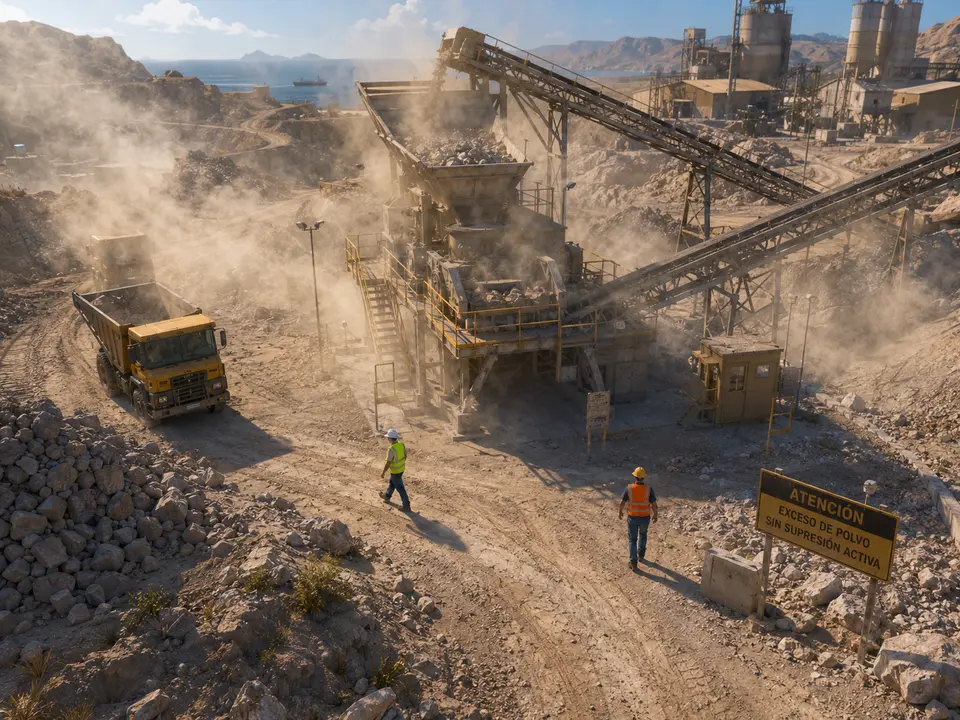
CAM-394A dust cloud covers the crusher and nothing is spraying
«Tell me when there is a dust cloud over the crusher and the sprays are not running.»
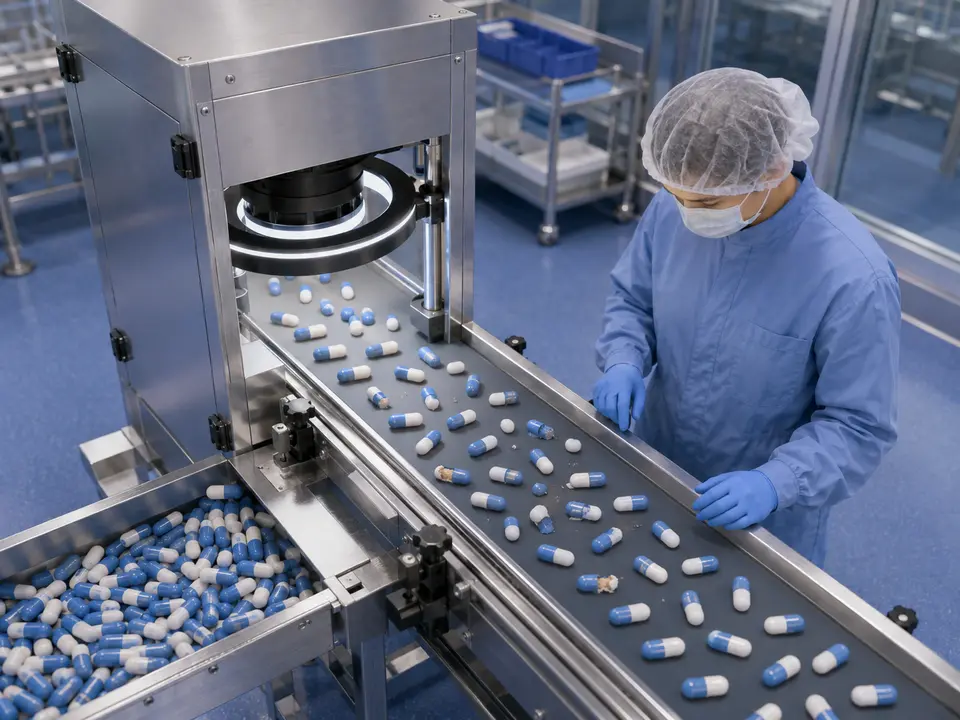
CAM-292Split capsules and loose powder among the good ones
«Alert me when split or broken capsules go past on the belt, or powder spilled around them.»


What it does not do
IRIS does not measure dust. It does not give a concentration, it does not say whether there is silica and it does not replace perimeter monitors, occupational hygiene equipment or health surveillance. It sees a cloud in an image, and that is not a value.
It does not water either: it alerts whoever waters.
Questions
- Does it measure the dust concentration?
- No. A camera does not give milligrams per cubic metre, and claiming otherwise would be selling smoke. What IRIS adds is what the monitor cannot give: the scene. The monitor delivers a value and a time; the camera delivers what was happening at that time, at which point and with which machine running. Together they turn a loose number into a cause, and the cause is the only thing you can correct. That is why IRIS goes alongside what you already have, not instead of it.
- How does it know whether the sprinklers are running?
- Because water is visible. A sprinkler ring that is running looks completely different from a dry one, and that check is one of the simplest things you can ask of a camera. And it is the useful part of the alert: knowing there is dust tells a quarry supervisor nothing new, but knowing there is dust and the water is not coming out tells them exactly where to go. Most of the time it is a valve, a stopped pump or two blocked nozzles, and it gets fixed the same day.
- Does it work indoors too, with product powder?
- Yes, and it is the same problem at another scale. On a capsule inspection belt, loose powder around a broken capsule is not a cloud: it is a few grams on a band, and yet it decides whether a batch carries on or stops. The rule is written the same way — which view has to be clean, what counts as normal — and the alert also arrives while the belt is still running, which is when you can still separate the good from what has to be reviewed. The size of the scene changes, not the way you ask for it.
- What about windy days, with dust everywhere?
- On those days the alert is worth less, and that has to be said. When it blows hard, half the quarry raises dust and an alert per cloud would be pure noise. That is why the rule is not built on the cloud alone: it is built on the cloud and the watering together, and on a minutes threshold you decide. And that is why what pays off in the long run is not the alarm but the count: how many hours a month there was a cloud at each point and in how many of them the water was off. Wind affects the first column; it does not affect the second.
Every simulation
Something has spilled
Tell me if there is liquid or foam outside its place and it is still there two minutes later.
- The sentence
- Where it applies
- What it finds
- The same rule
Not seeing yours here?
These words are the ones we have built, not the ones IRIS understands. The list falls short on purpose: you ask for it in a sentence, and sentences do not run out. Tell us what is in front of your cameras and we will tell you whether it understands it, or not yet.
And the best part
Ten cameras or four thousand:not one of them goes unwatched.
The day IRIS starts, they all start: the ten in a school or the four thousand in a whole network. And it only raises its hand when the thing you asked for happens.
Tell us your problem and we will say whether IRIS understands it, or not yet.
We reply the same working day.