What if the key to the site were the number plate itself?
The number plate opens the barrier, and every pass is written down
A gated site today runs on cards that get lent out, remotes that get lost and a notebook in the gatehouse. IRIS reads the plate as the vehicle drives in, checks it against the lists the customer has loaded, and decides right there whether the barrier opens. Every pass is kept with its time, its camera, its photo and its video, so months later you can rebuild who came in, when they left and how long they took. Plate reading is switched on camera by camera: the customer picks them, and only where it is needed.
What IRIS is
IRIS watches the cameras for you.
IRIS Neural is an artificial intelligence that watches the cameras you already have and understands what happens in front of them. When something important happens —or something you told it you need to keep an eye on—, it alerts you; and whatever can be counted, it counts in numbers. All day long, without anyone having to watch a screen.
You tell it what you need to watch, and IRIS does it.
Works with the cameras you already have. Nothing to replace.
A person replies, not a form.
- Your footage never leaves your premises.
- It doesn't identify people.
- Certifications →
At a glance
What it can do
Reads on the move
No need to stop the car or ask it to line up. Each vehicle leaves dozens of readings as it crosses the camera's field, and one good one is enough.
166 formats, 72 countries
A lorry from across the border reads just like a local one at the same gate: the authorised list does not fall over because a foreign vehicle turns up. Each format is switched on and off on its own.
Switched on camera by camera
It ships switched off. You turn it on at the access gate, not on the camera watching a school playground. And where it is on stays on the record.
Lists: who gets through
Five kinds of list: blocked, authorised, VIP, watch list, and whatever the customer invents. Each plate can also carry its own timetable.
Ten kinds of access point
Barrier, gate, turnstile, bollard, roller shutter, road blocker… or just log the pass without opening anything. The opening sequence is built from the web, step by step.
Origin, destination, travel time
Two reading points and one subtraction: how long a stretch really takes to cross. That is a management figure, not surveillance.
Parking and occupancy
Spaces taken and free, who is inside right now and since when, and an alert when a vehicle has been in longer than it should.
Finding it afterwards
Sixteen filters to find one pass among hundreds of thousands: time, camera, colour, vehicle type, list. Every pass carries its photo and its video.
Characters that look alike
Zero and O, one and I, eight and B. Fifteen known pairs, switched on one at a time, each arriving with a real case from the site itself — or with a warning that here none has been measured.
Coming in twice without leaving
The old “pass me your card” trick, applied to the car. You can open anyway and log it, or refuse. And a car sitting at the barrier does not enter forty times: it is one pass.
When a reading fails, it says why
Five reasons for discarding a reading, counted by the hour even when the reading is not kept. You see how many are being lost and why, instead of staring at a counter that only shows the hits.
Every list states its purpose
A stated purpose, a legal basis and its own retention term, from one day to ten years, with deletion when it expires. A processing record is not something you improvise the week of the audit.
Number plates and vehicle control
A feature you switch on where it is needed, and nowhere else
A gated site today runs on cards that get lent out, remotes that get lost and a guard stepping out of the hut to write a plate in a notebook. When somebody needs to know which lorry came in at seven on Tuesday, the answer is in that notebook or it is nowhere. IRIS reads the plate as the vehicle drives in, checks it against the lists the customer has loaded, and decides right there whether the barrier opens. The credential stops being a piece of plastic and becomes the vehicle itself: it cannot be lent, lost or left at home. And every pass is kept with its time, its camera, its photo and its video.
This site spends nine zones saying IRIS does not read number plates, and on those cameras that is true. Plate reading is a feature switched on camera by camera, and it ships switched off. At a car park access gate you turn it on, because that is what it is for. On the camera over a school playground you do not, because there is no need at all: there IRIS still sees a vehicle, not a plate. Every installation decides where yes and where no, and that decision is written down with its date and the person who made it. Every access control tender asks for this feature. What is not common is being able to answer, with a date and a name, on exactly which cameras it is running. Plenty of products read plates; far fewer can show you where theirs is switched on.
Four things, and none of them is “reading a number”. First, the lists: the barrier opens by itself for whoever it should, at the hour it should, and a block list is never masked by a permit list. Second, origin and destination: two reading points and one subtraction tell you how long a lorry really takes from the gate to the dock, which routes repeat, and which vehicles came in and have not left. That is no longer security, it is operations: it measures the congestion everybody complains about and nobody can prove, and it chases nobody. Anyone can sell a barrier that opens by itself; very few can put that number on the table. Third, the access control itself: ten kinds of point — from a barrier to a bollard, or just logging the pass without opening anything — and an opening sequence the customer builds step by step from the web. And fourth, parking: free spaces, occupancy counted by identified vehicles, and an alert when somebody has been inside longer than planned.
What it does not do gets said too. It does not read make or model: it knows the vehicle type and the colour, and when the camera did not see them properly the field stays empty instead of being filled with something that looks real. There is no lane detection either; there is direction of travel and heading in and out, which is the figure that actually exists. The engine decides and records, but it does not move barriers on its own: opening by hand is a separate permission, asks for a written reason and stays in the name of whoever did it. Everything is logged, including the refusals — those are the customer's eight-in-the-morning phone call — and months later you can rebuild why that barrier opened that day and how it was configured back then. It all travels over a single port, 443, and it works with the site cut off from the internet.
A real number plate is not clean, not straight and not well lit. That is why one pass is not one reading: it is dozens while the vehicle crosses the camera's field, and the system treats them as a single pass, because one of them coming out well is enough. Then there is the problem of characters that look alike: zero and O, one and I, eight and B. IRIS keeps a catalogue of fifteen known pairs, switched on one at a time rather than as a block, because they are not all worth the same: when a letter is confused with a digit, the country's format usually breaks the tie; when two digits are confused, nothing breaks it, and that pair ships switched off. And every pair arrives with a real case from the site itself — two plates differing in that one character — or with a note saying none has been measured here. Never with an invented example.
What is not read properly is not stored — but it is not hushed up either. There are five reasons a reading gets discarded — it carries a character that does not belong, it is too short, too long, it has not a single digit, or the system is not confident enough — and each is counted by the hour even when the reading is thrown away. It is the only trace left of it, and it is what lets you see how many are being lost on that camera and why, instead of staring at a counter that only shows the hits. The screen always says how many plates and how many readings out of how many are on show, and with which filters: hiding data quietly is not filtering. And when one access point departs from the general rule to be more permissive, the screen warns in red before saving, because a physical barrier ought to be stricter than a list: one character of slack is the gate opening for the wrong car.
The figures
Counted, not estimated
- 166plate formats, from 72 countries
- 10kinds of access point: barrier, turnstile, bollard…
- 16filters for finding one vehicle among the readings
- 5separate permissions; opening a barrier is one of its own
- 15pairs of characters the system knows get confused
- 32steps at most in the sequence that opens an access point
Questions
Your site says IRIS does not read number plates. So which is it?
Both are true, and the camera is the difference. Plate reading is a feature switched on camera by camera, and it ships switched off. Where it is not switched on — a school playground, a prison wing, a construction site perimeter — IRIS sees “a vehicle” and that is the end of it: it does not read the number, does not store it and does not compare it with anything. That is why those pages say it does not read plates: on those cameras it is literal. Where it is needed — a car park barrier, the gate of a lorry yard — it is switched on, because that is exactly what the customer came to buy. Who switched it on, on which cameras and when stays in the audit trail, so the answer to “where are plates read on this site?” can always be looked up, and it is always a short list somebody can check. And switching it on is not only a technical decision: a number plate is personal data, so it is switched on where it is permitted and for a stated purpose, and what is kept is kept accordingly — with a retention period, with who may see it, and with a record of who has looked.
Does IRIS know who owns the car?
No. IRIS reads the number on the plate and compares it with the lists the customer has loaded, and that is where it ends. There is no vehicle registry behind it: it queries no official database, does not know the owner's name and cannot find it out. It does not read make or model either. What it does know is what the camera saw — the vehicle type and the colour — and when it did not see them properly it says so, instead of filling the gap with a guess. A plate only means something if the customer has put it on a list; and every list states what it is for, on what legal basis, and how many days its data is kept — from one day to ten years — with deletion when the term runs out.
Does IRIS open the barrier by itself?
IRIS decides, records and keeps count of who is inside. What physically moves the barrier is a sequence the customer builds from the web, step by step, and which can be tested before anything real happens: “what would you do with this plate, at this gate, at this hour?” — and the screen answers through the very same path the live engine uses. Opening by hand is a different matter with a permission of its own, separate from all the rest: you tick a box, write a reason, and it stays in your name. If the sequence fails halfway, it says at which step it failed and that something may have been left open, instead of calling an unconfirmed opening a success. And the credentials that open the barrier never leave the server: they do not reach the browser, because on many controllers that address is the key.
What if the plate is dirty, bent or covered?
With mud, a bad angle or poor light it usually manages, because one pass leaves dozens of readings and only one of them has to come out well. With a plate that simply is not legible, no: there is no reading, and the system does not invent one. What it does is count the discard with its reason, so you can see how many are being lost on that camera. If it is losing one in three, software will not fix that: moving the post, changing the angle or adding light will — and we say so before selling, not after. At an access point, a plate that cannot be read comes out as “not on any list”, is logged with its image, and the barrier does not open by itself: a person opens it by hand, with a written reason, in their own name. And note this is a different thing altogether: noticing that a vehicle is driving with no legible plate requires no reading at all, and that is done on cameras where plate reading is switched off.
And what if it gets a character wrong?
It happens, and it is planned for. When matching against a list there are three criteria: exact, known confusions only — the factory setting — and approximate. The middle one allows a difference only in characters that genuinely get confused, and only in the pairs that are switched on; not in any character, which is exactly what makes a loose comparison end up opening the barrier for the car next door. For a barrier you can demand the exact criterion, zero characters of difference, and if that access point ends up looser than the general rule, the screen says so in red before saving. Then there are two details that only show up once somebody has actually built one of these: the alert silence and the who-is-inside state are keyed to the plate on the list, not the plate as read, so a wobbly letter neither slips past its own silence nor counts as a second entry. And when two variants of a plate have shared the same track, that is no longer a resemblance: it is proof it was the same car, and the screen marks it as such.
The real interface, step by step
You set the rule once. IRIS applies it every time.
You will see a summary of the interface, played step by step and hands-free. Each round starts with another case. The complete tool does not fit in a demo.
- Finds the plate
- Reads the characters
- Follows the same plate
See it somewhere else

Why did the line stop?
237 cases, and in every one of them IRIS raises an alert when something happens. You see each image as it is, and then with what it understands on top.
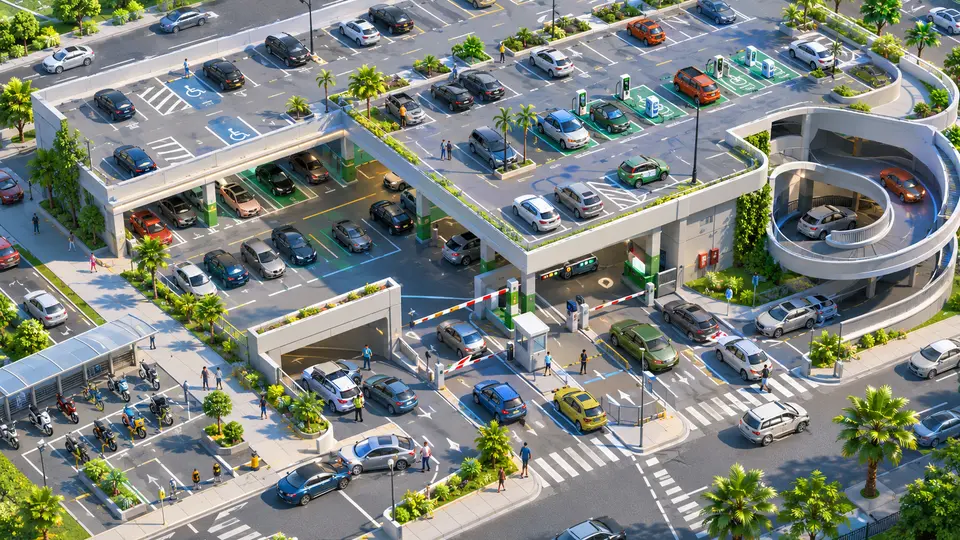
How many bays are free right now?
15 cases: 9 raise an alert when something happens and 6 only measure. You see each image as it is, and then with what IRIS understands on top.


And the best part
Nobody covers the night shift:the camera that is already on covers it.
It does not tire, it does not blink and it does not go for coffee. What happens at night is understood just as it would be at midday, and whoever is on duty hears about it while it is happening.
Tell us your problem and we will say whether IRIS understands it, or not yet.
We reply the same working day.