CAM-916
Snow or frost
The entrance to a site, in heavy snow. There is the stone building with its lit doorway, a lamp post, the beds and small firs buried in snow, a dark car coming down the drive with fresh tyre tracks and, top right, two parked cars already white. The whole frame is milky. And in the left third there is something more: frost on the glass itself, a granular, out-of-focus layer that is not landscape but ice stuck to the dome. IRIS tells the two apart: the snow that falls and moves, and the snow that has settled on the glass and does not move. What it does not know is when it will stop snowing.

Turn on IRIS Vision
AI-generated image
What IRIS is
IRIS watches the cameras for you.
IRIS Neural is an artificial intelligence that watches the cameras you already have and understands what happens in front of them. When something important happens —or something you told it you need to keep an eye on—, it alerts you; and whatever can be counted, it counts in numbers. All day long, without anyone having to watch a screen.
You tell it what you need to watch, and IRIS does it.
Here, for example, IRIS tells falling snow apart from frost that has settled on the glass and stopped moving. Once it sees the ice has been sitting there a while, it flags it with the camera, the time and the picture. With that alert you decide which domes actually need cleaning, instead of checking every single one.
Works with the cameras you already have. Nothing to replace.
A person replies, not a form.
- Your footage never leaves your premises.
- It doesn't identify people.
- Certifications →
What IRIS understands
What it recognises in this scene
- ice on the dome
The rule
You decide once. IRIS applies it always.
If
snow or ice left on the dome is covering part of the frame and is still there after the time maintenance has set
Then
- alert whoever is on call with the camera, the time and the video of how it got covered
- flag that camera as unreliable while it lasts, so it is not counted as fine on the list
- check it again by itself and clear the flag once the dome is clear
The instruction that set it up«Tell me if a camera is left with snow or ice on it and is still like that once the snow has stopped.»
What changes
What changes for whoever answers for the cameras working
Snow on the dome is the fault that turns up on precisely the day the camera matters most. It is the day of the blocked access, the car across the drive, the lorry that cannot get up the hill. It is also the day nobody is going to climb a ladder to check whether the dome is clear. What happens today is that the camera still shows as available on the list: there is signal, there is recording, there is a picture. Only the picture is a white wall. With IRIS the alert goes out when the ice stays, not when the storm peaks, and it goes out with the camera, the time and the picture. That is what decides which domes to go to, and it is almost never all of them.
What people usually ask
In winter, with the snow, will it not be a constant alert?
No, because snowing is not the fault. The fault is snow or ice left stuck to the dome once it has stopped. IRIS separates the two: what falls moves and changes in every frame; what sits on the glass stays still in the same spot. And the alert is set to fire only once that layer has been there for as long as you decide. A day of storm does not produce a hundred alerts: it produces the ones for the cameras that stayed covered.
Does it tell snow on the ground from snow on the glass?
Yes, and that is the difference that matters. Snow on the ground is in focus, follows the perspective of the scene and changes when a car drives over it. Snow on the glass is out of focus, stays on the same piece of the image and is unaffected by anything happening outside. A camera can be seeing a snowy landscape perfectly well, and that camera has no problem at all. The one with a problem is the one now looking at its own ice.
Is a heater all it takes to fix this?
In many cases yes, which is exactly why it is worth knowing which ones. Not every camera on a site ices up: the ones that do are the ones facing the wind, the ones without a sunshield and the ones facing north. If you know which get covered and how often each winter, you can fit heating or a shield on just those. IRIS repairs nothing. What it does is let the decision be made with data from your own site, instead of applying the same fix to all four hundred.
Simulation · how IRIS works
A camera looks. IRIS understands what it sees.
An extract of the real screen, no voice-over and hands-free. Each round poses another situation. What sits behind it is a good deal bigger than what you see.
- The alert fires
- It lands in the tray
- You open it
- You confirm or dismiss
See it somewhere else
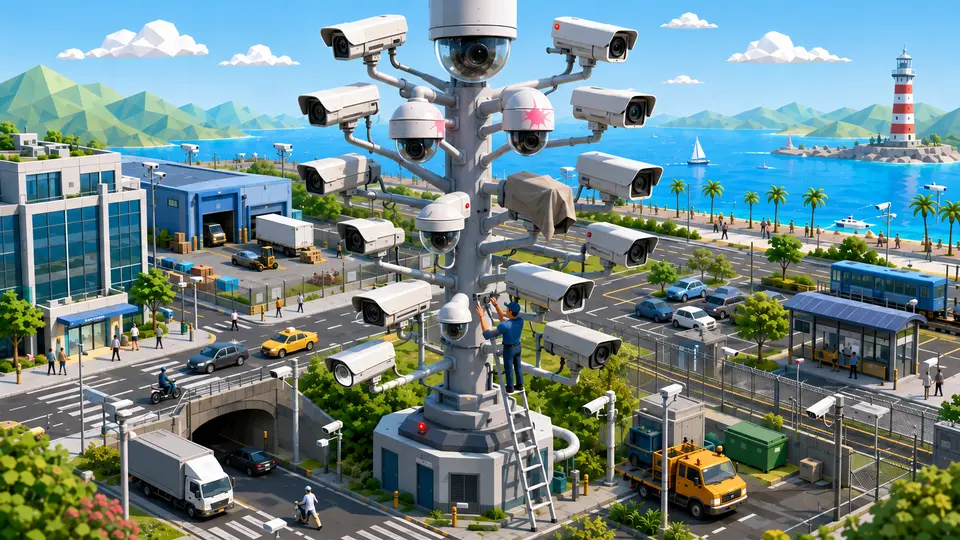
And who watches the cameras?
34 cases, and in every one of them IRIS raises an alert when something happens. You see each image as it is, and then with what it understands on top.

Who watches the cameras of a whole city?
23 cases: 18 raise an alert when something happens and 5 only measure. You see each image as it is, and then with what IRIS understands on top.


And the best part
Stop scrubbing through six hours.Ask what happened and watch only that.
You type what you are looking for in plain words — a white van, a door left open — and the moments it appears come back. What used to take an afternoon now takes minutes.
Tell us your problem and we will say whether IRIS understands it, or not yet.
We reply the same working day.