Solutions by typeLogistics efficiency
Who writes down the knocks the racking takes?
A knock nobody is going to report
It is 16:40 in aisle 12. A forklift has hit the racking on the right. The blue upright is bent inwards, two pallets have lost their load and there is burst cardboard across the floor. The driver is still sitting on the machine. Three colleagues in hi-vis have come over and are looking. In ten minutes the cardboard will be swept up, the forklift will be back at work, and the upright will still be bent, with two pallets on top of it, for the next six months.
1 cameras across 1 sectors
What IRIS is
IRIS watches the cameras for you.
IRIS Neural is an artificial intelligence that watches the cameras you already have and understands what happens in front of them. When something important happens —or something you told it you need to keep an eye on—, it alerts you; and whatever can be counted, it counts in numbers. All day long, without anyone having to watch a screen.
You tell it what you need to watch, and IRIS does it.
Works with the cameras you already have. Nothing to replace.
A person replies, not a form.
- Your footage never leaves your premises.
- It doesn't identify people.
- Certifications →
This is how you ask for it
«Alert me when a forklift hits the racking, and keep me the video of the impact.»
The knock almost never gets reported. Not out of bad faith: the driver carries on working, and saying so feels like buying yourself trouble. The danger is not the knock, it is the bent upright that holds twelve tonnes for six months and then one day does not. When a whole bay comes down, it comes down on an aisle people walk along, and the investigation ends on the same question every time: how long had it been like that, and who knew?
You decide once
You decide which aisles are watched, what counts as contact with the structure and who gets told: the warehouse manager, maintenance, or both. That is written once, with the warehouse in the room. IRIS then applies it in every aisle on every shift, without depending on whoever caused the knock feeling brave that day.
Every warehouse with high racking has a periodic structural inspection. It is done properly, with the standard on the table and a report at the end. The problem is what happens between one inspection and the next, which is many months and many knocks.
A bent upright makes no noise. It holds. It goes on carrying two pallets and twelve tonnes, and from below you barely notice, especially if the hit was at mid-height and got hidden by the load. The person who caused it often did not even feel it, and the person who saw it assumed somebody else would mention it. It is the quietest failure in a warehouse: nobody lied, it simply never got written down anywhere.
IRIS sees the contact between forklift and structure, marks the exact second and keeps the video from ten seconds before. The warehouse manager gets the alert with the aisle, the time and the image, and can do the one thing that matters: look. If it was a scrape, close it. If it was a real impact, unload the bay and request the inspection today, not in three months when nobody remembers the knock. That does not make the racking safer: it makes somebody decide in time whether it is.
What changes
Before, the warehouse manager heard about a knock if somebody told him, and since telling had a cost, plenty went untold. Now he gets the alert the same day, with the aisle, the time and the video, and decides on the spot whether to close the bay or not. And after a year there is a map of which aisles take the hits.
Where we have seen it
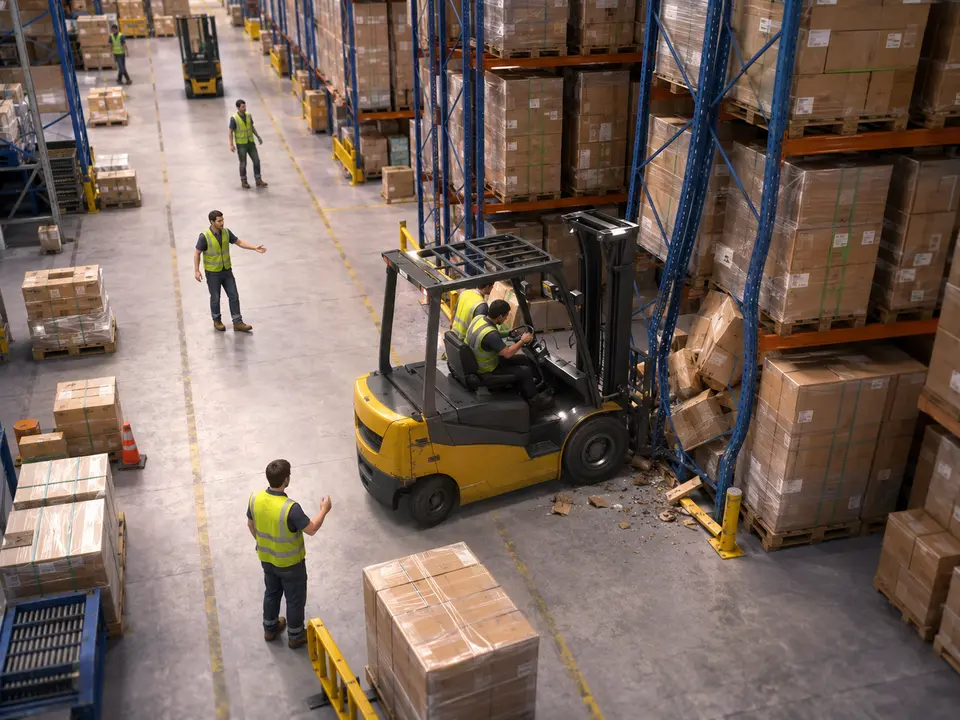
CAM-270A rack hit that nobody is going to report
«Tell me when a forklift hits a rack, and save me the video of the impact.»

What it does not do
IRIS does not say whether the racking is still safe. It sees the impact, marks the time and keeps the video; whether the structure holds or the bay has to be unloaded is decided by an inspection with the standard in hand. And it does not brake the machine or predict the impact: it detects what is already happening and puts it in front of a person.
Questions
- Does IRIS say whether the racking is still safe?
- No. IRIS sees the impact, marks the time and keeps the video: from that you know where it happened, which forklift was there and how hard it looks. Whether the structure holds or the bay must be unloaded is decided by an inspection with the standard in hand, as it should be. What the camera changes is that the inspection gets requested the same day and not three months later, when nobody remembers the knock and the load covers it.
- Does it know which forklift it was?
- Not by its number or its driver. IRIS does not read forklift plates and identifies nobody: it works with zones drawn on the image. What it delivers is the video of the moment, with the forklift inside the frame, the aisle and the exact minute. The warehouse matches that against its own shift log and knows who was there. The camera supplies the evidence; the name comes from the organisation, and that is how it should be.
- Can it stop the forklift before the impact?
- No. IRIS alerts, it does not drive or brake anything: it sends no command to the forklift and it does not predict the impact either. It detects what is already happening and puts it in front of a person right away. What happens next — close the aisle, unload the bay, call the maintenance contractor — is decided by the warehouse. That is the difference between a system that alerts and one that acts: here there is always a person in the middle, and that is deliberate.
- Is the video any use for the insurance report?
- Yes, and it is usually the part people are most grateful for. You keep the video from ten seconds before contact, the aisle, the exact time and what fell, without anyone having to reconstruct it from memory. The report gets filled in with facts instead of recollections, and the racking contractor arrives knowing what to look at. It does not replace the inspection’s technical report: it puts in front of it the image that report always lacks.
See it for yourself
This isn’t a video. It’s a slice of the real screen.
A summary of the real interface, played hands-free. You see one case from start to finish; what you do not see are the other screens, and there are many.
- Four cameras at once
- Each understands its own view
- The numbers climb by themselves
Not seeing yours here?
These words are the ones we have built, not the ones IRIS understands. The list falls short on purpose: you ask for it in a sentence, and sentences do not run out. Tell us what is in front of your cameras and we will tell you whether it understands it, or not yet.
And the best part
You do not need to buy cameras:you need yours to understand what they see.
Nothing gets built, mounted or rewired. It plugs into what is already up and running, and the only thing that changes is what those cameras understand.
Tell us your problem and we will say whether IRIS understands it, or not yet.
We reply the same working day.