Solutions by typePersonal safety
Who is looking at what is behind the machine?
Backing up, with someone behind
It’s 10:40 a.m. on the tipping floor. A loader fills its bucket, lifts the arm and starts to reverse in order to turn. Twenty-five feet behind it, a worker on foot is looking at his phone. The backing up alarm has been sounding across the whole yard all morning, so nobody hears it anymore. The driver is watching the right-hand mirror, which is where the problems have come from before.
3 cameras across 3 sectors
What IRIS is
IRIS watches the cameras for you.
IRIS Neural is an artificial intelligence that watches the cameras you already have and understands what happens in front of them. When something important happens —or something you told it you need to keep an eye on—, it alerts you; and whatever can be counted, it counts in numbers. All day long, without anyone having to watch a screen.
You tell it what you need to watch, and IRIS does it.
Works with the cameras you already have. Nothing to replace.
A person replies, not a form.
- Your footage never leaves your premises.
- It doesn't identify people.
- Certifications →
This is how you ask for it
«Tell me when a machine backs up and there is someone on foot in the same lane.»
A twenty-ton machine backing up doesn’t leave minor injuries. And what follows isn’t minor either: the machine impounded, the investigation, the site shut for days, the insurer, and a workforce that no longer wants to walk down that lane. On a quarry bench the version is different and just as expensive: a haul truck backing up past the marked edge takes the lip of the bench with it and goes down too.
You decide once
The organization decides once which lanes belong to machines and what happens next. If a machine backs up inside one of those lanes, and there’s a person on foot in the same stretch, then the supervisor is alerted immediately, the camera opens and the video is kept. On the quarry bench the decision is written with a line instead of with people.
Backing up is the maneuver that runs over the most people inside a site, and not because anyone in particular was careless. The machine is big, the blind spot behind it is enormous, and the driver watches the side where danger has come from lately. Behind them is a person on foot who trusts they’ll be seen, because they always have been.
The backing up alarm should solve this, and it does the exact opposite. It sounds across the whole yard, all day, every time any machine moves backward. Within a week the ear treats it like the noise of a fan: it’s there and it means nothing. When there really is someone behind, that beep is indistinguishable from the four hundred beeps before it.
IRIS watches the whole lane from above, which is the view nobody has. It sees the machine backing up, it sees the person on foot, and it speaks up before the machine is on top of them. On a quarry bench it doesn’t watch people, it watches a line: it alerts when the truck goes past the marked edge, before tipping. The alarm warns everyone, and that’s why it warns nobody. A warning that only sounds when someone really is behind means something again.
What changes
Before, the only defense was the beeper and the mirror, and everything else was learned when someone mentioned it in the cafeteria. Now the supervisor gets the alert with the camera open and sees where everyone was in that second. And there’s a count that didn’t exist: how often a backing up machine and a person on foot coincide, and in which lane.
Where we have seen it
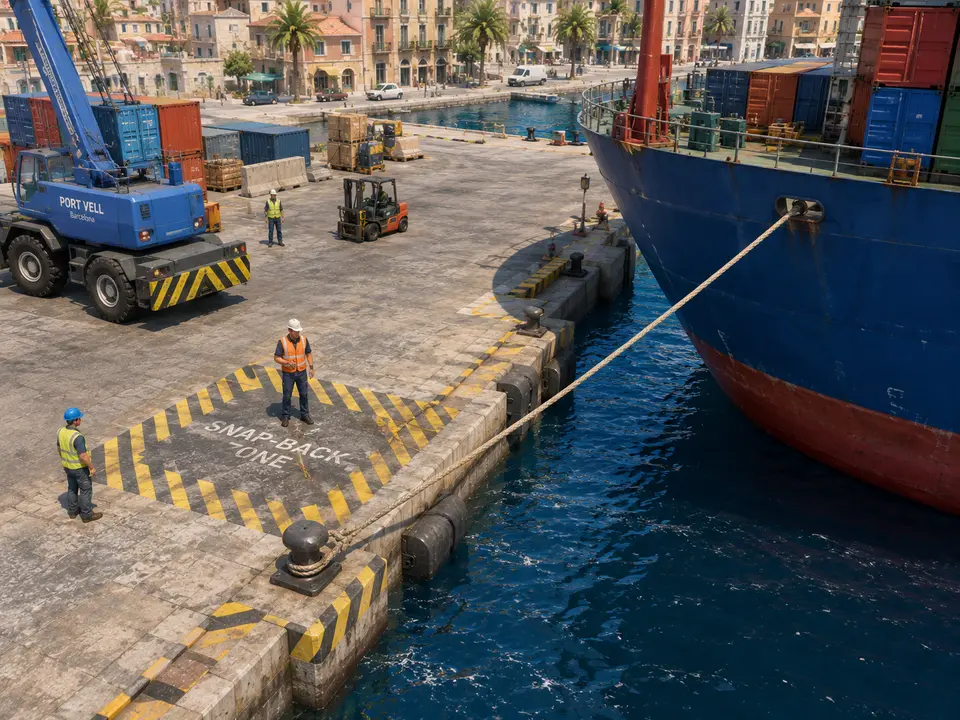
CAM-450Someone is standing inside the snap-back zone
«Tell me as soon as there is a person inside the painted snap-back zone while a mooring line is under load.»
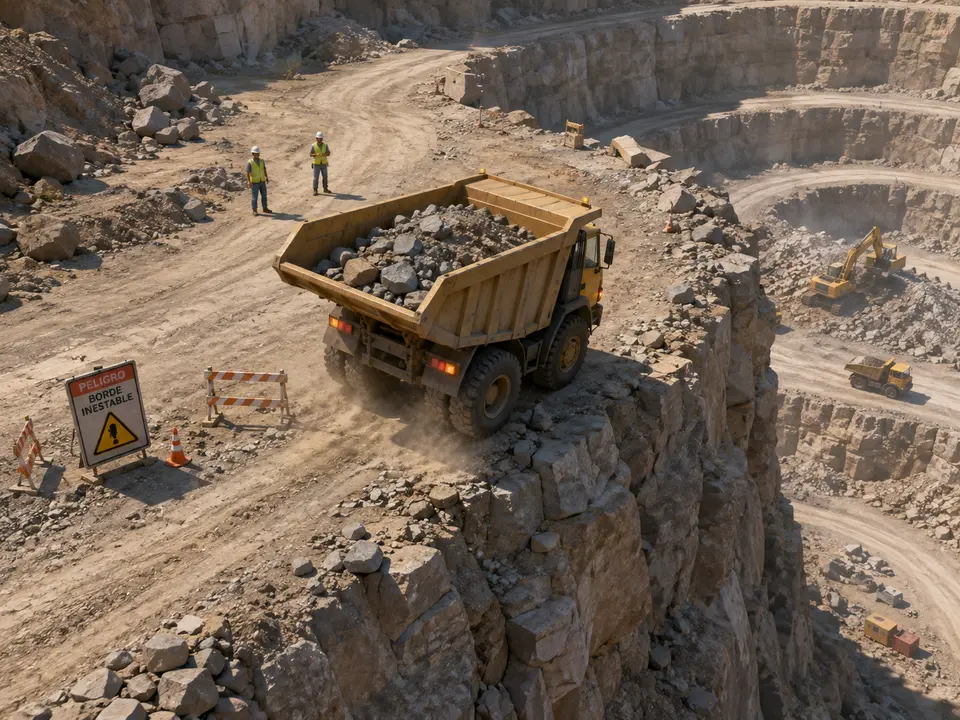
CAM-389A dump truck backing up to the very edge of the bench
«Tell me when a truck backs up past the edge markers, before it tips.»
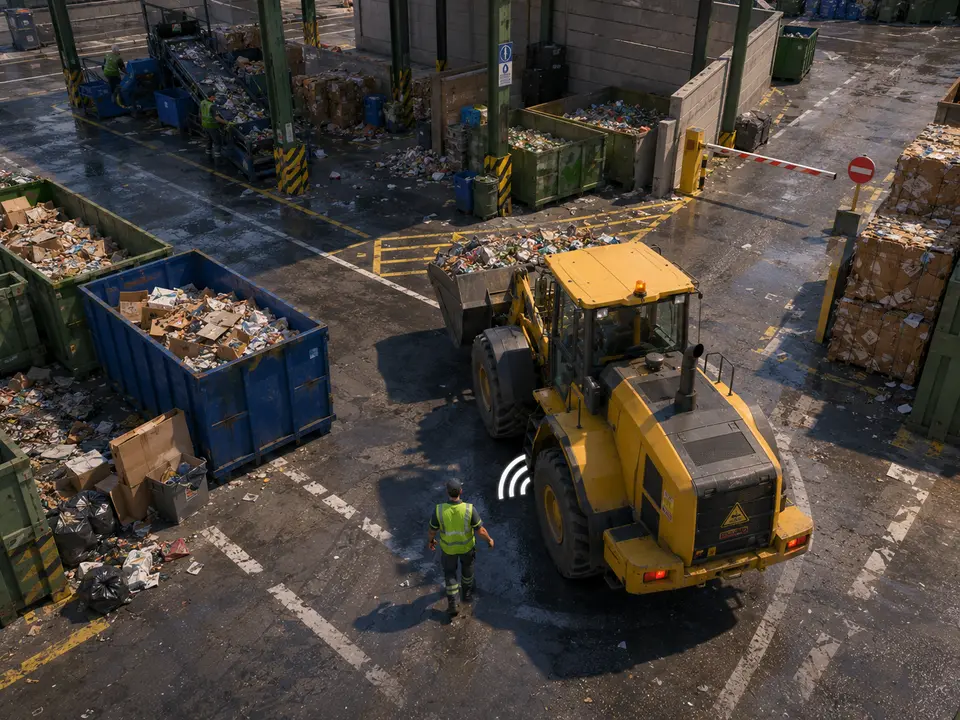
CAM-430A loader is backing up and someone is walking behind it
«Tell me when a machine backs up and there is someone on foot in the same lane.»


What it doesn’t do
IRIS is not connected to the machine and does not know which gear it is in. It sees the vehicle’s movement in the image, it sees the person on foot and it sees the zone you have marked.
And it shares the driver’s blind spot: if the load or the chassis hides the person in the image, IRIS does not see them either. That is why where the camera looks from matters so much.
Questions
- Do you have to connect IRIS to the machine?
- No. IRIS sees that the machine is backing up from the movement in the image, just as a person on a walkway would. Nothing has to be fitted to the vehicle and nothing has to be wired into its electronics, and that’s precisely what makes it usable across a fleet of different makes and ages. What the sentence asks for is the combination: a backing up machine and a person on foot in the same lane.
- Does it work on the edge of a quarry bench?
- Yes, though the rule takes a different shape there. Instead of watching people you watch a line: the marked edge. You ask IRIS to alert when a truck backs up past that line, before tipping. Because it’s a line on the ground, you set it up by drawing it on the image rather than describing it in words: a line can’t be described in a sentence, it has to be traced.
- Does it cover the snap-back zone of a mooring line on a quay?
- Yes, and it’s the same idea with different physics. When a line is under tension there is a painted strip where nobody should be, because if the line parts it sweeps that whole strip. You ask IRIS to alert as soon as a person is standing inside that zone while the mooring is working. Nobody stands there on purpose: they stand there because it’s the short way to the gangway, which is why the alert has to land in that instant.
- Does it replace the machine’s own backing up sensors?
- No. On-board sensors warn the driver and are still needed, because they’re in the cab and act in the moment. IRIS does something else: it watches the whole lane from above, sees what the driver can’t see and alerts whoever coordinates the yard, not only whoever is driving. It also leaves behind a count of how often this happens, which is what gets the lane laid out differently next month.
Every simulation
Something has spilled
Tell me if there is liquid or foam outside its place and it is still there two minutes later.
- The sentence
- Where it applies
- What it finds
- The same rule
Not seeing yours here?
These words are the ones we have built, not the ones IRIS understands. The list falls short on purpose: you ask for it in a sentence, and sentences don’t run out. Tell us what is in front of your cameras and we’ll tell you whether it understands it, or not yet.
And the best part
The disk fills up on its own.The questions stay unanswered.
Storing images is easy, and it isn’t cheap. What was missing was someone to look at them. IRIS looks at everything you record and shows you only what is worth a glance.
Tell us your problem and we’ll say whether IRIS understands it, or not yet.
A person answers, the same working day.