Solutions by typeMobility analysis
How many people come in through each door, and when?
You know how many came in. Not where.
Saturday, ten past six in the evening. The mall plaza has two doors. Through the big glass one, a stream that never breaks. Through the small one on the left, almost nobody: two people in ten minutes. Inside, the units facing that door have been empty all afternoon. At closing time the center will have one figure: how many came in. One figure, for the whole building.
8 cameras across 7 sectors
What IRIS is
IRIS watches the cameras for you.
IRIS Neural is an artificial intelligence that watches the cameras you already have and understands what happens in front of them. When something important happens —or something you told it you need to keep an eye on—, it alerts you; and whatever can be counted, it counts in numbers. All day long, without anyone having to watch a screen.
You tell it what you need to watch, and IRIS does it.
Works with the cameras you already have. Nothing to replace.
A person replies, not a form.
- Your footage never leaves your premises.
- It doesn't identify people.
- Certifications →
This is how you ask for it
«Tell me how many people come in through each door and when, and alert me if one stops counting while the center is open.»
That figure doesn’t help much. A total at closing time can’t tell you whether the small door is dead all day or only on Saturdays, or whether the left-hand mall fills up when the bus arrives. And those two things drive decisions that cost money: where the promotion goes, how many staff each shift needs, what rent a unit can carry and which one is being overpaid.
You decide once
You decide this once. You say where the counting line goes on each door, which way counts as in, what the opening hours are and how long without a count should trigger an alert. IRIS draws the number every day, on every door and every shift, with nobody having to remember to look. If a new door opens, you add its line and everything else stays as it was.
Counting isn’t something you ask IRIS for in a sentence. A line can’t be described in words: it has to be drawn. So this camera isn’t set up by saying what to look for, but by drawing where people walk. You trace a line across each doorway, you say which way counts as coming in, and from then on the number is always the same number: repeatable, comparable from one Saturday to the next, and auditable if anyone questions it.
That changes the conversation. Saturday stops being “it was busy” and becomes two curves: the big door climbing from eleven, the small one flat all afternoon. Whoever negotiates a unit’s rent no longer argues from impressions, they show the foot traffic past that door hour by hour. And the floor manager finds out that the peak hour isn’t the one they assumed, and moves staff where they’re actually needed.
The alert comes after, and it’s simple. If a door stops counting people while the center is open, it almost never means nobody’s coming: it means the door is shut, or the elevator beside it has stopped, or building work is blocking the way. That used to show up in a report on Monday. Now it shows up while it’s happening, when the door can still be opened.
What changes
Before, someone stood with a hand clicker two days a year and the rest was an estimate. Or you looked at average spend and assumed the rest. Now foot traffic through every door is counted every day and every hour, with nobody counting anything. Whoever builds the Saturday schedule looks at last week’s curve instead of remembering how it went.
Where we have seen it

CAM-590Two thousand four hundred pass, two hundred and sixty stop
«Tell me if foot traffic past the unit rises for two hours running and the number of people stopping does not rise with it.»

CAM-144Someone climbs the gate onto the dam crest
«Tell me the moment anyone climbs over the fence onto the crest, at any hour, and tell me which camera and where they got in.»

CAM-535How many people come in through each door, and when
«Tell me if one of the two doors stops adding people while the center is open.»

CAM-387A truck coming head-on down the wrong lane
«Tell me the moment a truck enters the haul road the wrong way, and show me where it came in.»

CAM-110A drone over the wall
«Tell me if something appears flying over the wall or the yard, and tell me where it came in and which way it is heading.»

CAM-69On-ramps in and out
«Tell me if a vehicle stops inside the hatched area or if someone enters by the exit the wrong way.»
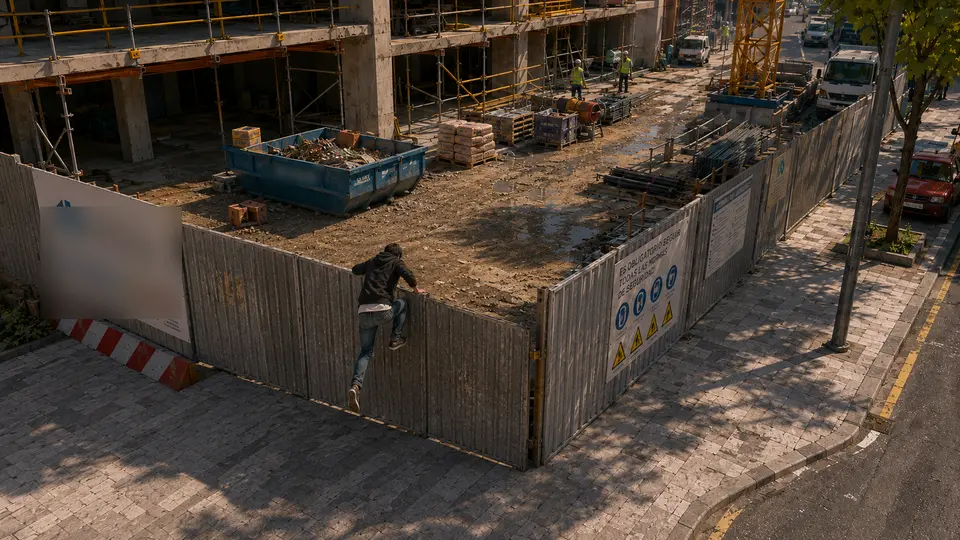
CAM-57Someone climbing the site fence
«Tell me if someone climbs the fence or gets in where nobody is meant to, whatever time it is, and show me the camera so I know where they came through.»

CAM-540How many get out of the car and which door they end up using
«Tell me how many people come in through the main door for each car that arrives at the parking lot.»


What it doesn’t do
This counts people, not customers. IRIS does not know who comes in, does not recognize faces and cannot tell that the same person came in twice: that is two crossings. It does not know whether the person crossing the line came to store or to cut through to the parking lot, and it will not know. The number says how many went past. What that foot traffic is worth is a business call, not a camera’s.
Questions
- Does this identify the people coming in?
- No. IRIS does not recognize faces, keeps no record of anyone and does not know whether the person crossing the line has been there before. What it does is add one when someone crosses in the entry direction and subtract one when they cross the other way. All that comes out is a number per hour and per door. If the same person goes in and out three times, the counter sees three crossings, not one repeated person: you need to know that when reading the figure, which is why we say it before you ask.
- Why draw a line instead of just asking for it in a sentence?
- Because a line can’t be described in words. Asking is for finding; counting is for measuring, and they aren’t done the same way. If you say “count the people coming in the main entrance,” nobody knows where the main entrance begins or at exactly what point someone counts as having entered. Drawing the line on the image fixes it for good, and that’s why the number can be repeated tomorrow, compared with last Saturday and defended in front of whoever audits it.
- Is the figure any use for negotiating a unit’s rent?
- Yes, and it’s one of the most requested uses. Foot traffic past a door, counted hour by hour and day by day, is the figure you argue value with. It stops being the landlord’s opinion against the tenant’s. The same line shows whether foot traffic rises during a campaign and whether the people who stop rise with it, which doesn’t always happen: there are malls where plenty walk past and nobody stops. That contrast is what decides it.
- What if we open a new door or move an entrance?
- You draw another line and it’s counting. No turnstiles, no floor mats, no sensors in the frame: the count comes from the camera already looking at that spot. If a door closes for building work, its curve goes to zero, and that’s the signal that something’s up, not a fault. And if the entrance moves ten feet, you move the line. What you can’t do is move it every week and then compare months: the line moves rarely, because its whole value is that it doesn’t move.
Demo · IRIS at work
We won’t just tell you. We’ll show you.
It’s a summary of the real screen: it plays by itself, step by step, and shows only the path of one case. The actual tool has far more than fits in here.
- The alert fires
- It lands in the tray
- You open it
- You confirm or dismiss
Not seeing yours here?
These words are the ones we have built, not the ones IRIS understands. The list falls short on purpose: you ask for it in a sentence, and sentences don’t run out. Tell us what is in front of your cameras and we’ll tell you whether it understands it, or not yet.
And the best part
By the eighth hour of a shiftnobody watches the way they did in the first. That isn’t a flaw.
It’s being human. A camera has no eighth hour: at four in the morning it understands what it understood at noon, and it speaks up just the same.
Tell us your problem and we’ll say whether IRIS understands it, or not yet.
A person answers, the same working day.