Solutions by typeMobility analysis
What if there’s nothing to read where the plate should be?
Three days parked and nothing to read on it
It’s 11:20 a.m. in a narrow street in the old town. A car has been parked against the curb for three days, rear facing the camera. In the recess of the bumper, where the plate goes, there’s nothing: no dirty plate, no bent plate, no screws with a plate behind them. Neighbors have stopped folding their mirrors to squeeze past. Nobody has called, because everyone assumes the car belongs to somebody else.
2 cameras across 2 sectors
What IRIS is
IRIS watches the cameras for you.
IRIS Neural is an artificial intelligence that watches the cameras you already have and understands what happens in front of them. When something important happens —or something you told it you need to keep an eye on—, it alerts you; and whatever can be counted, it counts in numbers. All day long, without anyone having to watch a screen.
You tell it what you need to watch, and IRIS does it.
Works with the cameras you already have. Nothing to replace.
A person replies, not a form.
- Your footage never leaves your premises.
- It doesn't identify people.
- Certifications →
This is how you ask for it
«Alert me when a vehicle has been parked on the street for more than a day and there is no readable plate where the plate should be. I do not want to know what it says: I want to know there is nothing to read.»
A vehicle whose plate can’t be read is a vehicle that, for the authorities, doesn’t exist: it can’t be notified, billed or removed without a file that starts precisely by identifying it. And at a quarry the same hole is measured in tons: a truck that leaves loaded without crossing the truck scale takes away material that appears on no paperwork.
You decide once
You decide it once, and what you decide is the threshold. You say which streets are watched, how long parked is already odd there, who gets the alert and what comes with it: the picture of where the plate should be and how long that car hasn’t moved. At the quarry the rule is different and you set it the same way: if a truck leaves loaded without crossing the truck scale, alert the site manager and keep the plate image. IRIS applies it on every camera on that list, every day.
Almost every plate reader in the world is built to read what the plate says. There are places where the useful question is the opposite: is there anything to read? A plate caked in mud, a plate removed, a plate hidden behind a bike rack or a towball.
And it works in two places with nothing in common. In an old-town street, an abandoned car takes months to become a case file, because nobody keeps count of the days. A camera already looking at that street can keep it: this car hasn’t moved for three days and has no readable plate. At a quarry checkpoint the scene is different: a line on the truck scale lane, the barrier down, and a loaded truck leaving by the right-hand lane without weighing. There what you need is a record and the plate image kept, whether it can be read or not.
A car with no readable plate isn’t a car with something to hide: most of the time it is mud, a plate bent in a parking knock, or a badly fitted bike rack. So IRIS accuses nobody. What it does is put a check the day’s list, with the photo and how long it’s been there, so someone can go, look and decide. The difference between a street with abandoned cars and a street without them isn’t a technology: it’s that somebody keeps count.
What changes
Before, an abandoned car was noticed because a neighbor got fed up and called, almost always weeks later. Now it turns up by itself on the morning list, with the photo and the number of days it’s been there, and whoever handles the case starts with the date in hand. At the quarry the same happens with something else: the truck that didn’t weigh stops being discovered at month-end and is known the same day, with its image kept.
Where we have seen it

CAM-15Vehicle with no readable plate
«Tell me when a vehicle has been standing in the street for more than a day and there is no readable plate where the plate should be. I don’t want to know what it says: I want to know it isn’t there.»
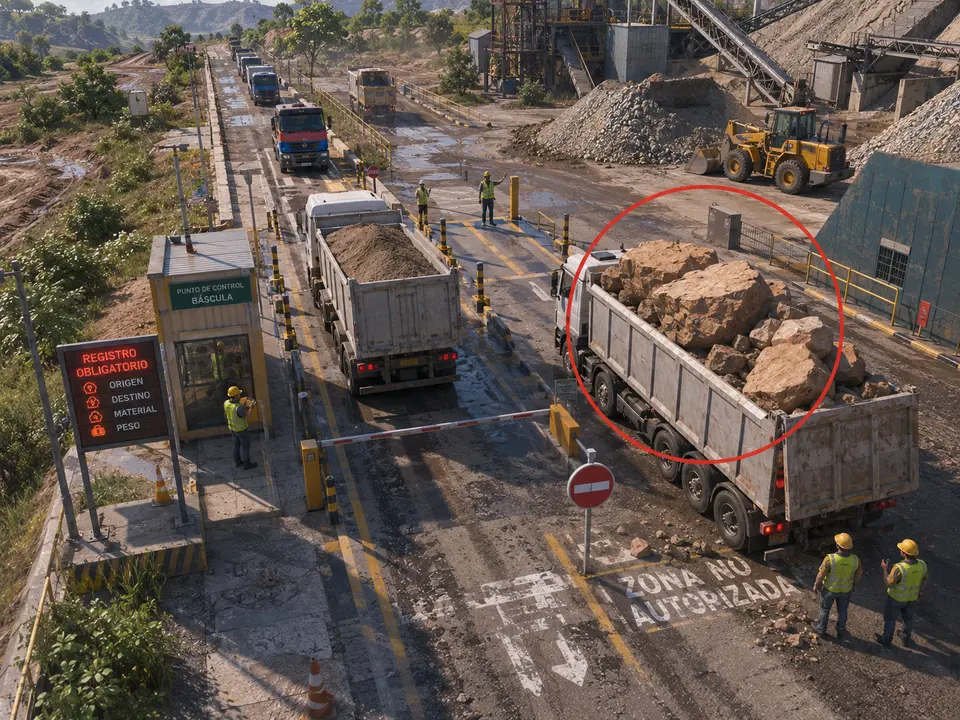
CAM-386A loaded truck slipping past the truck scale
«Tell me when a loaded truck leaves the quarry without crossing the truck scale, and keep the plate for me.»


What it doesn’t do
IRIS does not say whether a plate is false, whether the vehicle has been reported, and it queries no official database. Nor does it know who owns the car.
And it gets it wrong in both directions: at night, against the light or in rain, a perfectly readable plate can look unreadable. That is why the alert is a check with a photo, not an accusation.
Questions
- Does it store the plates of every car?
- No, unless you ask for it. This rule doesn’t need to read any plate: it looks at where the plate should be and checks whether there’s anything readable. What’s stored is the alert, with the image of the vehicle and how long it’s been parked. When you do want plates read — at a quarry exit, for instance — that’s turned on where you say, and how long they are kept and who may see them is decided by your organization under its own rules. IRIS carries out that decision; it doesn’t make it.
- What if the plate is just dirty and nothing’s going on?
- Well, most of the time that is exactly what it is, and that’s fine. Mud after roadworks, a plate bent in a parking knock, a bike rack over it. IRIS doesn’t say anyone is suspected of anything: it says there is no readable plate there and shows the photo. A person does the checking, in two seconds and often without leaving the desk. The value isn’t in catching anyone: it’s that a vehicle nobody can identify stops going unnoticed for months.
- Does it work at night?
- Yes, but with more false alerts, and it’s worth knowing beforehand. In low light, in rain or with a headlight facing the camera, a plate that reads perfectly by day can be unreadable in the image. That’s why the rule is usually written with time in it: don’t alert on a car that has just parked, alert on the one that hasn’t moved for a day or three and has never shown a readable plate across several hours of daylight. That way the alert arrives when there really is something to look at.
- Does it cover the truck that skips the truck scale?
- Yes, and there the rule isn’t about plates, it’s about sequence. IRIS watches the truck scale area and the exit area and checks the order: if a loaded truck crosses the exit without having been on the truck scale, that’s what it alerts on, with the time and the image. The plate is kept if it’s clearly visible and if you asked for it, so the alert is still useful the next day. If it isn’t visible, the alert still holds: what matters is that it left loaded without weighing, and that’s visible either way.
Every simulation
Something has spilled
Tell me if there is liquid or foam outside its place and it is still there two minutes later.
- The sentence
- Where it applies
- What it finds
- The same rule
Not seeing yours here?
These words are the ones we have built, not the ones IRIS understands. The list falls short on purpose: you ask for it in a sentence, and sentences don’t run out. Tell us what is in front of your cameras and we’ll tell you whether it understands it, or not yet.
And the best part
Nobody covers the night shift:the camera that is already on covers it.
It doesn’t tire, it doesn’t blink and it doesn’t go for coffee. What happens at night is understood just as it would be at midday, and whoever is on duty hears about it while it’s happening.
Tell us your problem and we’ll say whether IRIS understands it, or not yet.
A person answers, the same working day.