Solutions by typePersonal safety
Is the cell stopped, or just standing still?
Into the cell with the robot still live
It’s 11:15 a.m. The welding cell hasn’t moved for three minutes because a part is missing. An operator elevators the latch, steps through the fence door and goes in to look at the jig. The three robots are still, but they aren’t stopped: they’re powered and waiting for the signal to move again. If the part arrives while he is inside, the arm starts where it always starts.
3 cameras across 2 sectors
What IRIS is
IRIS watches the cameras for you.
IRIS Neural is an artificial intelligence that watches the cameras you already have and understands what happens in front of them. When something important happens —or something you told it you need to keep an eye on—, it alerts you; and whatever can be counted, it counts in numbers. All day long, without anyone having to watch a screen.
You tell it what you need to watch, and IRIS does it.
Works with the cameras you already have. Nothing to replace.
A person replies, not a form.
- Your footage never leaves your premises.
- It doesn't identify people.
- Certifications →
This is how you ask for it
«Tell me the moment someone goes through the cell door while the cell is not stopped.»
A welding arm doesn’t brake because someone is in front of it: it performs the movement it was programmed to do, at the speed it was programmed to do it. A hit like that isn’t a bruise. Then comes the rest: the cell sealed off, the investigation, weeks with that station down while everything’s reviewed, and a whole line running at half capacity. All for a fault that was going to take ten seconds to clear.
You decide once
The decision is made once, and it holds for every identical cell. If a person crosses the fence door, at any moment, and the cell is still signaling that it’s available to move, then the line manager is alerted with the camera open and the video is kept from before. There’s no wait time here: inside a live cell, one second is already too much.
A still robot and a stopped robot aren’t the same thing, and that difference is what takes hands off. Still means waiting; stopped means it has no power and can’t move even if the signal arrives. From the fence door the two look exactly alike: a quiet cell. And the person who goes in is almost always the one who knows that cell best, precisely because they trust it and because it’ll only take ten seconds.
The day it goes wrong there is no warning. The part arrives, the controller gets the signal and the arm runs its path. There’s no noise beforehand, no light that changes in time, and nothing that reacts to the body inside. A robot doesn’t improvise: it repeats. That’s why cells are fenced, and why the problem is never the fence but the stretch of time the door is open.
IRIS watches that door and watches inside the cell. It sees the body crossing while the cell is still signaling that it’s live, and it says so at that moment. And the same camera does the boring job too: flagging that the cell has gone five minutes without producing a part because the bin is empty. One prevents an injury, the other prevents an hour of stopped line. The second is what shows up in the accounts; the first is what nobody forgets.
What changes
Before, an entry like that was known only if someone happened to walk the gantry at that moment, and otherwise never. Now the line manager gets the camera open at the exact minute, with the person still inside the fence. And at month end they see something new: people go into that cell twelve times a day, always for the same jam.
Where we have seen it
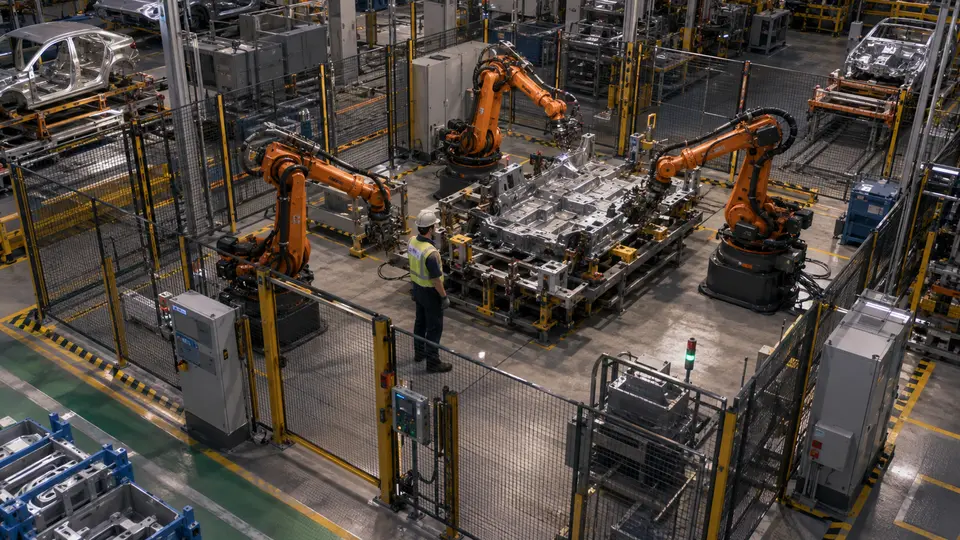
CAM-233A person inside the fence with three robots live
«Tell me if somebody enters the welding cell while it is still available to move.»
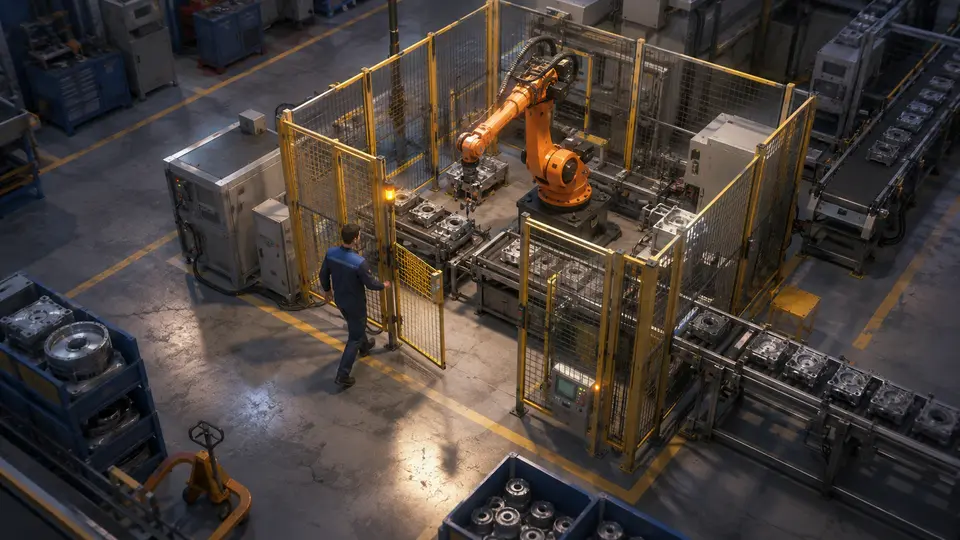
CAM-253Someone walks into the cell with the robot still running
«Alert me the moment someone crosses the robot cell gate while the cell is not stopped.»
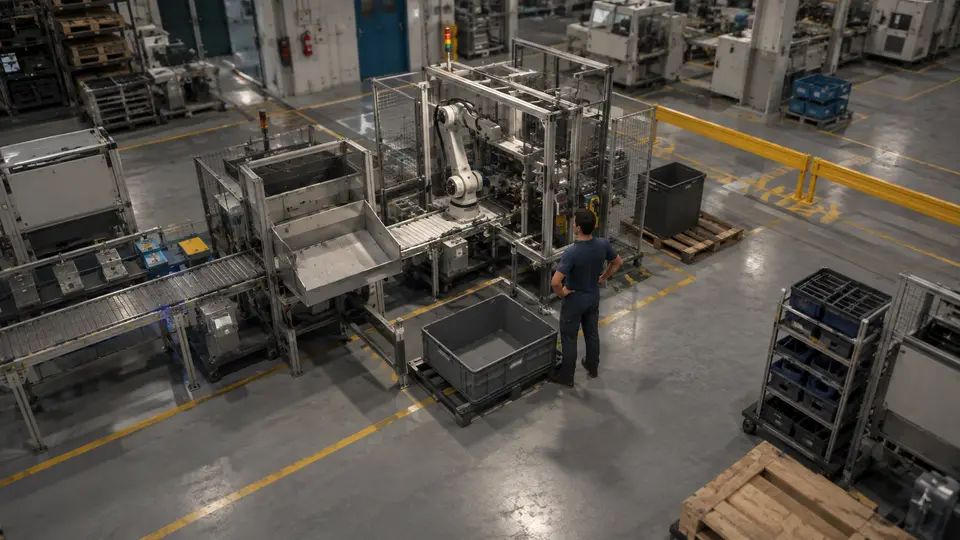
CAM-243The cell is ready and the bin is empty
«Tell me if the bin at the cell runs empty and the robot goes more than five minutes without putting out a part.»


What it doesn’t do
IRIS is not wired into the machine safety system and does not know whether the interlock is engaged or whether the cell is genuinely energized. It sees a person crossing the door and a cell still signaling that it is live.
And it stops nothing. Stopping a cell is commanded by a system built for that, with light curtains and emergency stops. IRIS is the alert, not the brake.
Questions
- Can IRIS stop the cell?
- No, and it shouldn’t. Stopping a cell is the job of machine safety: interlocks, light curtains and emergency stops, which are built and certified for exactly that. IRIS alerts, and the alert reaches whoever is running the line with the camera open and video from a few seconds earlier. What it achieves is that somebody finds out now, not at Monday’s meeting.
- Does IRIS know whether the cell is genuinely stopped?
- No, not with certainty, and that’s why the sentence is written carefully. IRIS works with what is visible from outside: the beacons, the door indicators, the recent movement of the arms and the state shown on the panel. With that it separates a cell that is waiting from a cell that is locked out. If that installation has no visible signal at all, the honest thing is to say so before setting the rule, not after.
- Can the same camera show when the cell has run out of parts?
- Yes, and it’s one of the most profitable scenes in a plant. You ask for it in a separate sentence: flag when the cell’s bin runs empty and the robot has gone a few minutes without producing a part. One rule is safety and the other is production, but they come from the same image and the same camera. In practice, the production one is what makes sure nobody ever switches the system off.
- Do you need to change anything in the robot or the controller?
- No. IRIS works from the image of the camera already looking at that cell, so there’s nothing to touch on the robot, the controller or the station program. This matters more than it sounds: in a plant with cells from three makers and four different ages, anything that requires integrating machine by machine simply never gets done. Here the rule is written once and covers every cell that has a camera.
See it for yourself
No extra alarms here. Just what needs looking at.
Not a recorded video, not an explanatory drawing: a summary of the real screen, with a different case every time it starts. There’s a lot more behind it.
- You draw the line
- It counts by itself
- A number comes out
Not seeing yours here?
These words are the ones we have built, not the ones IRIS understands. The list falls short on purpose: you ask for it in a sentence, and sentences don’t run out. Tell us what is in front of your cameras and we’ll tell you whether it understands it, or not yet.
And the best part
No building work, no trenches, no new cabling:the cameras are already up and already looking.
What changes is what happens to the picture. It used to be stored and never seen; now it’s understood while it happens, on the same equipment you bought years ago.
Tell us your problem and we’ll say whether IRIS understands it, or not yet.
A person answers, the same working day.