Solutions by typeLogistics efficiency
Where did that load end up, and who saw it?
Where it goes matters as much as what it is
It’s 6:20 a.m. at the entrance to the sewage plant. A tanker has come through the gate and reversed up to an open manhole. A corrugated hose runs down from the tank and straight into the opening. The engine is running. There’s nobody in the site office: the shift starts at seven. Nobody has signed a docket, nobody has taken a sample and nobody knows what is going into the network.
4 cameras across 3 sectors
What IRIS is
IRIS watches the cameras for you.
IRIS Neural is an artificial intelligence that watches the cameras you already have and understands what happens in front of them. When something important happens —or something you told it you need to keep an eye on—, it alerts you; and whatever can be counted, it counts in numbers. All day long, without anyone having to watch a screen.
You tell it what you need to watch, and IRIS does it.
Works with the cameras you already have. Nothing to replace.
A person replies, not a form.
- Your footage never leaves your premises.
- It doesn't identify people.
- Certifications →
This is how you ask for it
«Tell me if a tanker discharges into the manhole outside opening hours or with nobody from the plant beside it.»
What goes into that opening can’t be taken back. If it’s a sludge that should never have gone there, the plant finds out hours later, when the biological process destabilizes and reagent has to be dosed, or when a parameter spikes at the outlet and the discharge falls outside its limit. Then the expensive part starts: the notice to the river authority, the explanation of why nobody was on site at six in the morning, and an investigation that only gets as far as a plate number if somebody recorded it. The same goes for a dump truck emptying its body in the middle of the yard instead of in the box: loose waste ends up in the drain, and the drain ends up in the river.
You decide once
You decide this once. You say where each authorized discharge point is, when it may be used, whether somebody from the plant has to be present and who’s told: if a tanker connects at the manhole outside hours or with nobody beside it, alert the operations manager with the camera, the time and the plate, and keep the full video of the maneuver. IRIS applies it seven days a week, in August too, and at six in the morning too.
Almost everything that gets unloaded gets unloaded properly. The problem is the exceptions, and the exceptions always have the same shape: the load was right, the truck was right, and the place wasn’t. A dump truck that raises its body in the middle of the yard because the box at the far end is a hundred and thirty feet away and it’s six forty-five. A tanker that connects the hose outside the yellow mark because the pipe is easier to reach from there. A car left unloading suitcases under the hotel canopy while a line of four builds up behind it. None of the three thinks they are doing anything serious, and in a way they are right: what’s serious isn’t the act, it’s where it ends up.
Because the place is what turns a nuisance into a case file. At a hotel, unloading in the wrong spot costs a blocked entrance and a guest who walks in annoyed. At a waste plant, it costs material ending up in the drain instead of on the concrete of the box. At a sludge plant, it costs a thickening tank overflowing while the tanker keeps pumping, and then what’s on the ground is no longer carelessness: it’s a spill, with a report behind it and an authority asking questions. The same maneuver, ten feet further over, is a different thing. And one detail makes it all worse: this happens when nobody’s there. First thing in the morning, at shift change, on a Sunday afternoon. It isn’t a discipline problem, it’s a coverage problem: the will is there, what’s missing is a pair of eyes at twenty past six.
IRIS watches the discharge point and compares what it sees with what you decided. It sees whether the body is raised outside the box, whether the hose is connected outside the mark, whether an unloading starts with nobody from the plant beside it, whether sludge appears outside the tank while the truck keeps pumping. When any of that happens it says so at once, with the camera, the time, the plate and the full video of the maneuver stored. It judges nobody and closes nothing: what it does is let somebody call while the truck is still there, and make sure that the next day, when it has to be explained, the video exists instead of a reconstruction built from memory.
What changes
Before, this was discovered from the result: an odd parameter at the outlet, a heap of waste where it shouldn’t be, a complaint from a neighbor. Now it’s discovered from the maneuver: the moment the hose connects off-spot or the body is raised outside the box, the manager has the camera, the time and the plate on his phone and can call while the truck is still there. And when it has to be explained to an authority, the full video exists instead of a reconstruction.
Where we have seen it

CAM-506One car unloading at the door and the line growing behind it
«Tell me when there are more than four cars waiting at the door, or when one has been parked in the drop-off spot for more than ten minutes.»
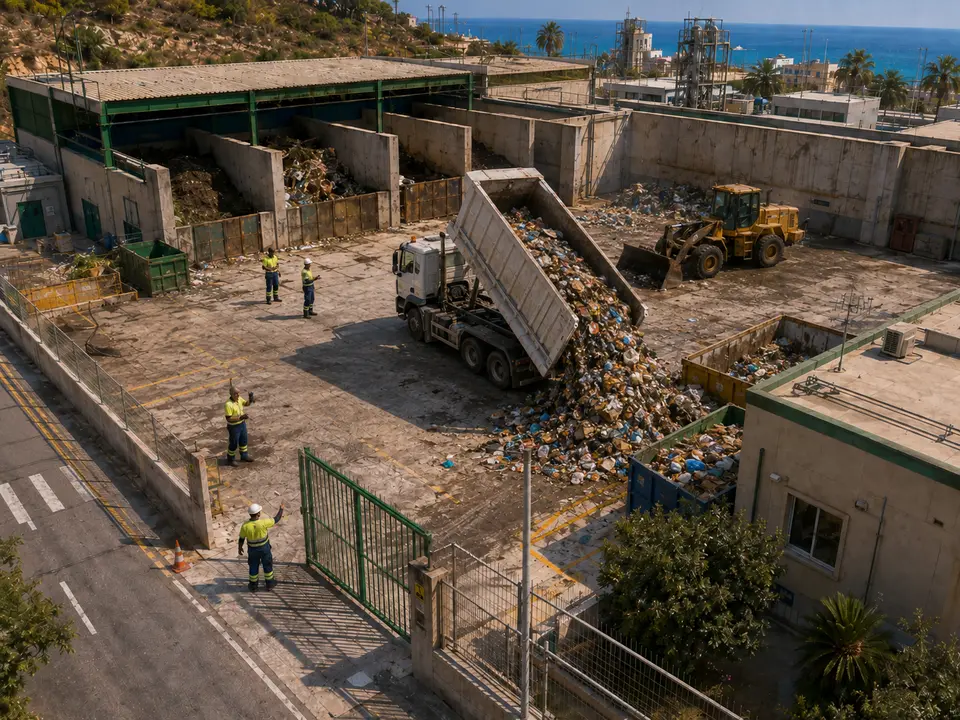
CAM-181Tipping outside the bay
«Tell me when a truck tips its load outside the tipping bays.»
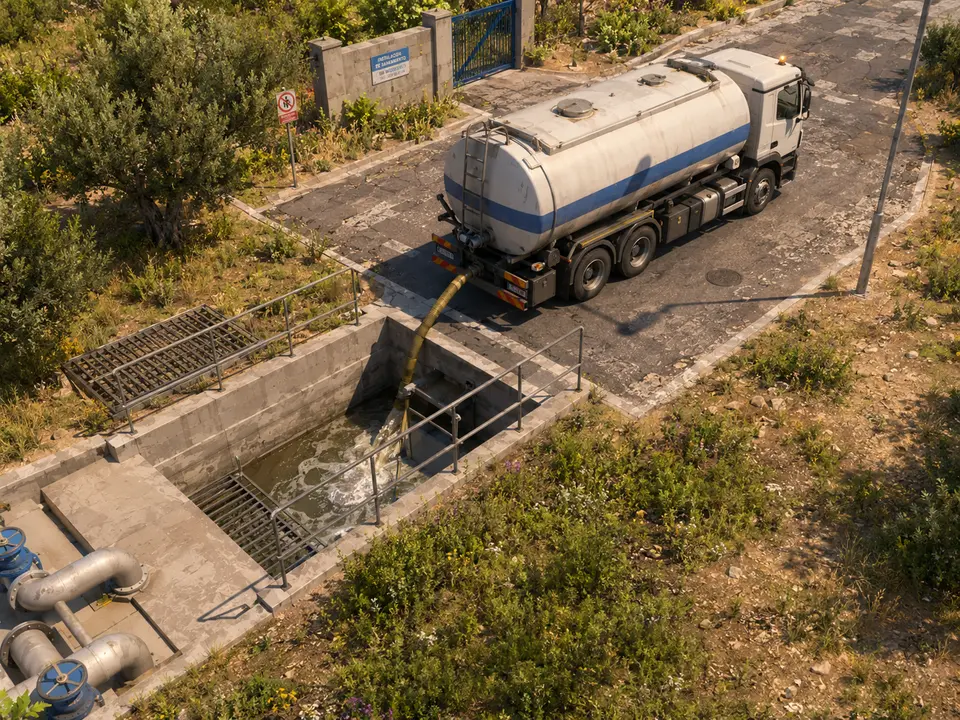
CAM-417A tanker is emptying into the chamber and nobody’s there
«Tell me if a tanker unloads into the chamber outside opening hours or with nobody from the plant next to it.»
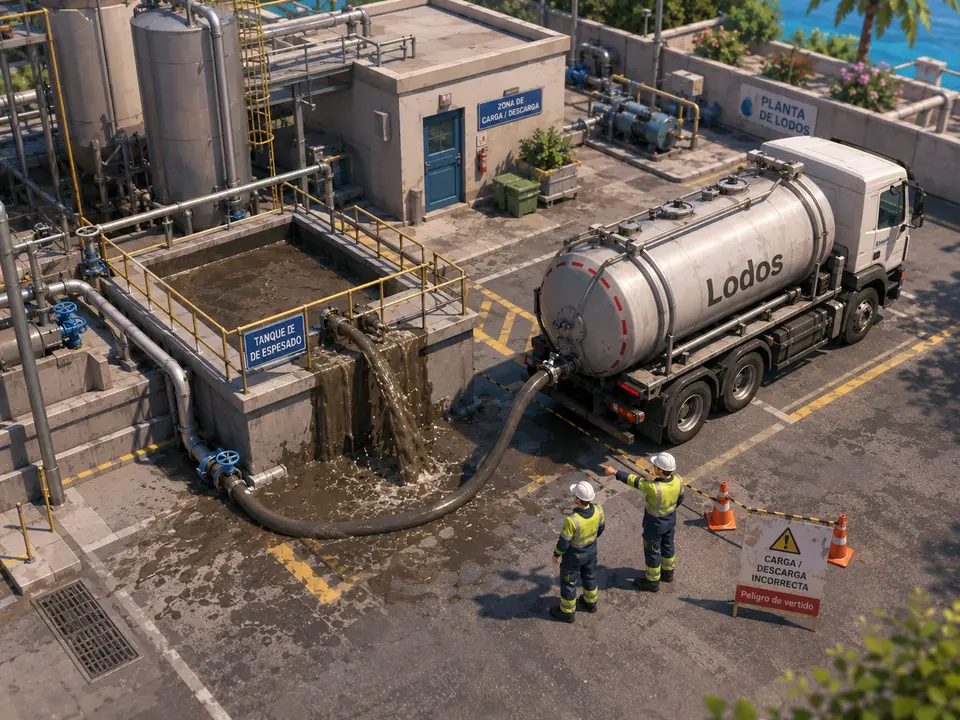
CAM-418The thickener is overflowing and the tanker keeps unloading
«Tell me if sludge appears outside the tank during an unload, or if the truck hooks up outside the marked point.»


What it doesn’t do
IRIS does not analyze what is being unloaded. It does not know whether that sludge was allowed into that manhole, or whether the waste matched the docket: that is what a sample and a piece of paper are for, not a camera.
And it closes no valve and prevents no maneuver. It alerts while it is happening and stores the video with the plate. Stopping the pump, calling the haulier or opening a case are decisions made by people, and that is how it must stay.
Questions
- Is it any use if the plant is empty at that hour?
- Yes, and that’s exactly when it’s worth most. Unloading in the wrong place almost never happens mid-morning with the plant full of people: it happens at twenty past six, at shift change or on a Sunday. IRIS doesn’t depend on somebody being awake in front of a monitor: it watches the discharge point at that hour just as it does at midday and sends the alert to the on-call phone, with the camera open and the plate. And if nobody answers, the video is stored anyway.
- How does IRIS know where unloading is allowed?
- Because you marked it on the image, once. The concrete box, the yellow line on the ground, the authorized opening: each point is drawn on the camera that sees it and given its hours. From then on IRIS interprets nothing: it compares. The body was raised inside the box or outside it; the hose is inside the mark or outside it. It’s the same difference as between asking for an alert in words and setting a boundary by drawing it.
- Does IRIS know what is being unloaded?
- No. IRIS sees a truck, a hose, a raised body and material coming out, but it doesn’t analyze what is inside and it doesn’t replace sampling. What it adds is the where, the when and the who arrived: the exact point, the time, the plate and the video. With that, whoever has to decide can cross-check against the docket and the lab result. We’ll never claim a camera knows what a tanker is carrying, because it doesn’t.
- And the hotel case, which isn’t a spill?
- It’s the same problem with a different cost. Under a hotel canopy, unloading away from the marked spot pollutes nothing: it blocks the entrance. IRIS counts how many cars are waiting and how long the first one has been stopped, and alerts when it passes the limit you set, so another member of staff comes out to the door. Here there is no incident and no report: there’s a line that clears before the guest notices it. The same rule, a different measure.
The real interface, step by step
A camera looks. IRIS understands what it sees.
An extract of the real screen, no voice-over and hands-free. Each round poses another situation. What sits behind it is a good deal bigger than what you see.
- It lands in the tray
- You open it
- You confirm or dismiss
Not seeing yours here?
These words are the ones we have built, not the ones IRIS understands. The list falls short on purpose: you ask for it in a sentence, and sentences don’t run out. Tell us what is in front of your cameras and we’ll tell you whether it understands it, or not yet.
And the best part
You have cameras to spare.What you run out of is eyes to watch them.
One person can follow two or three screens. Nobody can follow forty. IRIS watches them all and speaks up when someone needs to decide.
Tell us your problem and we’ll say whether IRIS understands it, or not yet.
A person answers, the same working day.