Solutions by typePersonal safety
Are you sure nobody’s left inside?
Before you fire, you count
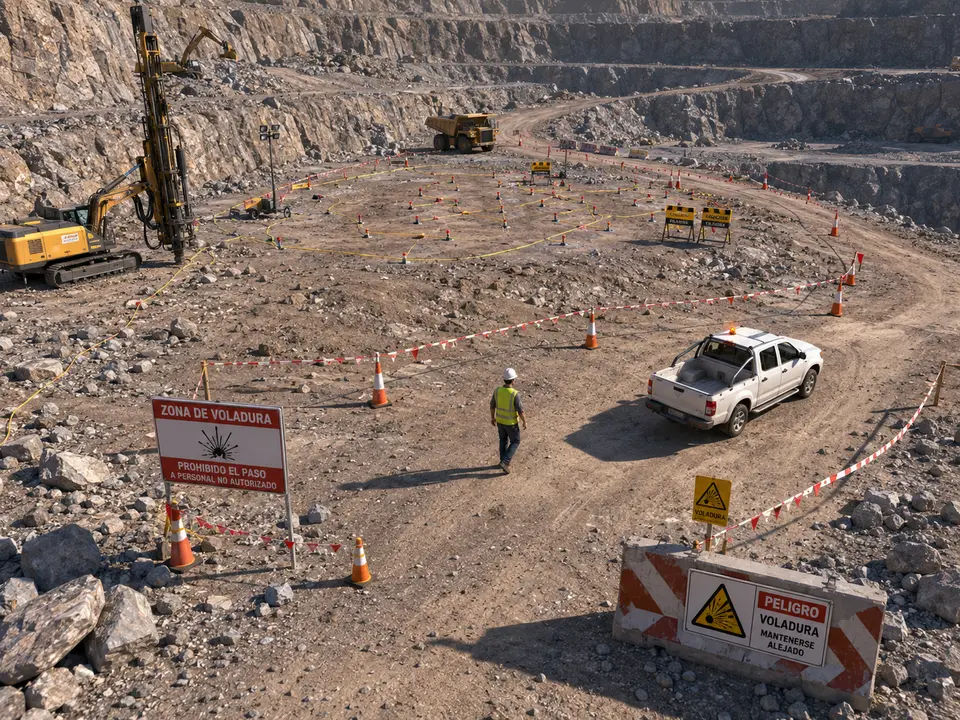
It’s 1:55 p.m. and there are five minutes to the blast. The siren has sounded, the shotfirer has driven the perimeter in the pickup and called the roll on the radio twice. Everyone answered. But behind the waste stockpile there is an angle you can’t see from the haul road, and this morning there was a broken-down truck there. Nobody remembers whether it was towed away.
1 cameras across 1 sectors
What IRIS is
IRIS watches the cameras for you.
IRIS Neural is an artificial intelligence that watches the cameras you already have and understands what happens in front of them. When something important happens —or something you told it you need to keep an eye on—, it alerts you; and whatever can be counted, it counts in numbers. All day long, without anyone having to watch a screen.
You tell it what you need to watch, and IRIS does it.
Works with the cameras you already have. Nothing to replace.
A person replies, not a form.
- Your footage never leaves your premises.
- It doesn't identify people.
- Certifications →
This is how you ask for it
«Before every blast, tell me how many people and how many vehicles are still inside the perimeter, and warn me if anyone else goes in.»
With that doubt in the air there are only two ways out, and both are bad. You stop the blast and start again: half an hour of idle machines, a charge left waiting and a firing window lost. Or you fire anyway, trusting the radio roll call was right. The first costs money and the second costs what can’t be paid. And the shotfirer, who signs for it, is left alone with his memory in the five minutes beforehand.
You decide once
What’s decided once here isn’t an alarm, it’s a moment. The blasting manager marks the perimeter on the images, says when the count is requested and who receives it. And the sentence reads: when the countdown starts, tell me how many people and how many vehicles you can see inside the perimeter, and if anyone else goes in, warn me.
A blast is the one thing in a mine that can’t be half stopped. Everything else allows a second chance; this doesn’t. And the procedure that protects it is a good one: siren, perimeter drive, radio roll call, signed sheet. The problem isn’t the procedure; it’s that the whole thing rests on somebody answering and somebody having looked behind the stockpile.
And there are places nobody looks. A blind angle behind a waste pile, a machine that broke down in the morning, a contractor’s vehicle that came in by another track. The radio roll call doesn’t see them, because it only counts the people carrying a radio and listening to it. In the five minutes before firing, all of that lives in one person’s head.
IRIS counts what can be seen inside the perimeter: how many people and how many vehicles, camera by camera, and it says so before firing. And if anyone else goes in after the count, it warns. It replaces neither the drive nor the roll call: it puts a number on an I think nobody’s left. Before firing, the shotfirer stops being alone with his memory.
What changes
Before, the five minutes ahead of a blast were a stack of assumptions: the siren, the drive around in the pickup, the radio roll call and the shotfirer’s memory. All of that is still there. What exists now, on top of it, is a number per camera right before firing and a warning if anyone goes in afterward. The check no longer lives in one head.
Where we have seen it
CAM-395Someone is still inside the blast zone
«Before every blast, tell me how many people and how many vehicles are left inside the bunting, and warn me if anyone else goes in.»

What it doesn’t do
IRIS only sees what falls inside its cameras’ field of view. Behind a stockpile, a large machine or a fold in the ground there may be uncovered space, and that has to be known when the cameras are sited.
That is why the count is an aid to the perimeter drive and never a replacement for it. The order to fire is still given by a person, and no system takes on that responsibility.
Questions
- Does it replace the shotfirer’s perimeter check?
- No, under no circumstances. The perimeter drive, the siren and the radio roll call remain the procedure, and IRIS touches none of it. What it adds is a number: how many people and how many vehicles can be seen inside the perimeter in the minute before firing, camera by camera. It’s one more check, made from somewhere else and with different eyes, so the decision doesn’t rest on one person’s memory alone.
- Does it count vehicles as well?
- Yes, and in a mine it is usually the more useful of the two counts. People carry radios and answer; a broken-down machine or a contractor’s vehicle that came in by another track doesn’t. That’s exactly the gap the radio roll call leaves, and it’s the gap a count made by looking fills. IRIS says how many people and how many vehicles are inside, separately, and which camera each is on.
- Does it warn if somebody goes in after the count?
- Yes, and it’s half the value of this scene. The count says how the perimeter looks at one instant; the follow-up warning covers the minutes between that instant and the blast, which is exactly when somebody might go back for a tool or walk in without having heard the siren. Without that second part, the count would be a photograph and not a watch, and a four-minute-old photograph authorizes nothing.
- Can IRIS see behind a stockpile or a machine?
- No, and this is the most important limit on this page. IRIS only sees what falls inside the frame: behind a waste pile, a parked haul truck or a fold in the ground there can be uncovered space. That’s known when the cameras are sited and it must be written down, because a count presented as complete when it isn’t would be worse than no count at all. That’s why the count accompanies the perimeter drive; it doesn’t replace it.
Demo · IRIS at work
We won’t just tell you. We’ll show you.
It’s a summary of the real screen: it plays by itself, step by step, and shows only the path of one case. The actual tool has far more than fits in here.
- The alert fires
- It lands in the tray
- You open it
- You confirm or dismiss
Not seeing yours here?
These words are the ones we have built, not the ones IRIS understands. The list falls short on purpose: you ask for it in a sentence, and sentences don’t run out. Tell us what is in front of your cameras and we’ll tell you whether it understands it, or not yet.
And the best part
Nobody covers the night shift:the camera that is already on covers it.
It doesn’t tire, it doesn’t blink and it doesn’t go for coffee. What happens at night is understood just as it would be at midday, and whoever is on duty hears about it while it’s happening.
Tell us your problem and we’ll say whether IRIS understands it, or not yet.
A person answers, the same working day.