Solutions by typeEnvironment and cleanliness
How long does it take to spot a fire that starts inside the pile?
The fire starts inside and shows late
It’s 5:00 a.m. in the tipping bunker. The pile reaches halfway up the wall and a column of white smoke is rising along one flank, with a small flame at its base. Two people are on site: one is at the truck scale, the other has stepped out into the yard. The grab carries on with its cycle. The smoke has been rising for twenty minutes and this is still a fire an extinguisher could handle.
2 cameras across 2 sectors
What IRIS is
IRIS watches the cameras for you.
IRIS Neural is an artificial intelligence that watches the cameras you already have and understands what happens in front of them. When something important happens —or something you told it you need to keep an eye on—, it alerts you; and whatever can be counted, it counts in numbers. All day long, without anyone having to watch a screen.
You tell it what you need to watch, and IRIS does it.
Works with the cameras you already have. Nothing to replace.
A person replies, not a form.
- Your footage never leaves your premises.
- It doesn't identify people.
- Certifications →
This is how you ask for it
«Alert me the moment there is smoke or flame in the pile, day or night, even with nobody on site.»
Half an hour later it no longer does. A bunker fire isn’t put out with a hose: it’s put out by emptying the bunker with the crane while it burns, with firefighters inside the hall and the plant stopped. A day of stoppage means trucks diverted to another plant and waste piling up on the street. Then comes the rest: the insurance report, the city visit and photos of the black smoke circling the town.
You decide once
The plant decides once which zones carry the risk — the bunker, the bulky waste yard, the rejects, the battery bay — and who gets called at each hour of the day. IRIS applies that rule 365 days a year, Sunday night included, which is exactly when the hall is empty and the smoke has the whole night ahead of it. The alert arrives with the camera open, so whoever receives it can look before sending anyone.
Anyone running a waste plant knows fire isn’t a remote possibility: it’s a question of when. Everything comes in with the load, and among that everything come batteries that break under the grab. The pile heats up inside for hours, and its first announcement to the world is a column of white smoke on one flank of the heap.
That’s exactly what the camera sees. The smoke doesn’t have to fill the hall to reach a detector forty feet up, nor climb high enough for someone in the yard to notice. IRIS watches the surface of the pile and raises an alert when smoke appears where there was none, with the camera open and the minute it started. And it does the same at five on a Sunday morning, which is the worst possible time.
What changes then isn’t the technology, it’s the size of the problem. A twenty-minute fire is dealt with by pulling the hot spot aside with the grab and one extinguisher. A two-hour fire is dealt with by firefighters inside the hall, the plant stopped and a call to the city. Same camera, same heap, same waste: the only difference is when somebody found out.
What changes
Fire used to be spotted by whoever walked past, and at night nobody walks past. The detector in the hall is designed for a fully developed fire, not for a thirty-inch flame in a corner of the bunker.
Now that first smoke has a time, a camera and a video, and the shift gets it on the phone. What gets decided then is whether it needs an extinguisher or a call. Both decisions are far cheaper at five than at seven.
Where we have seen it
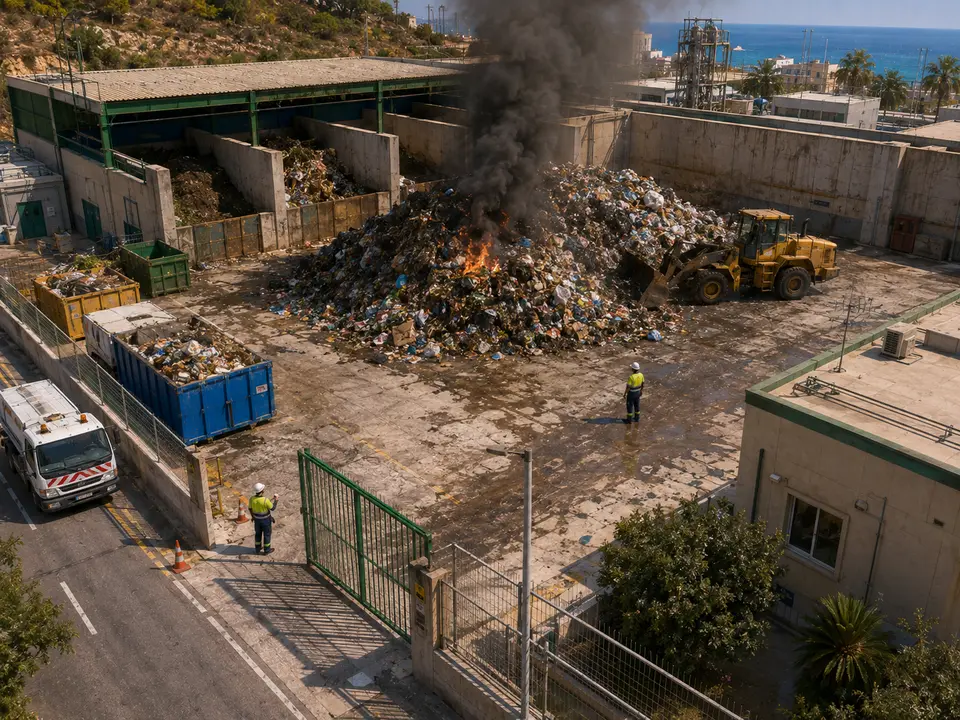
CAM-179Fire in the waste pile
«Tell me the moment smoke or flame comes off the pile, day or night, even when there is nobody on site.»
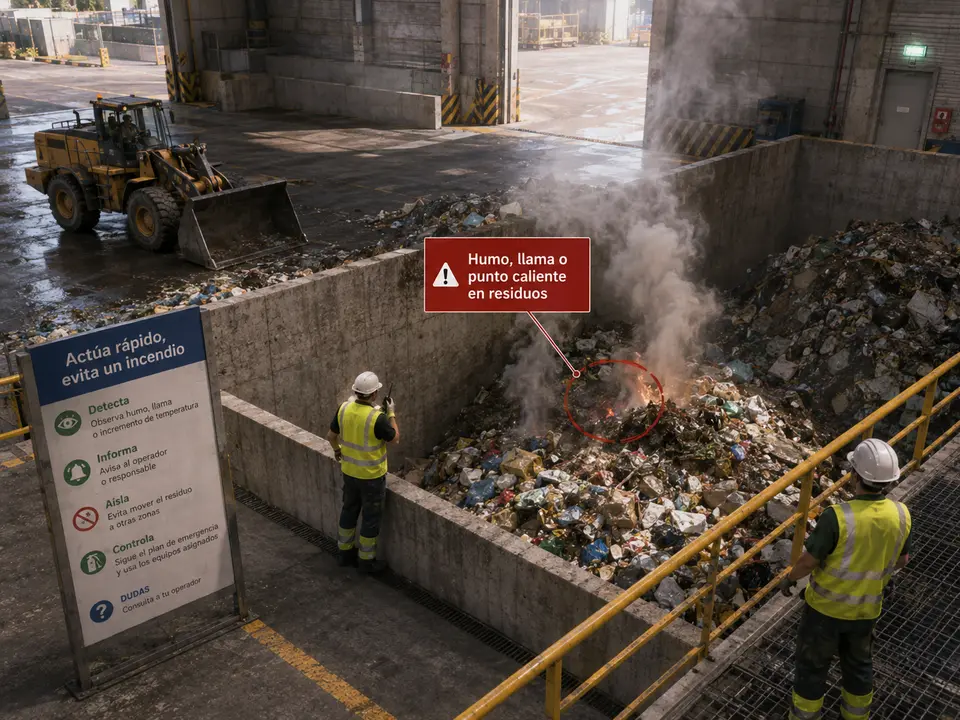
CAM-422A hot spot is already smoking in the waste bunker
«Tell me as soon as there is a hot spot, smoke or flame in the bunker, even if there is no visible fire yet.»


What it doesn’t do
IRIS does not put anything out and does not replace the fire system or the detectors. It is one more pair of eyes, not a sprinkler.
And it has a clear limit: it watches the surface. An ember buried under six feet of waste is invisible to anyone until it breaks out, unless the camera is thermal. What it does do is never get tired of watching the heap, including at five on a Sunday morning.
Questions
- Do we need a thermal camera?
- Not for smoke or flame: the camera already installed sees that, because smoke changes the image very obviously. Yes for a hot spot that isn’t smoking yet, because a normal camera doesn’t measure temperature and can’t invent it. Many plants end up with both: the existing camera for smoke, and a thermal one over the bunker and the rejects yard, which is where fire starts from the inside.
- Does it replace the fire detectors?
- No, and nobody should sell it that way. The fire system is designed, certified and maintained, and a camera doesn’t change that. What IRIS adds is time up front: a ceiling detector needs the smoke to climb forty feet and fill the volume; the camera sees the column while it’s still hugging the pile. They work together, and the order matters: the camera warns first, the system trips second.
- What about at night, with the hall dark?
- Yes, and at night is when it shows most. A flame is light: against a dark background it stands out even better than at midday. Smoke is the opposite and needs some illumination to separate from the background, so a dark bunker is best served by light in the area or a camera built for low light. Most plants already light the tipping area, because the grab works at night.
- Do steam and dust confuse it?
- Sometimes yes, and that’s worth saying up front. A cloud of dust when the grab drops, or the mist from a hosing down, looks like a smoke column for a few seconds. The rule is tuned on site: how long it has to last, which part of the bunker counts, and whether a light source underneath is also required. Even so, the principle is clear: on a waste pile we’d rather it warned too often than too rarely.
See it for yourself
This isn’t a video. It’s a slice of the real screen.
A summary of the real interface, played hands-free. You see one case from start to finish; what you don’t see are the other screens, and there are many.
- Four cameras at once
- Each understands its own view
- The numbers climb by themselves
Not seeing yours here?
These words are the ones we have built, not the ones IRIS understands. The list falls short on purpose: you ask for it in a sentence, and sentences don’t run out. Tell us what is in front of your cameras and we’ll tell you whether it understands it, or not yet.
And the best part
Recording is memory.Understanding is attention, and that’s the part you had never bought.
The recording is still kept in case you need it. What’s added is that those same images are understood as they arrive, not months later and not by hand.
Tell us your problem and we’ll say whether IRIS understands it, or not yet.
A person answers, the same working day.